AI agents for HR and internal operations get pitched as one thing: a chatbot that answers policy questions. That’s the least useful part of the story.
Our breakdown of AI agent vs. chatbot vs. virtual assistant explains why that mix-up caps what most HR teams ever build. The real gains sit in offboarding, scheduled reporting, and payroll explanations, work nobody demos because it isn’t flashy.
This guide ranks the use cases that actually move ticket volume and headcount conversations, backed by named, verified deployments.
Quick answer: AI agents pay off fastest in HR and internal ops on bounded, repeatable, low-judgment work: tier-1 query deflection, offboarding, scheduled reporting, and payroll explanations. The underrated wins are offboarding automation, archive digitization, and exit-interview summarization, not another policy bot. Terminations, compensation, and PIP decisions stay with a human.
Key Takeaways
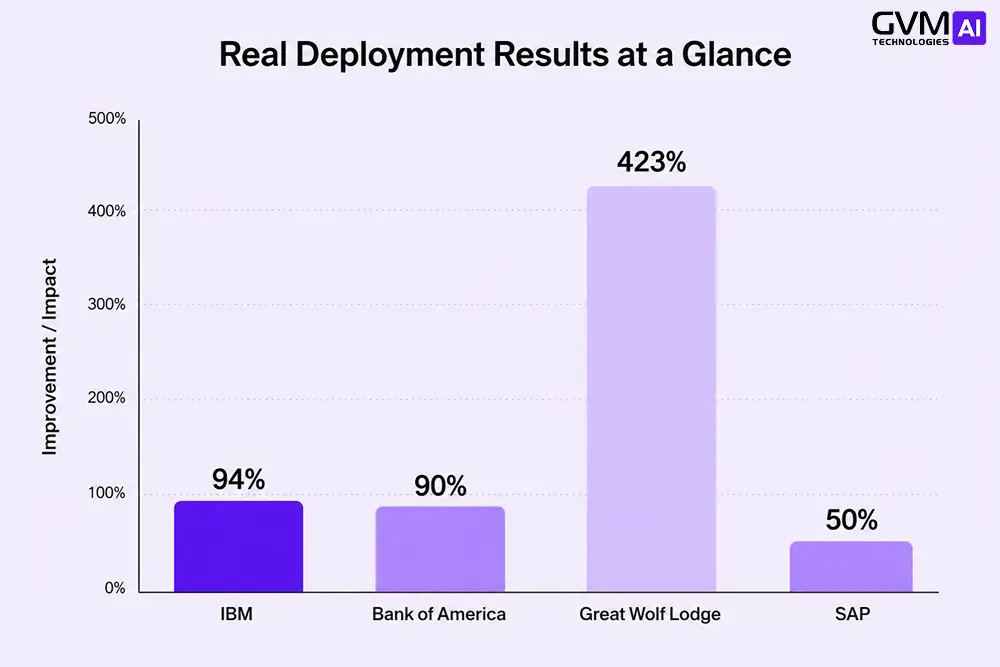
- IBM’s AskHR agent resolves 94% of common employee questions instantly, contributing to a 75% drop in HR support tickets since 2016.
- Bank of America’s Erica for Employees is used by 90%+ of 213,000 staff, cutting IT service calls by more than 50%.
- Great Wolf Lodge’s recruiting agent lifted scheduled interviews 423% and saved $700,000 in job-ad spend in a single year.
- SAP’s own preview data shows a 40-60% cut in tier-1 HR ticket volume once its HR Service Agent is fully deployed.
- Offboarding, scheduled reporting, and payroll-explanation agents are the most underrated wins: high frequency, low judgment, and rarely built first.
- 40%+ of organizations are projected to face a shadow AI incident by 2030, and HR holds some of the most sensitive data in the company.
What AI Agents for HR and Internal Operations Actually Mean
An AI agent reads a request, decides what it means, and finishes the action itself: pulling a leave balance, routing IT provisioning, or drafting a report, without a human scripting every branch first.
That’s different from a scripted chatbot that only answers when phrasing matches a tree, and different again from a workflow tool that runs the same fixed sequence regardless of input.
AI Agent vs. HR Chatbot vs. RPA Workflow
- Scripted chatbot: matches phrases to a decision tree. Off-script input stalls it.
- RPA or workflow tool: runs a fixed sequence a human designed. Reliable, but blind to anything outside that sequence.
- Reasoning agent: reads the actual request, decides the right action, and adapts when the input breaks the happy path.
A team that builds a rules engine and calls it an “AI agent” gets rules-engine results. Our AI agent vs. no-code automation guide covers this exact confusion.
Why HR Beats Sales and Support as a First Deployment
HR operations has better starting conditions than most teams assume. The questions repeat constantly, the source documents already exist, and a wrong answer usually gets corrected, not escalated into a crisis.
The catch: most “HR AI” already in production is closer to plumbing than intelligence. Automating a confirmation email with an agent runs slower and costs more than a plain workflow doing the same job. Save the agent budget for the parts that need judgment.
The Underrated Use Case Gap
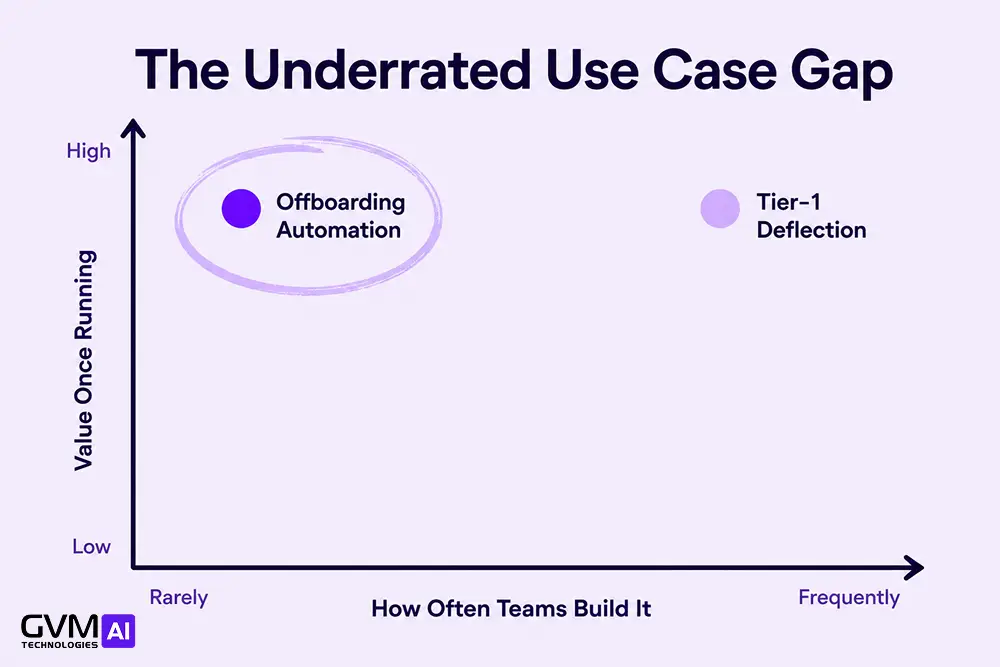
Ticket deflection gets all the attention because it’s the easiest thing to demo. The table below ranks use cases by how often teams actually build them against how much time they save once running.
| Use Case | How Often Teams Build It | Value Once Running | Verdict |
|---|---|---|---|
| Tier-1 query deflection | Very common | High | Obvious, still build it first |
| Onboarding orchestration | Common | High | Obvious |
| Recruiting scheduling agent | Common | High | Obvious |
| Offboarding automation | Rare | High | Underrated |
| Scheduled reporting | Rare | Medium-high | Underrated |
| Payroll explanation agent | Very rare | High | Underrated |
| Exit-interview summarization | Very rare | Medium-high | Underrated |
| Archive digitization | Very rare | Medium | Underrated |
The pattern holds across nearly every HR ops team we’ve seen: individual-assist tools (Copilot, ChatGPT drafting) get adopted first, workflow orchestration gets built last. That’s exactly why offboarding and reporting agents stay rare long after tier-1 deflection ships.
Our guide to measuring AI agent productivity gains covers how to prove that “value once running” column with real numbers instead of a guess.
8 AI Agent Use Cases for HR and Internal Operations
1. Tier-1 HR Query Deflection
A policy Q&A agent connected to the HRIS and knowledge base fields questions on leave balance, benefits, and payslip access. IBM’s AskHR resolves 94% of these instantly and helped cut support tickets 75% since 2016.
2. Offboarding and Exit Automation
Onboarding gets built first because it’s visible. Offboarding gets skipped, until access revocation, equipment return, and final pay all slip through the cracks at once. An agent triggered by a termination date can chain all three automatically.
3. Scheduled and On-Demand Reporting
Pulling the same headcount or attrition report every month is exactly what an agent should own end to end. Set it to run on a schedule or answer through Slack, and “which team has the highest overtime this quarter” gets a real answer instead of a spreadsheet wait.
4. Proactive Manager Nudges
An agent that watches for overdue reviews or incomplete training and nudges the manager, without a human triggering it, removes a chase HR repeats every cycle. Small per nudge, real across a few hundred managers a quarter.
5. Payroll and Benefits Explanation Agents
A pay-discrepancy question generates a disproportionate share of HR ticket volume. SAP’s Explain Pay agent answers these directly from the payroll calculation, cutting resolution time by up to 50% per SAP’s own release data.
6. Document and Archive Digitization
Offer letters, contracts, and scanned onboarding paperwork sitting in old archives are a real agent target. An agent that reads PDFs and files them against the right employee profile turns a manual archive project into a background job.
7. Exit Interview and Sentiment Summarization
AI condenses a large batch of unstructured text into themes fast. An agent that summarizes dozens of exit interviews surfaces retention signal a single reviewer misses simply from volume.
8. Internal Knowledge Search
An agent that answers “where’s the parental leave policy” or “what’s our expense limit” from indexed internal documents removes the search step entirely, the same category Wells Fargo is scaling across its banker workforce. Our guide to AI agent memory and context covers how that retrieval actually works.
Real AI Agent Deployments in HR and Internal Ops
| Deployment | What It Does | Verified Result |
|---|---|---|
| IBM AskHR | Employee query agent on watsonx Orchestrate | 94% instant resolution, 75% fewer tickets since 2016 |
| Bank of America, Erica for Employees | Internal assistant for HR, IT, and benefits | 90%+ of 213,000 staff use it; 50%+ fewer IT calls |
| Great Wolf Lodge, “Emma” | Conversational recruiting and scheduling agent | 423% more scheduled interviews; $700,000 saved in one year |
| SAP HR Service Agent (preview data) | Tier-1 policy and benefits deflection | 40-60% cut in tier-1 HR ticket volume |
| Copilot Studio + Power Automate (self-built) | Policy Q&A agent plus deterministic flows | 25-40% tier-1 deflection within 90 days |
Our AI agents in customer support breakdown found the same gap in a different department: vendor deflection numbers rarely survive an independent audit.
Reality check: vendor deflection numbers and independently measured ones rarely match. Ask whether “deflected” means a question answered correctly, or a conversation a human simply never touched. Those aren’t the same metric.
Judgment, Workflow, and Human Sign-Off
The mistake that turns a promising HR pilot into a mess is the same one covered in our guide to AI agents for sales and lead qualification: one system deciding and writing to the system of record, with no separation between the two.
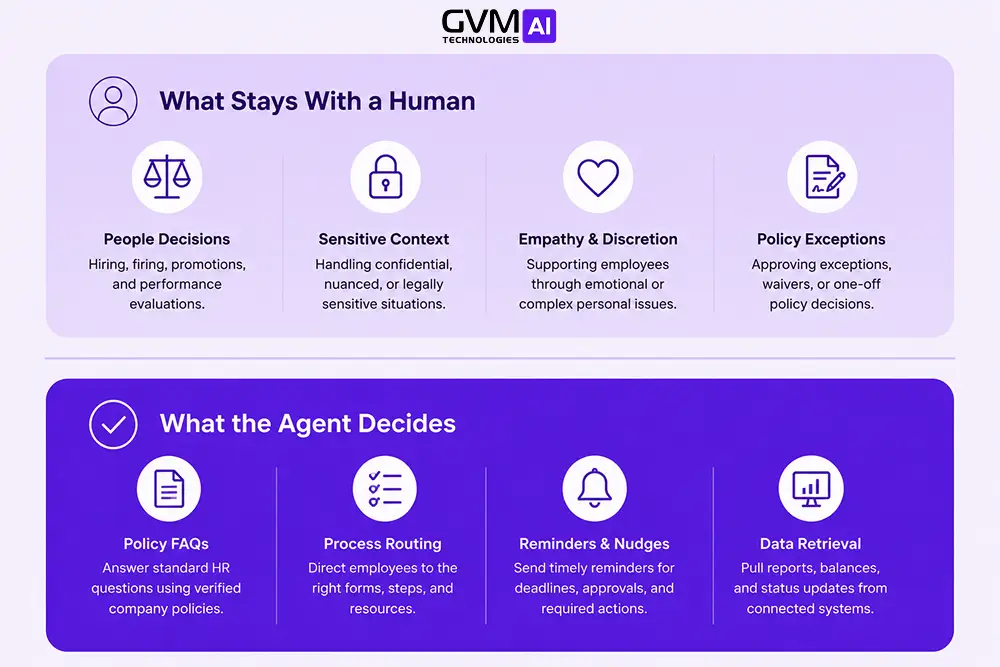
What the Agent Should Decide
Policy answers, report generation, document extraction, and feedback summarization. This is where the agent earns its keep, and where a mistake is cheap to fix.
What Must Stay With a Human
Terminations, compensation decisions, and performance improvement plans carry legal exposure. An agent can prep the file. It should never make the call.
Teams that let one system both decide and write to the HRIS are the ones who find a hallucinated field silently corrupted a record.
The Governance Problem Nobody Budgets For
Employee PII and the Shadow AI Risk
Employee data deserves the same scrutiny as customer financial data. Our guide to shadow AI in the workplace covers the broader risk: 40%+ of organizations are projected to face a shadow AI incident by 2030.
Standing Access and Approval Gates
The bigger exposure isn’t a chat window. It’s an agent wired into the HRIS with permissions nobody has reviewed since setup. Define exactly which fields it can read and write, and who approved that scope, before go-live.
Our AI agent readiness checklist scores this exact gap before you spend on a deployment.
Common Mistakes That Stall an HR AI Pilot
- Automating the boring parts. A confirmation email doesn’t need an agent. It needs a workflow.
- Skipping documentation before automating. An undocumented process just gets guessed at.
- Feeding the agent a stale handbook. Old policy documents produce confident wrong answers.
- No named owner once it’s live. Output quality drifts quietly without someone checking it.
Our phased AI rollout framework covers starting narrow on purpose, and our AI change management checklist covers naming that owner before day one.
Build, Buy, or Blend for HR Ops
A platform like SAP or ServiceNow gets a working agent live fastest, at vendor pricing. A self-built stack (an LLM API plus n8n or Power Automate) costs less but needs someone to own the data plumbing.
Our comparison of an AI agency vs. an in-house AI team covers that trade-off, and training your team to work alongside an AI agent covers what HR staff need to learn once one is live.
FAQs About AI Agents for HR & Internal Operations
1. What’s the easiest AI agent use case to start with in HR?
Tier-1 policy and benefits deflection. The questions repeat constantly, and a wrong answer just gets corrected.
2. What’s the most underrated AI agent use case in HR?
Offboarding automation. It gets skipped because nobody budgets time for departing employees, yet the security exposure is real.
3. Can a small HR team build this without buying a platform?
Yes, for a narrow use case. An LLM API plus a curated policy set and a workflow tool gets a ticket-deflection agent live without enterprise pricing.
4. Is it safe to feed employee data into an AI agent?
Only after security and legal settle the data-boundary question in advance. Employee PII needs the same scrutiny as financial data, not less.
5. How much can AI agents reduce HR ticket volume?
Teams automating a specific workflow end to end report 40-75% reductions for that workflow, based on verified deployments like IBM’s AskHR and SAP’s HR Service Agent.
6. Should HR agents handle terminations or compensation decisions?
No. Those stay with a human. An agent can prep the file and flag missing documentation, but the decision carries legal exposure.
The Bottom Line
AI agents for HR and internal operations deliver real time savings, but the wins that move the needle sit past the obvious chatbot: offboarding, scheduled reporting, and payroll explanations.
- Start with tier-1 deflection because it’s provable, not because it’s the biggest win
- Build offboarding and reporting next; they’re underrated because almost nobody gets there
- Keep terminations, compensation, and PIP decisions with a human, permanently
- Settle the data-boundary question with security and legal before any record touches an agent
Ready to Find Your Highest-ROI Internal Ops Workflow?
Most HR teams start with a chatbot because it’s the easiest thing to demo, then wonder why it didn’t move a real number. The workflow worth automating first is usually the one nobody’s watching closely enough to notice it’s broken.
GVM Technologies AI maps your actual HR and ops workflows, the data behind them, and the governance gaps, before recommending what to automate first. See the same discipline applied to a live deployment in our AI agent case study.
Talk to our team about which internal workflow is actually worth automating first, before you buy against a vendor’s demo number.