
This AI agent readiness checklist scores your business against seven factors before you spend money on an AI agent: data quality, process documentation, named ownership, system access, error reversibility, review capacity, and task fit. Most failed rollouts don’t fail because the model was weak. One of these seven was ignored.
Quick answer: Readiness isn’t about budget or a modern tech stack. It’s whether your data has one trustworthy source, your process is written down with exceptions, one named person owns the outcome, your systems can be reached, a mistake is cheap to undo, and someone has real time to review output.
Key Takeaways
- Readiness is per-workflow, not company-wide. A team can be ready for lead intake and unready for refunds at the same time.
- Most public checklists are built for enterprise CTOs. Small businesses need a leaner version.
- The biggest gap between a “ready-looking” workflow and a truly ready one: nobody was assigned to keep watching after launch.
- Review quality drops over time. Careful checking in week one often becomes rubber-stamping by week six.
- A cheap-to-undo mistake and an irreversible one are different risk categories. Scoring them the same leads to bad decisions.
What “AI Agent Ready” Actually Means
An AI agent decides its own steps toward a goal, calls tools or APIs to act, and adjusts based on results, all without a human scripting every step first. Readiness isn’t about company size or budget, and it isn’t tied to which core AI solutions for business you’ve already adopted.
Working through an AI agent readiness checklist properly means testing one specific workflow against seven checkpoints, not your whole company at once.
The one-line test: If a stranger could read your process notes and correctly handle 90% of real cases, that workflow is close to ready. If you’d need to shadow someone for three weeks first, it isn’t.
Score high for invoice matching and low for refunds, and both can be true in the same company on the same day.
Why AI Agent Deployments Actually Fail
Gartner predicts over 40% of agentic AI projects will be canceled by the end of 2027, not from weak models but skipped groundwork. RAND found that technology performance was rarely why AI projects actually died.
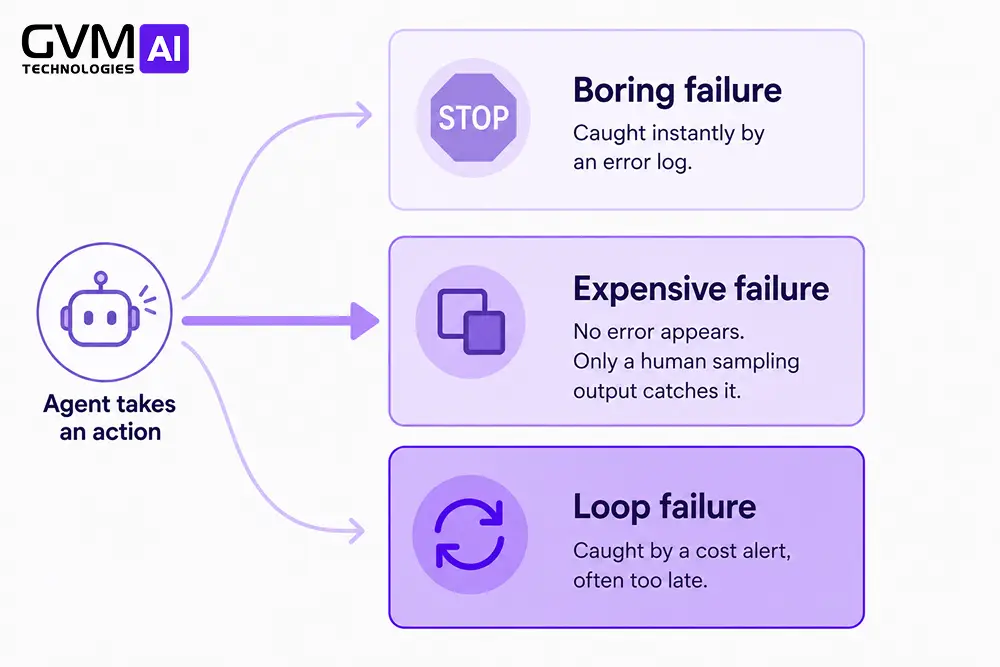
Not every AI mistake carries equal risk:
| Failure class | What it looks like | Who catches it |
|---|---|---|
| Boring | Bad input, error thrown, stops | An error log, instantly |
| Expensive | Agent acts confidently on wrong data, no error appears | Only a human sampling output |
| Loop | Agent retries the same broken step endlessly | A cost alert, often too late |
A duplicate customer record confuses a human for a second. An agent given the same three records treats them as three customers and updates the wrong one, with no error thrown. One documented case: a looping agent burned roughly $180 in API costs in under an hour before a cost alert caught it.
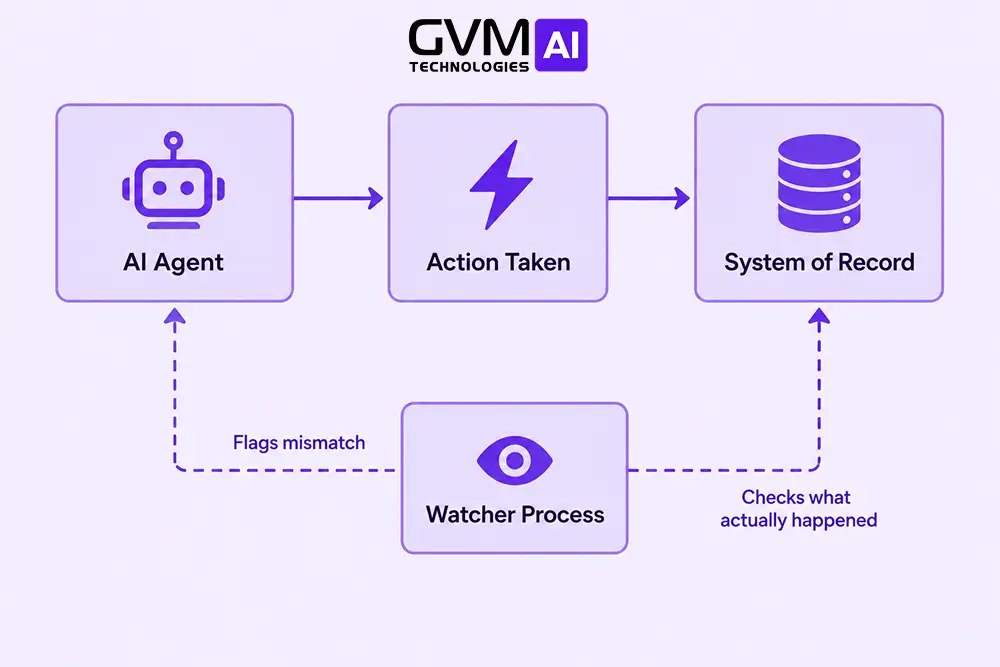
Production teams add a watcher process: a second, simple check confirming the agent’s actions actually landed (ticket closed, lead routed, record updated). A “completed” log only proves the agent believes it finished.
This also catches state sync failures, where the agent acted on data that was correct when read, then changed seconds later by someone else. See AI-driven data analytics for decision-making if reporting lag is already a pain point.
The 7-Point AI Agent Readiness Checklist
Run this AI agent readiness checklist once per workflow, not once per company. Score 0 to 2 on each factor below. Fourteen points total.
| # | Factor | 0 (Not ready) | 1 (Partial) | 2 (Ready) |
|---|---|---|---|---|
| 1 | Task Fit | Rare, or already under 20 min/week | Recurring, unclear volume | High-volume, clearly worth it |
| 2 | Data Quality | 3+ systems, no source of truth | One system, some stale fields | One clean, current source of truth |
| 3 | Process Docs | Lives in one person’s head | SOP exists, skips exceptions | A stranger could follow it |
| 4 | Named Ownership | “IT,” “ops,” and “whoever asked” all differ | Owner exists, doesn’t check output | One person reviews on a schedule |
| 5 | System Access | No API, manual login only | API exists, undocumented | Stable, documented API |
| 6 | Reversibility | Sends money or deletes with no review | Needs manual cleanup, contained | Caught before reaching a customer |
| 7 | Review Capacity | Nobody has time to check output | Occasional spot-checks | Dedicated recurring review time |
Task fit comes first because a task that already takes twenty minutes a week rarely justifies the build. Review capacity is the factor most checklists skip, and it matters most: teams that check every action carefully in week one often rubber-stamp by week six, even when nothing about the agent changed.
Self-Reported vs. Actual Readiness
| Businesses assume “ready” means | What actually predicts it |
|---|---|
| We bought an AI platform | A documented, repeatable process |
| The team is excited | Someone specific reviews output |
| Data is “in the cloud” | One deduplicated source of truth |
| We have budget | The mistake is cheap to undo |
| Leadership approved it | Systems have a usable API |
| A case study impressed us | Tested against 20+ real examples |
| Everyone says they’re ready | The current process is painful enough to fix |
Self-reported confidence is unreliable. Teams scoring highest on surveys aren’t always the teams that actually change how they work; pain in the current process predicts adoption better than stated enthusiasm.
What Your Score Means
Your total maps to one of three next moves, not a pass-or-fail verdict:
- 0 to 5, not ready. Spend the next few weeks on data cleanup, writing down the real process with its exceptions, and naming one accountable owner. Don’t evaluate vendors yet.
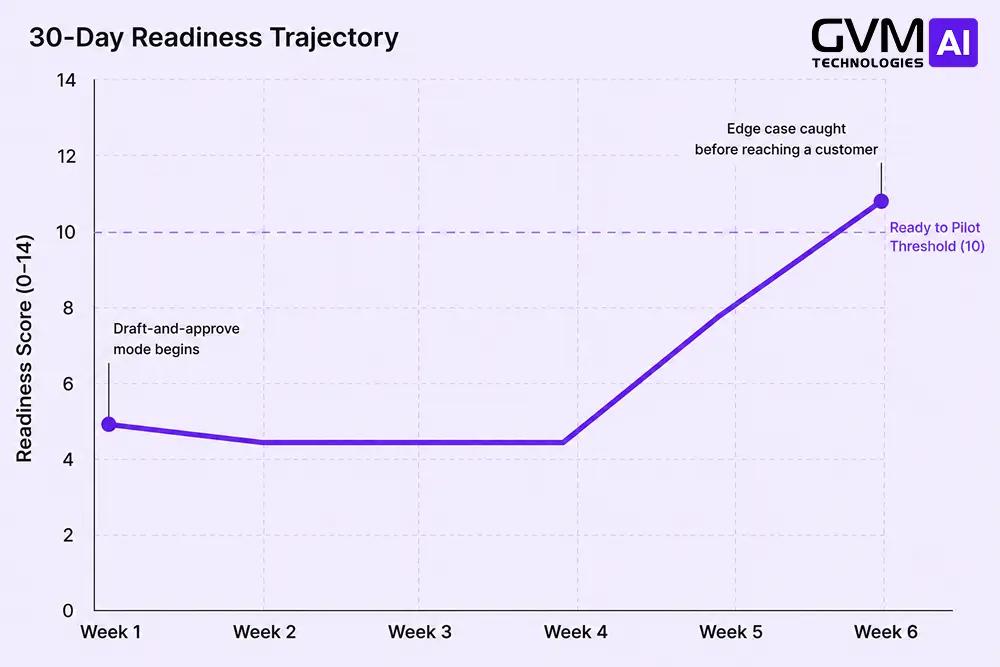
- 6 to 10, partially ready. Fix your lowest-scoring factor first, usually process documentation or named ownership. Run the agent in draft-and-approve mode for two to four weeks before removing human review.
- 11 to 14, ready to pilot. Hand over a narrow, well-scoped task with defined tool access, but still launch with a spending cap, a named owner, and a kill switch before scaling volume.
Scores are per-workflow, not per-company. A 25-person business can score 12 on lead-intake and 4 on refunds at the same time, and treating readiness as one company-wide number is the most common mistake teams make here.
What Your Agent Should Never Do
A high score doesn’t mean unlimited authority. Agree on this list before launch, per OWASP’s LLM risk guidance:
- Never send money or refunds without human approval.
- Never permanently delete records. Archive or flag instead.
- Never respond outside its defined scope.
- Never change its own permissions or instructions.
Five Misconceptions That Get Businesses in Trouble
Most of these show up after launch, once the excitement of the kickoff has worn off:
- “A bigger budget makes us more ready.” A documented $5,000 workflow with a named owner beats an undocumented $50,000 one almost every time.
- “Team enthusiasm means we’re ready.” Enthusiasm is a launch-day asset and a month-three liability unless it’s backed by a review habit that outlasts the kickoff meeting.
- “If it makes a mistake, we’ll catch it fast.” Only if someone is actually watching on a schedule; without named ownership, a small mistake can repeat for weeks unnoticed.
- “More autonomy is always the goal.” Full autonomy is earned after a workflow proves itself under human review, not a starting point most agents should skip to.
- “Readiness is one number for the whole company.” It’s per-workflow, and treating it as a single company-wide score is the fastest way to misjudge a rollout.
Red Flags: Pause Even With a Good Score
A few situations override an otherwise decent score. Fix these first, then return to the checklist.
- Someone is already using consumer AI tools on company data without approval.
- The manual task already takes under 20 minutes a week.
- Nobody has agreed who maintains the agent long-term.
- The intended reviewer is already at full capacity elsewhere.
- Nobody can state success in one sentence.
Real Scenario: Paper Score vs. Real Score
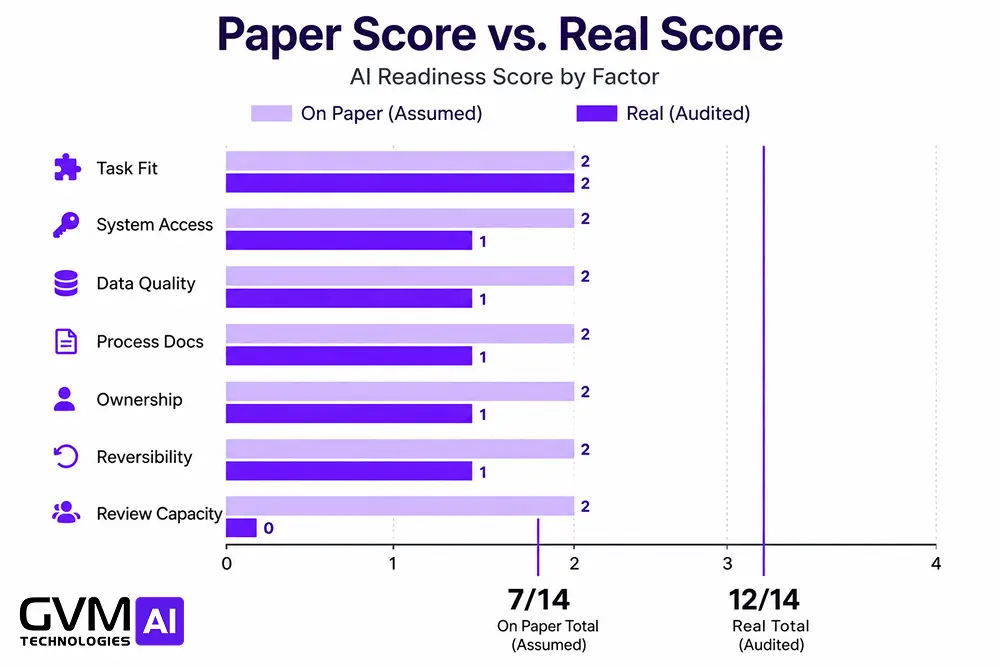
A 40-person e-commerce team wants an agent to triage 300 support tickets a week. On paper, the workflow scores 12 out of 14: modern helpdesk, documented team, approved budget.
An honest check drops it to 7:
- System access, 2/2: solid API.
- Task fit, 2/2: volume justifies it.
- Data quality, 1/2: three systems, occasional mismatches.
- Process docs, 1/2: misses 15% of ambiguous tickets.
- Ownership, 1/2: “the support team” meant no one specifically.
- Reversibility, 1/2: wrong replies are recoverable.
- Review capacity, 0/2: no daily review plan.
One team lead took ownership for 20 minutes a day, exceptions got documented, and the agent ran in draft-and-approve mode for three weeks. Six weeks in, the score reached 11, and the draft phase caught an edge case before it ever reached a customer.
30-Day Fix-It Plan
- Pick one workflow. Don’t fix data company-wide.
- Write down every exception. This becomes the agent’s instructions later.
- Name one owner today. Not a team. One person.
- Check real system access. All manual clicking is a systems problem first. See AI in IT infrastructure management.
- Re-score in 30 days. Most businesses move from a 5 to a 10 through organizational work, not engineering.
Build, Buy, or Wait?
| Situation | Move | Why |
|---|---|---|
| Data and process solid, task is complex | Custom AI agent | Needs purpose-built flexibility |
| Simple task, tooling exists | No-code automation | Most of the value, less cost |
| Needs multiple coordinating agents | Review single vs. multi-agent systems first | Wrong split adds coordination risk |
| No one in-house can build it | Outside help | The gap won’t close on its own |
| Skills exist, bandwidth doesn’t | Reassign ownership first | Hiring won’t fix a low score alone |
Compare an AI automation agency against building in-house, or browse GVM’s business automation solutions. A good task-fit score doesn’t automatically make customer-data access safe; that’s a separate check.
Ready to Score Your Actual Workflow?
Running this AI agent readiness checklist yourself gets you most of the way there. The hard part is spotting the gap you’re too close to see.
GVM Technologies AI runs this exact assessment before recommending anything, including telling you to wait. See our approach, or talk to our team about where your workflow actually stands. No pitch, just an honest read on your numbers.
FAQs
1. How long does it take to become AI agent ready?
Usually 30 to 60 days per workflow, since it’s mostly documentation and ownership work rather than engineering.
2. Do I need a dedicated data team to pass this checklist?
No. One trustworthy source of truth for that workflow’s data, kept accurate by one person, is enough for most small businesses.
3. How is an AI agent readiness checklist different from a general AI readiness checklist?
General checklists cover company-wide governance and infrastructure; an AI agent readiness checklist asks whether one specific task is safe to hand real decision-making authority to.
4. Can a small business realistically use AI agents?
Often more easily than large ones, since a five-person team usually has clearer ownership than a 500-person company with three departments pointing at each other.
5. What happens if a business deploys an agent before it’s ready?
Usually a quiet, compounding error rather than a dramatic failure, one that erodes trust until someone finally audits the output and finds the pattern.
6. Should a business start with a chatbot instead of a full agent?
Yes, if the process is simple with few real exceptions. See AI agents vs. chatbots vs. virtual assistants for how to tell which one a task needs.
7. Is customer data access automatically safe once a workflow scores well?
No, that’s a separate check; see Is It Safe to Give an AI Agent Access to Your Customer Data? before granting it.
8. Should a business hire an agency or build in-house?
Depends on whether the gap is technical or organizational, and a low readiness score won’t be fixed by hiring either one until the groundwork is done.
9. What is a kill switch, and do small businesses need one?
A fast, pre-agreed way to pause an agent immediately with no code changes, paired with a spending cap and one named person authorized to use it.
10. Is agent drift the same thing as a bug?
No. A bug is a fixable, reproducible error, while drift is slow, quiet quality decline caught only by sampling real output on a schedule.
11. Can insurance cover mistakes made by an AI agent?
Coverage varies by insurer and by what the agent was authorized to do, so treat it as a backstop, not a substitute for ownership and review.
The Bottom Line
An AI agent readiness checklist only works when it produces a per-workflow score, not a company-wide badge earned once. It comes from clean data, a documented process, one named owner, reachable systems, cheap-to-undo mistakes, and someone actually watching after launch.
Score low, and the fix is weeks of process work, not more budget. Score high, and it’s time to pilot narrow, with a human reviewing early output before autonomy expands.