
An AI change management checklist for leadership covers the work that has to happen before a single workflow gets automated: sponsorship, governance, and a named metric. It sits above our AI agent readiness checklist, which scores whether one workflow is ready to pilot.
Skip this layer, and the workflow inherits a governance gap it cannot fix alone.
More than 80% of AI projects fail to deliver business value, roughly twice the failure rate of ordinary IT projects, per RAND Corporation research.
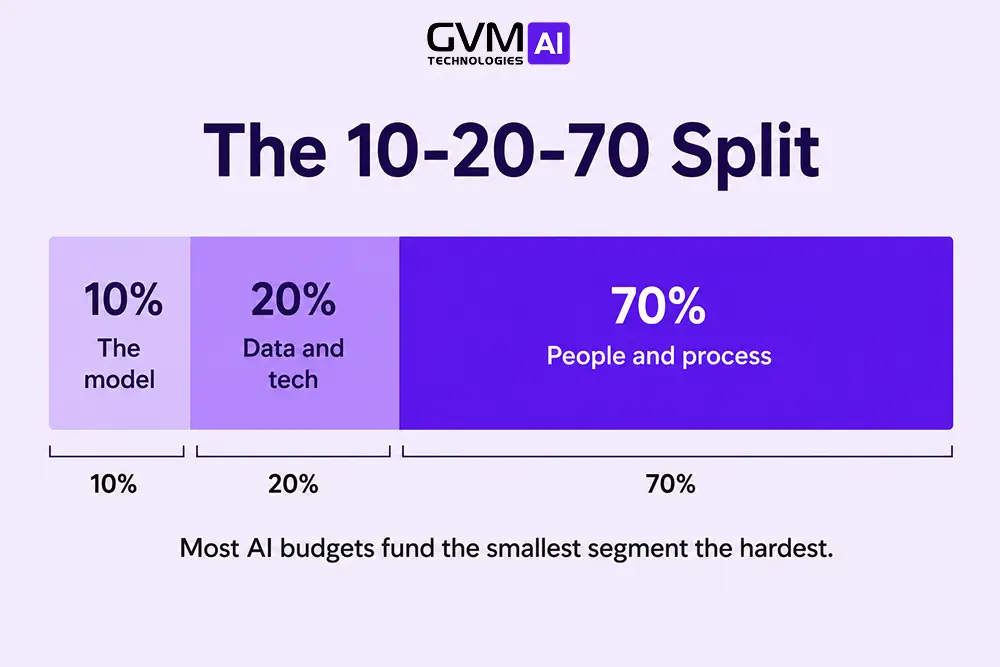
BCG puts a number on why: only 10% of AI success traces to the model, 20% to data and technology, and 70% to people, process, and the leadership decisions below.
Quick answer: An AI change management checklist for leadership means making 7 decisions before deployment: name the business problem, appoint 1 accountable sponsor, define who governs and reviews, align Legal, Security, IT, HR, and Finance, pick 1 outcome metric, design honest incentives, and set a clear handoff.
Skip a single decision, and the pilot inherits a gap it can’t fix on its own.
Key Takeaways
- More than 80% of AI projects fail to deliver business value, about 2x the failure rate of non-AI IT projects (RAND).
- 76% of companies now have a Chief AI Officer, up from 26% a year ago. Only 14% have defined who owns AI governance (IBM, Logicalis).
- 75% of C-suite leaders admit their own AI strategy is “more for show” than real guidance (Writer and Workplace Intelligence).
- BCG: AI success is 10% the model, 20% the data, 70% people and process.
- Boards face personal liability for unmanaged AI risk under the EU AI Act starting August 2026.
- 87% of companies are raising AI budgets while 48% of AI projects miss their business objectives (Logicalis).
What Change Management for AI Actually Means
Change management for AI is organizational work, not technical work. It means a named sponsor, defined governance, a real success metric, and cross-functional sign-off, agreed before a vendor gets picked.
Where This Sits: The Three Layers of AI Readiness
Most AI adoption advice skips straight to the workflow. That’s the wrong starting point. There are 3 distinct layers, and each answers a different question.
| Layer | Answers | Owner | Guide |
|---|---|---|---|
| Leadership | Is the org aligned to sponsor and govern this? | Executive sponsor | This guide |
| Workflow | Is this task’s data and ownership ready? | Workflow owner | Readiness checklist, linked above |
| Rollout | Will people trust and adopt it? | Named change driver | AI agent rollout without pushback |
| Scale | How do we expand it safely? | Gate owner | Phased AI rollout framework |
A team can run a flawless pilot and still lose the initiative at month 4. Usually it’s because nobody at the leadership layer named a budget owner past the first quarter.
The “We Explored AI” Problem
Leadership teams often announce AI to satisfy a board update, not to solve a named problem. The euphemism is almost always the same: “we explored AI.” Nobody funds a second phase, and the initiative quietly disappears.
That pattern has numbers behind it now. 75% of C-suite leaders admit their AI strategy is more for show than real guidance, per Writer and Workplace Intelligence’s 2026 survey of 2,400 leaders and employees.
39% have no plan to generate revenue from AI tools they’ve already bought.
Why AI Deployments Fail at the Leadership Level
The failure data all points the same direction: away from the model, toward the organization deploying it.
| Source | Finding |
|---|---|
| RAND Corporation, 2024 | More than 80% of AI projects fail to deliver business value, about 2x the rate of non-AI IT projects |
| S&P Global Market Intelligence, 2025 | 42% of companies abandoned most AI initiatives in 2025, up from 17% in 2024 |
| Logicalis CIO Report, 2026 | 48% of AI projects miss their business objectives; only 14% define who owns governance |
The People-Process-Culture Math Nobody Budgets For
BCG’s research puts a number on the imbalance: AI success is 10% the model, 20% the data and technology, 70% people and process. Most AI budgets flip that ratio, funding tools heavily and leadership decisions barely at all.
Spending Up, Success Down: The Governance Gap
87% of companies are increasing AI budgets while 48% of AI projects miss their business objectives, per the Logicalis CIO Report 2026.
Chief AI Officer titles have surged to 76% of companies, up from 26% a year earlier, per IBM’s 2026 C-Suite Study of 2,000 CEOs. The title is spreading faster than the authority behind it.
Under the EU AI Act, board members face personal liability for unmanaged AI risk starting August 2026. Fewer than half of boards currently treat AI risk as a standing agenda item.
The AI Change Management Checklist: 7 Leadership Decisions
These decisions belong to leadership, not the team that runs the pilot. None require picking a vendor first.
1. Name the Business Problem Before the Vendor
“We’re exploring AI” is not a business problem. “Support tickets take 4 days to resolve and it’s costing us renewals” is one. A leadership team that can’t state the problem in 1 sentence, without the word “AI” in it, hasn’t decided anything yet.
2. Appoint 1 Executive Sponsor With Real Authority
Committees don’t sponsor initiatives. 1 named executive does, with real budget authority and the standing to say no to a rushed timeline.
That gap between title and authority is exactly why 76% of companies now have a Chief AI Officer while only 14% have defined who’s accountable for governance.
3. Decide Who Governs, Reviews, and Owns the Fallout
3 names, decided before launch, not after:
- Who approves what the system is allowed to do
- Who reviews its output on a set schedule
- Who owns the response when something breaks
This maps to the “Govern” function in the NIST AI Risk Management Framework, which treats accountability as the starting point, not an afterthought. Skip it, and the fallout from AI agent hallucinations in production lands on whoever happened to be in the room, not on anyone who could have prevented it.
4. Align Legal, Security, IT, HR, and Finance Before Kickoff
A rollout that Legal or Security learns about after launch gets frozen the first time it touches sensitive data. Align these 5 functions before kickoff:
- Legal: data handling, vendor contracts, liability
- Security: access boundaries, what systems the AI can reach
- IT: integration points, ownership of the stack
- HR: role impact, how the change gets communicated
- Finance: the budget model, and who owns it past quarter one
5. Pick the 1 Metric This Initiative Will Be Judged On
Pick the outcome, not the activity:
- Good metrics: cost per resolution, revenue per rep, error rate
- Bad metrics: logins, usage counts, token spend
A rising login count with a flat error rate proves the tool got touched, not that the work improved.
Usage metrics also get gamed. Teams told to “prove AI adoption” have padded queries and burned tokens on pointless tasks just to move a dashboard number. When usage becomes the KPI, gaming the KPI becomes the job. Our guide to measuring AI agent productivity gains covers the 4-layer alternative once this decision is made.
6. Design Incentives That Reward Honesty, Not Activity
29% of employees admit to sabotaging their company’s AI strategy, a figure that climbs to 44% among Gen Z. Leadership’s incentive design decides which way that number moves.
Amnesty for honest early bug reports beats a usage mandate every time. It’s the same governance principle that keeps shadow AI visible instead of hidden.
7. Define What “Ready to Hand Off” Actually Means
Write the bar down: sponsor named, governance owner named, Legal and Security signed off, metric agreed. “We’re ready to start” is not a bar. That handoff is where this checklist ends and the workflow layer begins.
Score Your Leadership Team: The 14-Point Scorecard
Score each decision 0 to 2 with this AI change management checklist. It measures leadership decisions, not workflow data quality.
| # | Decision | 0 (Not started) | 2 (Done) |
|---|---|---|---|
| 1 | Business problem | “We’re exploring AI” | 1 sentence, tied to a number |
| 2 | Sponsor | A committee, no owner | Named, real budget and veto power |
| 3 | Governance | No review process | Named reviewer, named incident owner |
| 4 | Cross-functional | Legal finds out post-launch | All 5 functions signed off |
| 5 | Metric | Usage or logins only | 1 outcome metric, baselined |
| 6 | Incentives | Usage tied to reviews | Amnesty for honest reporting |
| 7 | Handoff | “We’re ready to start” | A written bar, sponsor-agreed |
- 0 to 5: Not ready to leave leadership’s desk. Fix sponsorship and governance first.
- 6 to 10: Partial groundwork. Close the lowest score before handing off.
- 11 to 14: Leadership’s job is done. Hand off to the workflow layer next.
What Skipping This Costs
Two well-documented cases show what happens when the technology works exactly as designed and nobody was assigned to check its output.
| Case | What Happened | The Real Failure |
|---|---|---|
| Deloitte Australia, 2025 | A government report, built partly with GPT-4o, contained fabricated citations and a fake judge quote. Deloitte issued a partial refund on the ~USD 290,000 contract. | Nobody assigned a human reviewer to verify citations before a client saw the report. |
| Air Canada, 2024 | The airline’s chatbot gave a customer wrong bereavement-fare policy. A tribunal ordered Air Canada to pay CAD 812.02. | Nobody decided the chatbot’s answers needed the same policy review as the website copy. |
Neither model malfunctioned. Both companies just never decided, at the leadership level, who checks the output before it reaches someone who matters. The technical fix comes second; the governance fix has to come first.
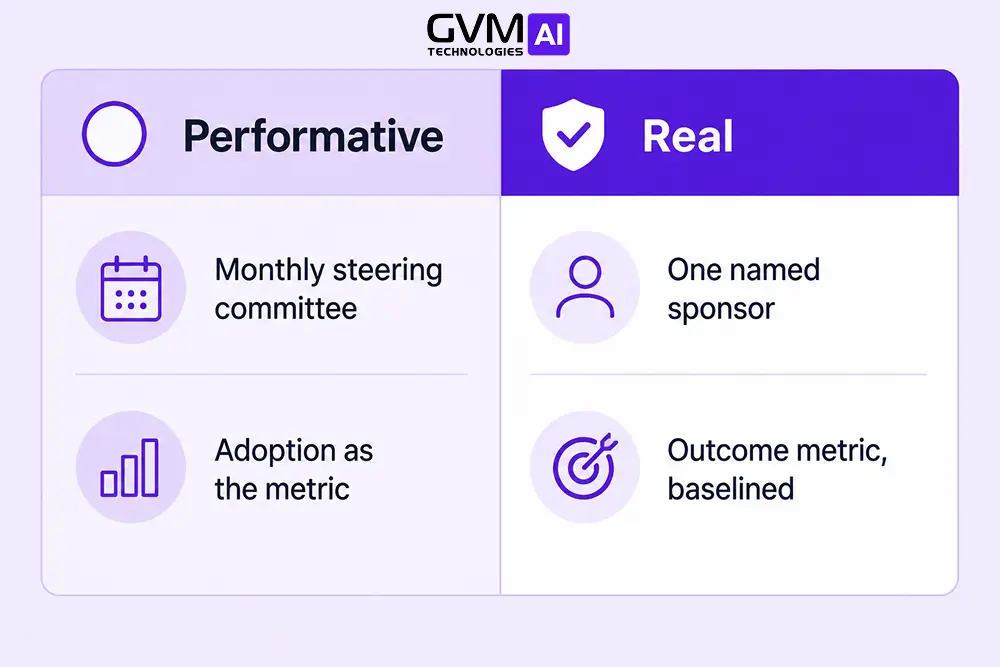
Signs Your AI Change Management Is Performative, Not Real
75% of leaders privately admit their own strategy is more show than substance. Here’s how to tell which one is happening inside your organization.
| Performative | Real |
|---|---|
| “We’re using AI now” is the whole announcement | A specific workflow, tied to a specific metric |
| A steering committee that meets monthly | 1 named sponsor with budget authority |
| Success measured by adoption or logins | Success measured by the agreed outcome metric |
| Legal finds out after the pilot ships | All 5 functions signed off before kickoff |
| The initiative quietly disappears after 2 quarters | A written bar for what “ready to scale” means |
Watch for one more pattern nobody puts in a slide deck: some pilots get killed not because they failed, but because they worked.
A workflow that quietly proves a team of 2 can do what used to take 10 threatens a budget line, a headcount plan, or a billable-hours model somewhere in the org.
If a successful pilot stalls with no technical explanation, check who benefits from it staying small.
Common Mistakes Leadership Teams Make
- Announcing AI before naming the problem. The clearest predictor of “more for show.”
- Treating a Chief AI Officer title as a governance structure. 76% have the title; only 14% have the accountability underneath it.
- Letting Legal and Security find out after the pilot has momentum. Fixing an objection then costs political capital nobody wants to spend.
- Measuring adoption instead of outcome. A rising login count with a flat error rate proves nothing improved.
- Raising the AI budget without fixing governance first. 87% of companies are doing exactly this, which is how spending and failure rates rise together.
How Long Leadership Alignment Actually Takes
Leadership alignment across all 7 decisions typically takes 2 to 4 weeks, before any technical work starts.
- Naming the problem and sponsor: 1 to 3 days.
- Governance and cross-functional sign-off: 1 to 2 weeks, mostly waiting on review cycles, not new work.
- Metric and handoff bar: 2 to 4 days.
What actually stretches it: a sponsor who won’t commit budget past quarter one, and a governance committee with no decision rights, only a meeting invite. Both are visible in week 1.
FAQs About AI Change Management
1. Who should own AI change management: the CIO, the CAIO, or the COO?
Whoever has real budget authority and the standing to say no to a rushed timeline. The title matters less than the decision rights attached to it.
2. How is an AI change management checklist different from a workflow readiness checklist?
An AI change management checklist covers the organizational layer: sponsorship, governance, funding. The workflow checklist linked earlier scores one task’s data and ownership. Both need to clear before a pilot starts.
3. Does a small business need this level of process?
Yes, though it moves faster. A 10-person company can often name a sponsor and settle governance in 1 conversation.
4. What’s the single biggest predictor an AI initiative will stall
No named executive sponsor with budget authority past the first quarter.
5. Does the EU AI Act really create personal liability for board members?
Yes, for unmanaged AI risk, starting August 2026. That’s why board-level AI risk oversight belongs on this checklist, not just in a compliance filing.
6. What if leadership wants to skip straight to a pilot?
Show them the failure data first: more than 80% of AI projects fail without this groundwork, at roughly 2x the rate of ordinary IT projects.
7. Can an outside partner run this leadership-level process?
Often, especially for cross-functional alignment, where an outside facilitator can move Legal, Security, and Finance to agreement faster. Compare the tradeoffs in our AI agency vs. in-house AI team guide.
The Bottom Line on Change Management for AI
The technology mostly works. The failure data keeps pointing at the same gap: 87% of companies are raising AI budgets while 48% miss their business objectives, because spending grew faster than governance did.
An AI change management checklist for leadership is 7 decisions, made by name, before a vendor gets picked: the problem, the sponsor, the governance owner, the 5 aligned functions, the metric, the incentives, and the handoff bar.
Deloitte’s report and Air Canada’s chatbot both ran on technology that performed exactly as built. What was missing was a leadership decision about who checks the output before it reaches someone who matters.
Ready to Build an AI Change Management Plan That Survives Contact With Reality?
Most AI initiatives don’t fail because the model was weak. They stall because leadership never named a sponsor, a governance owner, or a metric before the pilot started.
GVM Technologies AI runs this exact checklist with leadership teams before scoping a single workflow. The same accountability structure then carries through the AI agent deployment itself, shown in production in our customer outreach agent case study.
Talk to our team about which of these 7 decisions your leadership has actually made. No pitch. Just an honest read on where the gaps are.