
Shadow AI in the workplace means employees using AI tools or AI-powered features that IT, legal, and security never approved. It is already happening at your company, most likely through a personal ChatGPT account or a connected AI agent nobody reviewed.
The danger is not that AI is being used. It is that sensitive data leaves through a channel you cannot monitor or pull back once it is gone.
Quick answer: Shadow AI matters because data sent to an unapproved tool behaves like data sent to an unvetted third party. It can be stored, used to train future models, or reviewed by vendor staff.
Gartner projects that 40%+ of organizations will face a related security or compliance incident by 2030. Banning AI is not the fix. An approved option good enough to replace the risky one is.
Key Takeaways
- 40%+ of organizations will face a shadow AI incident by 2030, and 69% of security leaders already suspect it inside their own company, per Gartner.
- Independent surveys put unauthorized AI use at 43% to 55% of employees, and Varonis puts combined shadow AI and shadow IT use as high as 98%.
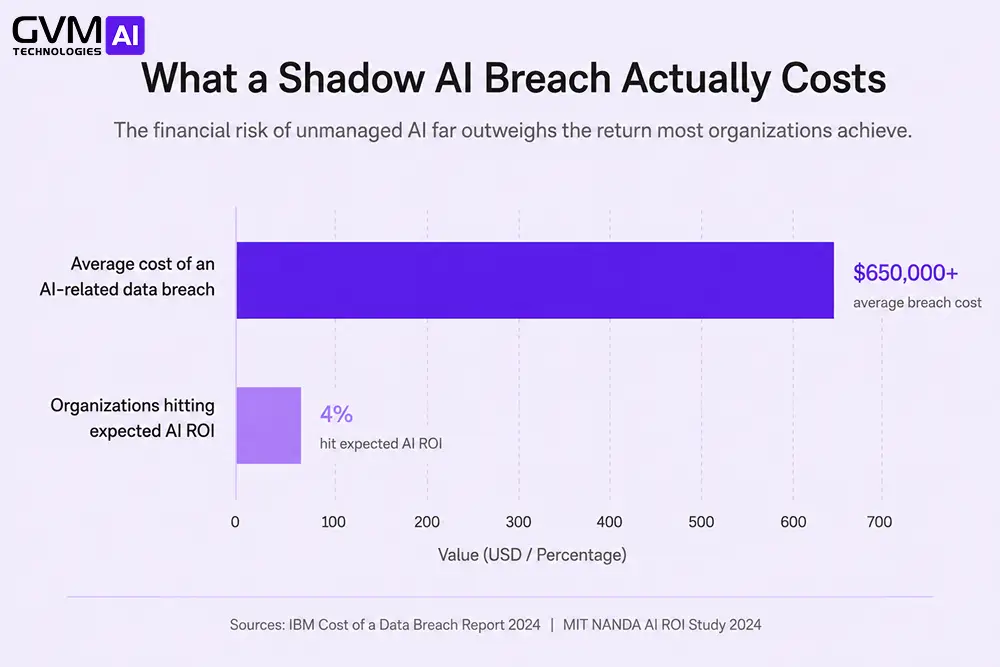
- AI-related breaches cost over $650,000 on average, and only 4% of AI projects hit their expected ROI, per ISACA.
- Samsung’s 2023 ban followed three source-code leaks in a single 20-day window, still the reference case in most governance conversations.
- AI meeting notetakers can trigger consent-law violations in the 10-plus US states requiring every party’s permission to record a call.
- The least-discussed 2026 risk is not a chat window. It is an AI agent wired into a CRM with standing access nobody reviewed.
Shadow AI in the Workplace: A Clear Definition
Shadow AI is any AI tool used for work that IT, security, or legal never signed off on. Unapproved software is a policy violation. Unapproved AI is that plus a live data event, since input can be logged, stored, or used to train a model.
1. Shadow AI vs. Shadow IT
Shadow IT covers any unapproved app, and the data usually just sits there. Shadow AI actively processes what you give it, which is a materially different risk category.
2. Common Examples and What Does Not Count
| Category | Example |
|---|---|
| Personal chat accounts | An employee’s own ChatGPT, Claude, or Gemini login |
| Browser-native AI | Gemini in Chrome or a summarizer extension |
| Meeting notetakers | Otter.ai sending a transcript to a third-party server |
| No-code automations | A Zapier flow with an AI node added outside IT |
| Connected agents | An agent linked to internal tools via an MCP server, with no one tracking its access |
A company-licensed tool used as legal approved it is simply AI, not shadow AI. The line is approved and visible versus unapproved and invisible.
How Widespread Shadow AI Has Become in 2026
| Metric | Figure | Source |
|---|---|---|
| Orgs facing a shadow AI incident by 2030 | 40%+ | Gartner |
| Employees using AI without approval | 49% | Forbes |
| Employees sharing sensitive data, unprompted | 43% | Foley & Lardner |
| Combined shadow AI and shadow IT use | 98% | Varonis |
| Enterprises with no shadow AI policy | 63% | CloudEagle |
No two surveys agree on the exact number. Different methods landing on “somewhere between four in ten and nearly all of it” confirms the direction, not the decimal point.
Roughly half of employees will not admit their AI use unless asked, and this is not just a junior-staff problem. Executives share confidential material through personal channels for the same reason: asking permission feels harder than just doing it.
Why Employees Turn to Unauthorized AI Tools
Almost nobody does this to cause harm. They do it because the approved option is missing, slow, or worse than what is already on their phone.
- No approved tool exists yet, so employees open whatever is free and available.
- The approved tool is worse. A chatbot that cannot read a document loses to personal ChatGPT within five minutes.
- Asking takes longer than doing it. A ticket queue loses to a ten-second answer, every time.
Here is the part most conversations miss. The real failure is rarely the data leaving. It is the absence of proof anyone was watching.
Ask any employee: if a client asked whether their contract was ever shown to an unapproved AI tool, could they answer with total confidence? “Not sure” means shadow AI is already happening.
The Real Cost and Legal Exposure Most Companies Miss
A typical leak, like a misdirected email, is a one-time event. Shadow AI compounds, and it hits harder than security teams alone tend to frame it.
1. Data Exposure Nobody Can Recall
You cannot recall a prompt the way you recall an email. Consumer and enterprise accounts from the same vendor often carry different training terms, and an employee on a personal account has no reason to know which applies.
Tools built to catch files leaving the network miss most of this too. A prompt in a browser tab looks like ordinary encrypted traffic, not a file transfer, which is why the browser is the real risk point in 2026, not the firewall.
2. The Legal Risk Hiding in Plain Sight
More than ten US states require every participant’s consent before a call is recorded. An AI notetaker joining without it is not just a policy problem. It is a potential wiretapping violation, and pasting a contract clause into a public tool can waive attorney-client privilege.
3. What a Breach Actually Costs
IBM’s research puts the average AI-related breach north of $650,000. A second cost matters just as much: only 4% of companies hit their expected AI ROI, and shadow AI sprawl is a documented drag on that number. Fix the governance gap, and the ROI number moves with it.
A Real Example: Samsung, 2023
Samsung’s semiconductor division let engineers use ChatGPT to speed up debugging. Within 20 days, it logged three incidents (Forbes; CNBC):
- An engineer pasted proprietary chip-manufacturing code to check for errors.
- A second uploaded code meant to identify defects in production equipment.
- A third fed a meeting transcript to ChatGPT to draft minutes.
None intended harm. Samsung’s response, a company-wide ban followed by its own internal AI system, is the pattern most large organizations still copy.
It is also incomplete: a ban stops the visible version and does nothing about the version happening on a personal phone, off-network, where nobody is watching.
The Shadow Agent Problem: Beyond Chat Windows
Most shadow AI content stops at chat windows. That covers roughly half of the real exposure now.
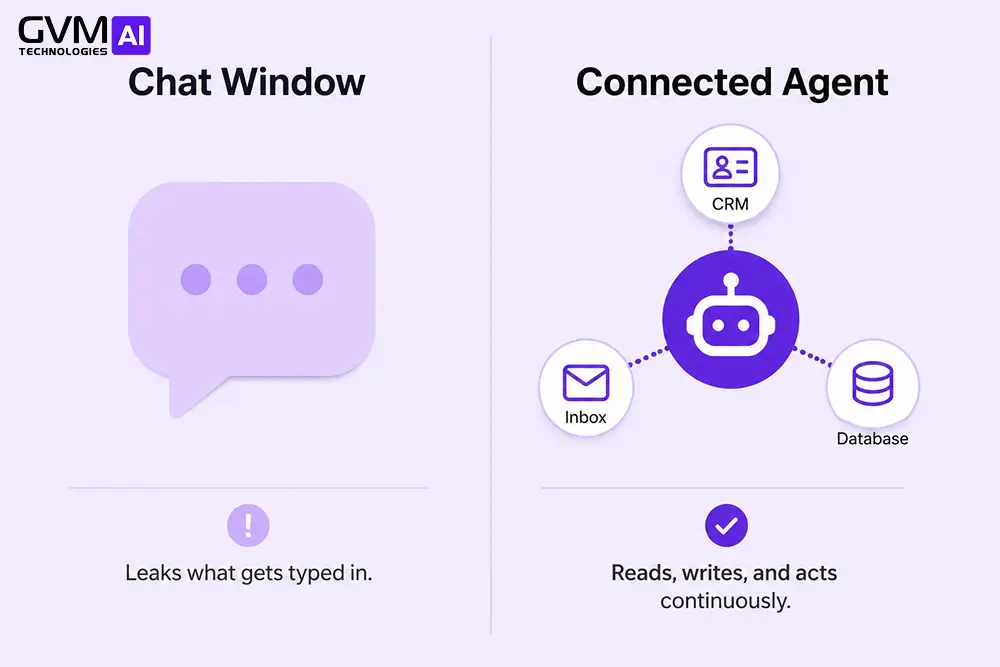
The newer risk is a shadow agent: an AI system connected to a CRM, inbox, or database through an MCP server or low-code platform, running on credentials nobody scoped.
1. Why a Connected Agent Is Riskier Than a Chatbot
A chat window leaks whatever gets typed and stops there. A connected agent reads, writes, and acts across every system it touches, continuously, with no human approving each step.
Every agent given its own login also creates an account nobody is tracking, which most companies never count or review.
2. How to Spot One Before It Becomes a Breach
Ask what a tool can already reach, not just what someone typed. Warning signs: an integration nobody remembers setting up, an account with broader access than the task needed, or an automation touching customer data with no named owner.
Our AI agent access to customer data guide scores that exposure directly, and our AI agent readiness checklist covers the ownership gaps that let an agent run unreviewed for weeks.
Why Banning AI Tools Backfires
Banning AI feels decisive, but it produces the least visibility of any option. When a company blocks AI domains, employees switch to a personal phone or photograph their screen and ask a personal account instead.
Every workaround removes the one thing a ban was supposed to protect. Companies that manage this well describe the goal as illuminating shadow AI, not eliminating it: surface what is happening, then build a path good enough that people stop routing around it.
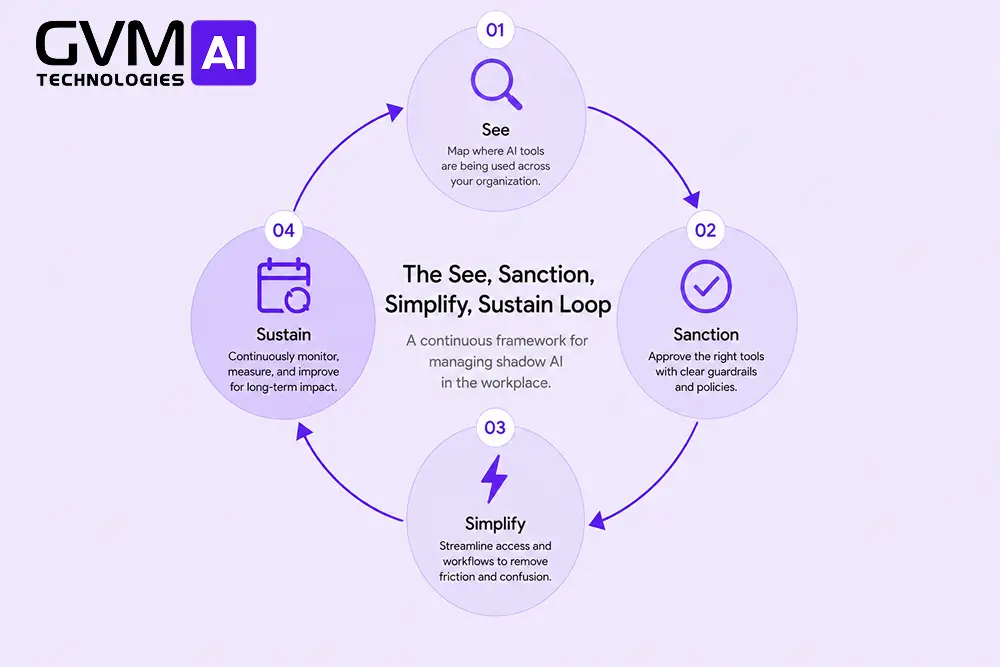
A Framework to Manage It: See, Sanction, Simplify, Sustain
1. See
Find out what is already in use. Frame a survey as fact-finding, not an investigation, and pair it with SSO logs, OAuth grants, and AI subscription expenses. You are building a baseline, not a case against anyone.
2. Sanction
Pick one or two tools backed by an enterprise agreement and a signed data-processing addendum, with training disabled by default. Confirm deletion rights and breach notification terms in writing before signing.
- Data can never be entered: customer PII, source code, NDA material, financial projections.
- Someone named reviews AI-assisted output before it ships.
3. Simplify
This step gets skipped most, and it moves the needle most. If the sanctioned tool takes longer to open than a browser tab, employees use the tab. Single sign-on and no capability gap against the free tool are what make a policy stick.
4. Sustain
Usage patterns shift monthly. A quarterly check of new SaaS signups and OAuth grants catches drift before it becomes a Samsung-sized story, and it is the only realistic way to catch a standing agent integration nobody has reviewed since setup.
Writing a Policy That Actually Works
Vague language is the top reason enforcement fails. It gives employees nothing concrete to check judgment against.
| Vague | Specific |
|---|---|
| “Be careful with sensitive data.” | “Never paste customer PII or source code into an unapproved tool.” |
| “Use AI responsibly.” | “AI-assisted client communications need human review before sending.” |
| “Report issues if they happen.” | “Report exposure to [named person] within 24 hours. No discipline for prompt disclosure.” |
That last row matters most. Zero protection for honest disclosure guarantees the next leak stays hidden, since roughly half of employees already hesitate to admit their AI use.
Give Employees an Alternative They Will Actually Use
The instinct to lock everything down misses the lesson in the data: employees are rejecting inconvenience, not oversight. Three things get a tool adopted instead of routed around:
- Speed. It opens as fast as the personal account it replaces.
- Capability. It reads real company data, not just public knowledge.
- Trust. Guardrails and an audit trail are visible, not buried in fine print.
That is the layer GVM Technologies AI works in daily, building AI agents and chatbots wired into a company’s real systems with private cloud hosting and PII redaction built in from day one.
Our customer outreach agent case study shows what that looks like in production, not just on paper.
Common Mistakes That Make Shadow AI Worse
- Banning with no alternative ready. Employees fill that gap with their own phones.
- Writing a policy nobody trains on. An unread document is not a control.
- Treating this as purely IT’s problem. Legal needs a seat at the table too.
- Punishing honest disclosure. The next incident just goes quiet instead.
- Ignoring the agent layer. Chat-only policies miss the highest-access risk in the building.
Quick Reference: How Much Governance You Need
| Situation | Minimum needed |
|---|---|
| Small team, low confidentiality exposure | One-page policy, one approved tool, honest-disclosure clause |
| Client contracts, NDAs, financial data | The above, plus a signed data-processing agreement |
| Regulated industry (health, finance, legal) | The above, plus role-based access and an audit-ready cadence |
| Any connected AI agent | A full readiness and access review before it goes live |
FAQs
1. What is shadow AI, in plain terms?
Any AI tool used for work without IT, security, or legal approving it first, most often a personal ChatGPT, Claude, or Gemini account.
2. Is shadow AI illegal?
Not by itself, but it can trigger a breach of an NDA, a client contract’s data clause, HIPAA, or attorney-client privilege depending on what was shared.
3. How is shadow AI different from shadow IT?
Shadow IT is any unapproved software. Shadow AI is the subset that actively processes, and may retain or train on, whatever data gets entered.
4. How do you detect shadow AI without expensive tooling?
Start with SSO and OAuth connection logs, AI subscription expense reports, and a short, non-punitive internal survey.
5. Can an AI agent create risk without anyone using a chatbot?
Yes, and it is often the higher-risk version. A connected agent reads and acts on data continuously through standing access.
6. Does banning AI tools actually stop employees from using them?
Rarely. It usually pushes use to personal phones and home devices, where a company loses all visibility.
7. Can AI meeting notetakers create legal risk beyond data exposure?
Yes. States requiring all-party consent to record a call can make an uninvited AI notetaker a separate legal problem.
8. Is an internal chatbot or Microsoft Copilot shadow AI?
No, as long as it is licensed and covered by your own data agreement. Missing sign-off is the defining trait, not the presence of AI.
Shadow AI in the Workplace: The Bottom Line
Shadow AI in the workplace is not a story about careless employees. It is what happens when useful technology outruns approval processes.
Nearly half of employees already use AI you have not approved, mostly on free accounts, and roughly half will not tell you unless it is safe to. Banning it removes your visibility, not the behavior.
See what is happening. Sanction a real alternative. Simplify it until it beats the workaround. Sustain it on a schedule instead of waiting for an incident to force the conversation.
Ready to Replace the Risk With a Real Alternative?
A policy is the easy part. Building an AI system employees will actually choose over ChatGPT, trained on your own data and secure enough that IT and legal both trust it, is what closes the gap.
GVM Technologies AI designs exactly that: custom AI agents and chatbots and CRM automation, with private-cloud hosting, PII redaction, and audit logging built in from sprint one, not bolted on after a compliance review finds the gap.
Talk to our team about what a secure, approved AI option looks like for your business. No pitch, just a direct read on where your shadow AI exposure sits today.