
AI agents for lead qualification now score prospects at 87% accuracy against 76% for human-only teams, per a 939-company benchmark. That number only holds up in a hybrid setup, though.
Our breakdown of what an AI agent actually is explains why that distinction decides everything else here.
Remove humans from the loop entirely and 20 to 30% of genuinely qualified leads get labeled unqualified. Nobody notices until someone audits the “dead” pile and finds real budget sitting in the transcript.
Quick answer: AI agents for lead qualification work best as a speed-and-structure layer in front of your reps, not a replacement for them. Hybrid deployments hit 87% accuracy and qualify leads roughly 3x faster than manual review.
Full automation misclassifies 20-30% of qualified leads. Separating what the agent decides from what it writes to your CRM predicts which outcome you get.
Key Takeaways
- Hybrid AI qualification hits 87% accuracy versus 76% for human-only review, a 25% relative lift.
- Full automation misclassifies 20-30% of qualified leads as dead, a pipeline leak most teams never measure.
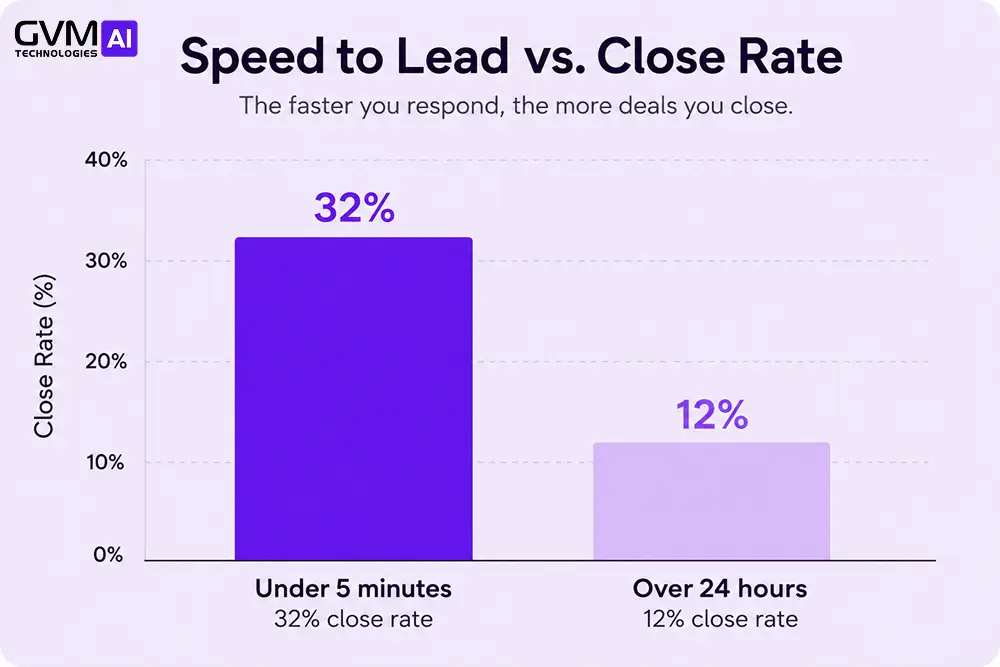
- Responding within 5 minutes instead of 30 makes a lead 21x more likely to qualify. Close rates run 32% versus 12% after 24 hours.
- Third-party intent-data feeds carry a 31-47% false-positive rate across the top four vendors audited in 2026.
- 70% of B2B companies now run a hybrid model, and that group beats fully-automated and fully-manual teams alike.
What Are AI Agents for Lead Qualification?
An AI agent for lead qualification reads a live conversation, decides what it means, and acts on it: asking a follow-up, extracting budget and timeline, scoring the fit, and routing or booking the lead itself.
That’s different from a scripted chatbot matching phrases to a branch, and different again from a static scoring rule that adds points for a job title regardless of what the prospect actually said.
AI Agent vs. Chatbot vs. Static Lead Scoring
- Scripted chatbot: qualifies only when phrasing matches a pre-built branch.
- Static lead scoring: scores firmographics, not what the lead said in the conversation.
- Reasoning AI agent: extracts intent, budget, and timeline from live language, then acts on it.
Confusing the first two with the third is why a “we tried AI and it didn’t work” story usually turns out to be a rules engine wearing an AI label. Qualified also isn’t the same as ready to close. A lead can have confirmed budget and still take four months to sign.
Where BANT, MEDDIC, and CHAMP Still Fit
Older frameworks (BANT for budget and timeline, MEDDIC for decision criteria, CHAMP for challenges first) still define what good qualification looks like. An agent doesn’t replace that logic.
It automates the extraction: asking the same questions conversationally, then writing answers into structured fields instead of a rep’s notepad.
Why Speed to Lead Is the Real Business Case
The average B2B company takes 47 hours to respond to a new lead. Only 23% respond within 5 minutes.
| Response Window | Qualification Likelihood | Close Rate |
|---|---|---|
| Under 5 minutes | 21x more likely than a 30-minute response | 32% |
| Over 24 hours | Sharp drop-off | 12% |
That 21x figure traces to lead-response research MIT’s James Oldroyd ran, popularized via Harvard Business Review. Our own customer support cost-savings analysis shows the same speed effect on the support side.
The Debounce Problem No Demo Shows You
An agent that replies in 800 milliseconds while a prospect is still typing message two of three doesn’t feel fast. It feels like it wasn’t listening.
Production teams fix this with a 45-60 second debounce window that resets on every new message, so a rapid three-text burst gets one complete reply instead of three interrupted ones.
Tasks AI Handles Well, and What Still Needs a Rep
- Strong fit: extracting budget and timeline from chat, voice, or SMS; classifying intent; drafting personalized follow-ups.
- Still needs a human: negotiating price mid-deal, judging long-term potential on a no-budget-today lead, and closing six-figure deals unattended.
- Never an agent’s call: CRM field updates and routing. Keep these in a deterministic workflow, since a wrong field name or date format corrupts a record silently.
The Real Accuracy Numbers Behind AI Agents for Lead Qualification
According to the Optifai Sales Ops Benchmark (939 B2B companies, Q2 2025 to Q1 2026):
| Metric | Hybrid (AI + Human) | Manual-Only |
|---|---|---|
| Qualification speed | 3x faster | 24-48 hour lag |
| Accuracy | 87% | 76% |
| SQL-to-opportunity rate | 32% | 28% |
| Cost per lead | $5-10 | $50-100 |
70% of companies run the hybrid model; only 15% went fully automated.
Why full automation misqualifies 1 in 5 leads: vague prospect answers, scoring thresholds tuned too generously for a demo, and models scoring firmographic proxies instead of what the lead actually said. All three are fixable. None get fixed by a bigger model.
A separate audit of 14 B2B SaaS sales organizations found third-party intent-data signals carry a 31-47% false-positive rate.
Roughly one in three “high-intent” accounts flagged for outreach was never actually in-market. An agent reasoning perfectly on bad input still produces bad prioritization.
The 3-Layer Qualification Stack
Most disappointing pilots trace to one mistake: one AI system making judgment calls and also owning the CRM record for that decision.
- Deterministic workflow layer. CRM writes, routing, calendar bookings. No LLM judgment, ever.
- Cognitive qualification layer. Intent classification, scoring, follow-up drafting. This is where the agent earns its keep.
- Human judgment layer. Borderline scores and enterprise deals. A rep decides, and that call trains the layer above.
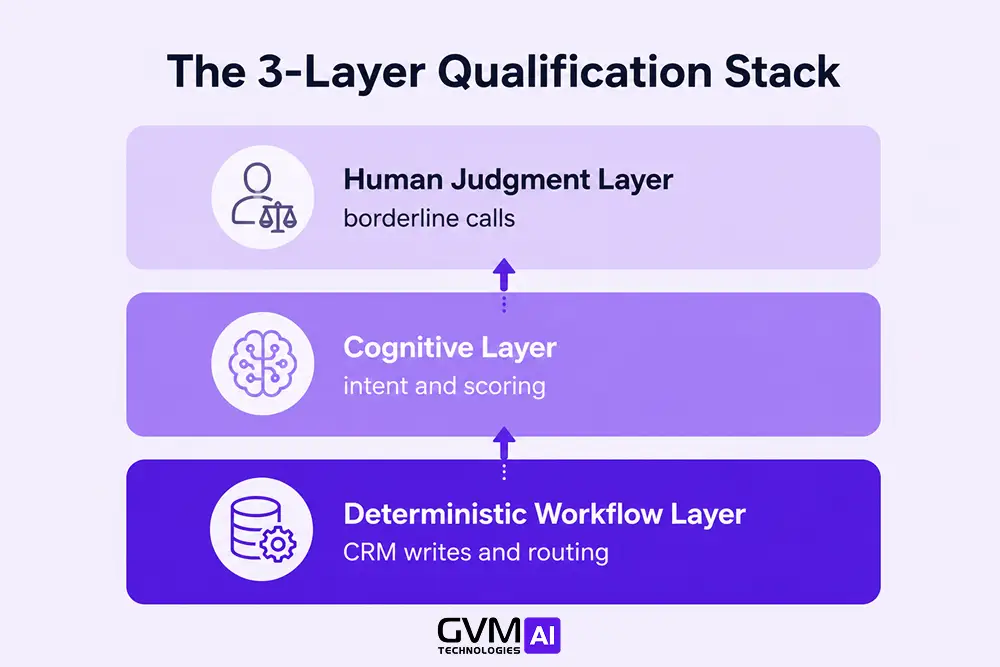
Collapsing layer one into layer two is exactly the failure mode in our guide to why AI agents hallucinate in production. Teams that separate all three report CRM-sync reliability moving from roughly 85% to effectively 100%.
The Lead Tiering Model for Sales Teams
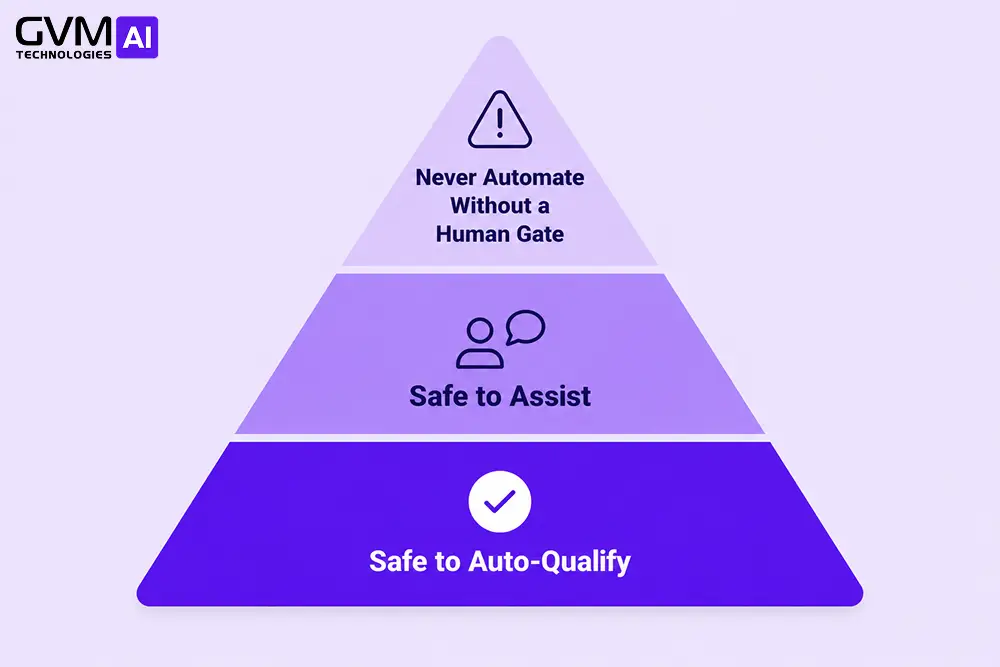
| Tier | Example | Automation Level |
|---|---|---|
| Safe to auto-qualify | Self-serve SMB, single decision-maker | Full autonomy |
| Safe to assist | Mid-market, multiple stakeholders | Agent drafts, rep confirms |
| Human gate required | Enterprise RFP, regulated industry | Agent summarizes only |
Scope the agent to one tier first, then expand once it earns trust. Teams that skip this report the roughest first quarter.
Building Qualification Logic Reps Actually Trust
What to Ask and How to Score It
- What problem are they solving, in their own words
- Timeline: now, this quarter, or just exploring
- Budget authority, or gathering information for someone else
- What they already tried, and why it failed
- Any competitor named
Our CRM automation team enforces this same schema-first rule on every deployment: structured fields route and report; freeform notes just create cleanup work.
The Three Ways to “Not Qualify” a Lead
- Not a fit. Wrong industry or size. Archive it.
- Not enough information. Budget or timeline never came through. Flag for follow-up.
- Not ready yet. Genuinely early-stage. Route to nurture, not the trash.
Most of the 20-30% false-negative rate lives in buckets two and three. Below roughly 80-85% score confidence, route to a human instead of guessing.
The Bias Your AI Scoring Model Quietly Inherits
A model trained on your team’s own deal history learns your team’s habits, including the bad ones. If reps have always deprioritized a specific lead source, the model learns to score that source lower, even if it converts well.
Audit the score by lead source, not just overall accuracy. It’s the one check almost nobody runs before go-live.
The Handoff Package That Decides Whether a Transfer Works
A lead who repeats their situation to a rep after transfer hasn’t experienced automation. They’ve experienced a slower process with an extra step.
Every handoff needs:
- The lead’s stated problem, in their own words
- Budget and timeline, if captured
- Any competitor mentioned, and objections already raised
- A specific reason for the transfer, not “routing to sales”
Our guide to how AI agents handle memory and context covers the mechanism behind persisting all of it.
The ROI Formula: Net Qualified Pipeline Added
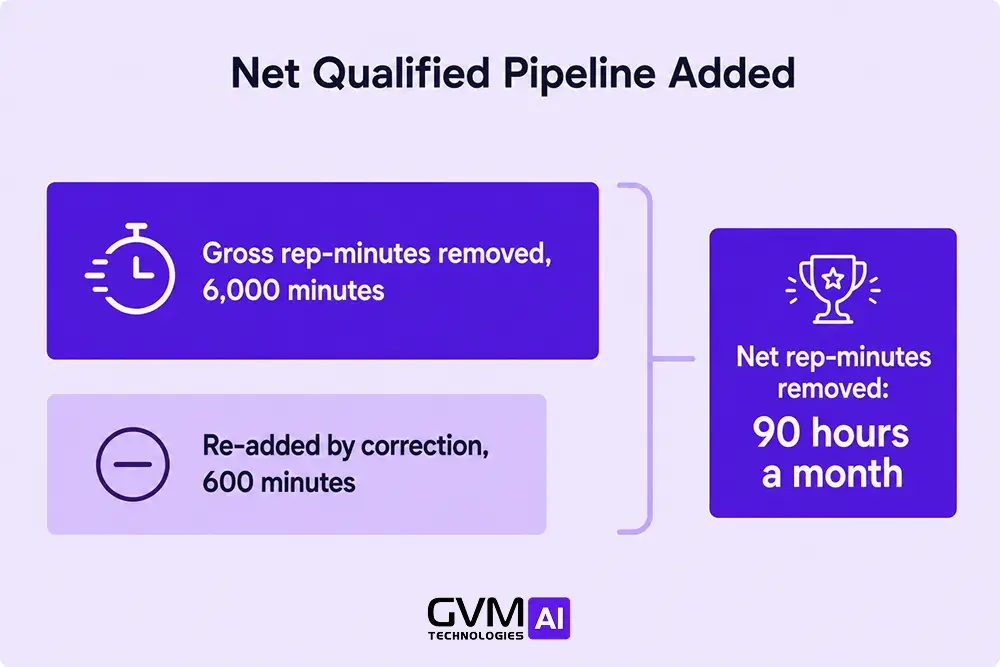
Net Qualified Pipeline Added = (Leads Fully Qualified by the Agent × Average Rep Qualification Time) minus (Rep Re-Qualification Time on Misrouted Leads)
| Line Item | Value |
|---|---|
| Leads qualified by the agent per month | 500 |
| Average rep time to qualify manually | 12 minutes |
| Gross rep-minutes removed | 6,000 minutes |
| Minutes re-added by correction work | 600 minutes |
| Net rep-minutes removed | ≈ 90 hours a month |
Priced at a fully-loaded rep rate, that’s the real number for a budget review, not the raw qualification count. Our guide to measuring AI agent productivity gains applies the same math across a full rollout.
What Named AI Sales Deployments Actually Show
| Company | Platform | Result |
|---|---|---|
| Fellow | Intercom Fin for Sales | 18 net-new meetings in one month, after-hours, ~48% conversion |
| Brightwheel | Intercom Fin for Sales | Surfaced demand a form-only system never captured |
| SaaStr | Qualified’s Piper AI SDR | 352% year-over-year increase in event-lead pipeline |
Reality check: as of 2026, there’s no published, controlled study running an AI agent against a human SDR on the same lead segment for 90 days through to closed-won. Treat vendor multipliers like “12x productivity” as a hypothesis to test, not a guarantee.
Choosing the Right Qualification Channel
SMS carries roughly a 98% open rate against 20% for email, and AI-run SMS qualification shows an 88% response-rate lift over human follow-up. A misrouted text is easy to correct mid-conversation.
Voice is less forgiving. A call is harder to walk back once the prospect hangs up, and an agent that can’t handle a soft pushback without sounding scripted is where most voice deployments fall apart.
Our comparison of voice AI agents vs. chat AI agents breaks down which channel fits which use case.
Before launching outbound voice qualification: confirm consent and disclosure rules for your list and jurisdiction. That review belongs with legal before it belongs in a prompt.
Common Mistakes That Turn a Good Pilot Into a Bad Quarter
- One system owns both judgment and CRM writes. The 3-Layer Stack above is the direct fix.
- Scoring firmographic proxies instead of what the lead said. A rules engine relabeled “AI” gives rules-engine results.
- Skipping the tiering model. Enterprise leads need a human gate before the agent earns trust.
- Deploying before 20+ closed deals exist to train against. Fewer means the model defaults to guessing.
- Collapsing all three “not qualified” buckets into one. Most false negatives hide there.
- Trusting intent data without auditing it. A 31-47% false-positive rate poisons even perfect reasoning.
- No idempotency check on outbound sends. A retry after a dropped API call is how a prospect gets the same message twice at 2 a.m.
- Never re-measuring after 90 days. Accuracy and trust both shift once real volume hits the system.
Build, Buy, or Blend
An off-the-shelf platform gets a working agent live faster, at the cost of less control over how scoring matches your ICP.
A custom build or agency partner gives full control, at the cost of owning the data plumbing. Our breakdown of AI agency vs. in-house AI team covers that trade-off directly.
The model matters less than pitches suggest. Our comparisons of GPT vs. Claude vs. Gemini and RAG vs. fine-tuning cover grounding the agent correctly.
Our guide to single-agent vs. multi-agent systems covers when to split qualification across specialized agents instead.
Rolling This Out Without Burning Your Pipeline
Start with a phased AI rollout on your safe-to-auto-qualify tier first, after running our AI agent readiness checklist to confirm your data and ownership are actually in place.
Sales teams resist change like every other department. Our AI agent rollout without pushback playbook covers bringing reps along instead of around the deployment.
FAQs About AI Agents for Sales & Lead Qualification
1. Can AI agents fully replace human SDRs for lead qualification?
Not reliably yet. The strongest data comes from hybrid deployments. Full automation currently misclassifies 20-30% of genuinely qualified leads.
2. How accurate are AI agents for lead qualification compared to humans?
A 939-company benchmark reports 87% accuracy for hybrid AI-assisted qualification versus 76% for manual-only review.
3. How much historical data do we need before AI lead scoring works?
Roughly 20 or more closed deals is the practical floor. Fewer, and the model defaults to guessing dressed up as a score.
4. What’s the biggest reason a pilot underperforms?
One AI system making judgment calls and also writing to the CRM, with no separation between the two.
5. Does responding faster to a lead actually matter?
Yes. Contacting a lead within 5 minutes instead of 30 makes it 21x more likely to qualify.
6. Should our first deployment be voice, chat, or SMS?
Chat or SMS is lower-risk for most B2B teams. Voice fits real estate and healthcare, where callers expect an immediate spoken answer.
7. Is third-party intent data reliable for prioritizing leads?
Treat it with caution. The top four vendors audited in 2026 carried a 31-47% false-positive rate on flagged accounts.
The Bottom Line
AI agents for lead qualification produce real gains: roughly 3x faster qualification, high-80s accuracy in hybrid setups, and a 21x conversion boost from cutting response time to minutes. None of that survives a fully autonomous deployment that skips the groundwork.
- Separate judgment (the agent) from record-keeping (a workflow), every time
- Sort leads into tiers before writing a single prompt
- Split “unqualified” into three real buckets, not one
- Build the handoff so a prospect never repeats themselves
- Track Net Qualified Pipeline Added, not raw qualification count
Ready to Build a Qualification System Your Reps Actually Trust?
Most teams get a qualification percentage from a vendor demo and back into a rollout plan from there. That’s backward, and it’s how a promising pilot turns into three months of rep complaints.
GVM Technologies AI scopes the lead-tiering model, the handoff design, and the ROI baseline before a single prompt gets written.
See that same discipline in our automated email and CRM outreach case study.
Talk to our team about what your own pipeline data would actually support, before you buy against someone else’s demo number.