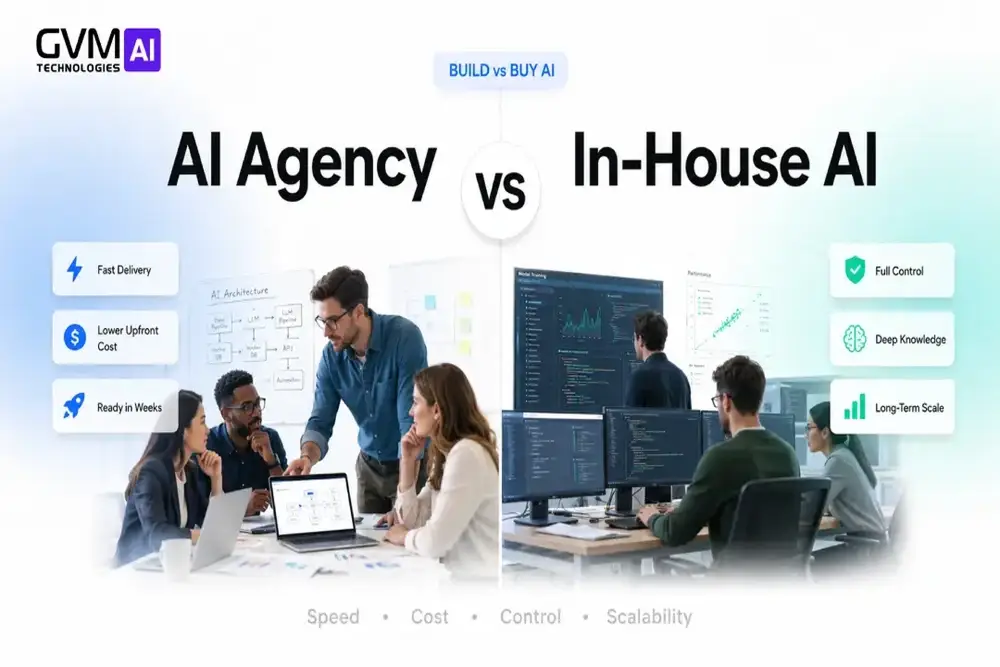
Quick answer: Hire an AI agency for 1 to 3 defined AI use cases you need live in 4 to 8 weeks. Build in-house once AI runs 10 or more use cases and is core to your product. This build vs buy AI decision comes down to timing, not preference. Most companies start with an agency, then move ownership internally once results are proven.
Key takeaways
- Agencies win on speed. Working AI in 2 to 8 weeks, versus a 3 to 6 month hiring pipeline before an in-house build even starts.
- In-house wins past a spend threshold. Roughly $500,000 a year in AI spend, or 10+ active use cases, is where the math flips.
- “Self-managed” is not low-maintenance. The work does not disappear. It transfers to you, silently, until something breaks.
- The real deliverable is a regression baseline, not the code. It is what proves a later prompt edit made things better instead of worse.
- Scope creep, not build quality, kills most agency relationships. A written scope with change-request pricing prevents it.
What an AI agency and an in-house AI team actually mean
An AI agency is an external team, usually 5 to 50 people, building AI systems for several clients at once. You are buying an outcome, plus patterns they already solved elsewhere.
An in-house AI team is engineers on your payroll, dedicated to you alone. You are buying permanent context and daily control. The tradeoff is a slower start.
Neither is universally correct. Each answers a different question: how fast do you need results, and how long will you need this capability?
The term for this choice in enterprise circles is build vs buy. Most CIOs frame it as a governance and time-to-value question, not just a staffing one. That framing applies just as well to a 12-person startup as it does to an enterprise.
Cost comparison: AI agency vs in-house AI team
An independent 2026 AI staffing comparison puts agency project costs at $25,000 to $150,000 in year 1, against $350,000 to $700,000 for a single in-house team once salary, benefits, and recruiting are counted.
A separate 2026 cost analysis sets a senior AI engineer’s fully loaded salary at $208,000 to $278,000 a year in the US, with a break-even point near $500,000 in annual AI spend.
| Cost factor | AI agency | In-house AI team |
| Year 1 total cost | $25,000 to $150,000 per project, or $2,800 to $10,000/month on retainer | $150,000 to $700,000+, depending on team size |
| Single senior AI engineer, fully loaded | Bundled into the project fee | $208,000 to $278,000/year in the US |
| Full team (engineer, designer, backend, PM) | Not applicable | $490,000 to $700,000 in salary alone |
| Break-even point | Favors agency below ~$500,000/year in AI spend | Favors in-house above that, or 3+ years of continuous use |
For 1 to 3 use cases, an agency almost always costs less in year 1. For 10 or more use cases stretched across years, in-house tends to win on total cost, once the investment has earned that shift.
GVM Technologies AI’s core AI solutions are priced against the first bracket, not the second.
Timeline comparison: how fast each option delivers a working system
Speed is where the gap is widest. It is rarely close.
An agency typically delivers a working prototype in 2 to 4 weeks and a production system in 6 to 8 weeks, a range confirmed across multiple 2026 AI implementation reports. An in-house hiring pipeline alone takes 3 to 6 months, before any code gets written.
That gap is not free. If a manual process costs your team real hours every week, the hiring delay is the actual price of building in-house first. It never shows up on an invoice.
When to hire an AI agency instead of building in-house
An agency fits when the problem is specific, costly, and time-sensitive.
Pick an agency when:
- You have 1 to 3 defined use cases, not a broad AI strategy
- You want proof the initiative pays off before committing to headcount
- Your industry is regulated and an experienced partner can navigate compliance faster than your team can learn it
- You are testing an AI proof of concept before deciding whether to scale it
GVM Technologies AI’s business automation and process AI work is built for exactly this scope. Audit first, build second, document everything.
When to build an in-house AI team instead of hiring an agency
In-house wins once AI stops being a project and becomes a permanent operating capability.
Pick in-house when:
- AI is core to your product, not a supporting process behind it
- You plan to run 10+ use cases over the next 2 to 3 years
- Compliance or security rules mean data cannot leave your infrastructure
- Engineering leadership can already manage AI specialists
A team you employ directly gets sharper at your edge cases every quarter. A vendor that built something and left rarely does, because their reason to keep learning your business ends at contract close.
Hidden costs neither option puts in the sales pitch
Both paths carry a cost that never shows up in the pitch.
For agencies, it is the maintenance tail. Some providers now sell fixed, 3-tier packages instead of open-ended custom AI development, specifically because unscoped work is where change requests and unbilled support hours erode margin.
For in-house teams, it is the ramp-up tax. A newly hired AI engineer needs weeks to understand your systems before shipping anything. That ramp time is paid at full salary regardless of output.
One pattern worth knowing: some companies pair 1 internal technical project manager with a rotating bench of freelance specialists. The PM owns context and continuity. The specialists handle execution without a full-time commitment.
The SCO framework: a 3-question test for this decision
Score each factor from 1 to 5. The highest score decides where you start.
- Speed pressure. What is the unsolved problem costing you per week?
- Control requirement. Does this touch regulated data, core IP, or a workflow only your team understands?
- Ownership horizon. Is this a one-time fix, or a multi-year capability?
If speed scores highest, start with an agency. If control scores highest, keep the build internal. If ownership scores highest, plan a hybrid now, instead of deciding twice later.
The hybrid model: agency first, in-house later
Most companies that scale AI successfully do not pick a permanent side. They sequence both.
- Engage an agency for architecture, planning, and the first production build
- Launch faster than an internal team could manage starting from zero
- Assign 1 internal owner to shadow the build from week 1
- Transition maintenance to that owner once the system proves its value, typically within 12 to 18 months
This avoids betting headcount on an unproven idea. It also avoids permanent dependency on a vendor for something that becomes core to the business. That transfer is built into every GVM Technologies AI engagement, documented from day 1.
Why “self-managed” rarely means low-maintenance
Self-managed is the most misunderstood phrase in AI agency contracts. Clients hear low-effort. It means the maintenance work still exists.
It moves to you. Silently, until an API changes or a prompt drifts and something breaks.
This is why engagements sour around month 2, even after a strong launch. Nobody explained that self-managed meant taking on an operational burden the client had never carried before.
Confirm these in writing before signing:
- What the agency owns after launch, listed explicitly
- What you own after launch, listed explicitly
- What counts as a support request versus a new paid project
Agencies that price the support tail into the contract upfront tend to still answer your calls in month 6. Agencies that quote a single delivery fee with no mention of what happens next usually stop answering by month 3.
Why handoff documentation matters more than the build itself
Source code and prompts are the easy 80% of an AI handoff. The part that protects you 6 months later is different.
It is a documented baseline proving what “working correctly” looked like before anyone touches the system again. Without it, editing a prompt is a guess.
A handoff package worth paying for includes:
- A small set of real test cases, including the edge cases from the original build
- Written notes on what counts as a failure, not just a wrong answer
- The last known good output, tied to a specific model and prompt version
- A plain-language playbook for making a change and rolling it back if it regresses
This separates an agency you can safely outgrow from one you are stuck with. Nobody but them understands what “correct” looks like otherwise.
How to evaluate an AI agency before you sign a contract
Use this checklist for any AI implementation partner, GVM Technologies AI included.
On process:
- Do they review how your team actually operates before proposing a solution?
- Can they show a specific example of a comparable problem solved?
- Do they lead with your business problem, or their tech stack?
On governance:
- Can they explain compliance handling for your specific industry?
- Is there a written handoff plan with architecture docs and a runbook?
GVM Technologies AI runs every engagement against this list, starting with a process review through its specialized applications work before recommending anything.
Common objections to hiring an AI agency, answered
1. Won’t an agency understand our business less than we do?
Answer: At week 1, yes. That gap closes fast if the agency’s first move is a process review instead of a generic build. It stays open if you skip that step and let them guess.
2. Doesn’t in-house give us more control?
Answer: Only once the team is hired, ramped, and shipping. Control you cannot exercise for 6 months is not control yet. It is a plan sitting on a shelf.
3. Aren’t AI agencies just reselling ChatGPT with a markup?
Answer: Some are. The vetting checklist above is built to filter those out. A serious AI development company reviews how your process runs, builds custom integrations, and hands over a regression baseline.
4. Is outsourcing AI development a security risk?
Answer: It can be, if the agency has no documented compliance process. A written data-handling and governance plan, checked before signing, removes most of that risk.
Common mistakes companies make in this decision
Real engagements tend to fail for a small, repeatable set of reasons.
- Hiring in-house before the problem is defined. Months pass figuring out what to build after the engineer is already hired.
- Choosing on price alone. The cheapest quote often excludes support, so the real cost shows up later as a second, unplanned project.
- No fixed scope in writing. Scope creep is consistently named as the top reason agency relationships break down in the first 6 months.
- Skipping the process review. Agencies that propose automation before mapping how the business runs tend to deliver systems that break the moment a process changes.
GVM Technologies AI’s resources hub covers how to scope AI initiatives before either path begins.
A real example of how a scoped AI engagement pays off
One useful pattern from real AI agency work involves a company managing a high volume of vendor invoices. It brought in an outside team to build a document analysis system using retrieval-augmented generation.
The system flagged duplicate charges and pricing errors, and surfaced cheaper supplier alternatives automatically. Within 2 months, the company reported saving roughly 14% on invoice-related costs, with no added headcount.
That is the shape a well-scoped agency engagement should take: 1 clear problem, a defined system, a measurable result before the relationship expands.
5 questions to answer before you decide
- How much is this problem costing us, per week, while it stays unsolved?
- Is AI core to our product, or a supporting capability behind it?
- Do we have the budget and patience to recruit and retain AI talent?
- Who owns and maintains this system 12 months from now, by name?
- How important is it that this knowledge lives inside the company permanently?
Answer these honestly and the agency vs in-house question mostly resolves itself.
Why businesses start with GVM Technologies AI
Building an in-house team from zero means recruiting, onboarding, and defining processes before development even begins. That timeline is a real cost, even though it never shows up on an invoice.
That gap is exactly what GVM Technologies AI closes, without asking for a headcount commitment on an idea that has not earned one yet.
What you get with GVM Technologies AI:
- A team that has already solved comparable automation, NLP, and predictive analytics problems across industries
- Custom AI solutions scoped to your operations, not a repackaged generic bot
- A documented, retainer-backed handoff process, so nobody is left holding a system they cannot maintain
- A clear path to transfer ownership internally once the system has earned its place
See how this plays out in GVM’s case studies, or read more on how AI is reshaping IT service delivery and infrastructure management.
FAQs
1. Is it cheaper to hire an AI agency or build an in-house team?
For a first project, an agency is usually cheaper. You skip recruiting costs and ramp-up time. For 10+ ongoing use cases over several years, in-house typically costs less, once that scale is real rather than projected.
2. Can I switch from an agency to an in-house team later?
Yes. This is the hybrid model, and the most common outcome. An agency builds and validates the first system, then hands over documentation and a regression baseline for your team to run from there.
3. What is the biggest mistake companies make when hiring an AI agency?
Choosing on the pitch instead of a documented process. Providers who skip straight to a proposal without reviewing how the team works tend to hand over something that breaks the first time a process shifts.
4. How long does it take an AI agency to deliver a working system?
Usually 2 to 4 weeks for a prototype and 6 to 8 weeks for production. In-house teams often need 3 to 6 months just to finish hiring before a build starts.
5. Do I need in-house technical staff to work with an AI agency?
Not to start. 1 internal point of contact who understands your systems speeds up the review and makes the eventual handoff cleaner.
6. Is AI worth it for a small business without a tech team?
Yes, if the target is measurable: manual data entry, slow response times, repetitive scheduling. That is the kind of scoped problem an agency should solve first.
The bottom line
This is a sequencing decision, not a permanent one. Start with whichever option proves the idea fastest, without over-committing budget to something unproven.
For 1 to 3 use cases, that means starting with a specialized AI agency. For 10+ use cases over multiple years, that means building internal ownership once results are undeniable.
Every GVM Technologies AI engagement starts with a process review, not a pitch. Contact GVM Technologies AI to scope your first project and see what a documented, handoff-ready engagement looks like from day 1.