
Training a team to work alongside an AI agent is not the same job as teaching them a new app. An app waits for a click.
An agent decides, acts, and reports back afterward. The people around it need a skill most software never required: judging when to trust the action and when to stop it.
Most companies skip that skill. They run a product demo, call it training, and move on.
It rarely survives week three. Fewer than one in three companies actively follow McKinsey’s recommended AI adoption practices, like defined KPIs and dedicated oversight teams. Fewer than one in five track AI program KPIs at all.
That gap is a different problem from launch-day resistance. Our guide to rolling out an AI agent without pushback covers earning trust before launch.
This guide train your team to work alongside an AI agent covers what comes next: what to teach, to whom, and in what order, once the agent is live.
Quick answer: Train a team to work alongside an AI agent by teaching three distinct skills, not one: directing it inside one specific workflow, catching confident-but-wrong output before it ships, and feeding it the tribal knowledge it doesn’t have.
Split the curriculum by role instead of running one all-hands session, tie autonomy to a measured track record instead of a launch date, and grade the program on override rate and repeat-correction rate, not attendance.
Key Takeaways
- Fewer than one in five companies track KPIs for their AI programs, per McKinsey’s 2025 State of AI research.
- 71% of US employees admit real, unresolved concerns about AI at work, per EY.
- Raising broad AI fluency is 2026’s top talent-strategy move, cited by 53% of leaders in Deloitte’s survey of 3,235 executives.
- Only 13% of organizations believe their AI agent governance is adequate, per Gartner.
- 75% of employees are comfortable working alongside an agent, per Workday, yet only 30% are comfortable being managed by one.
- A model’s stated confidence isn’t proof of accuracy. A claimed 90% confidence often reflects closer to 75% real-world accuracy, and that gap compounds across multi-step chains.
- Colorado’s rewritten AI law, effective January 2027, shifts the bar from paperwork to proving “meaningful human review” actually happens.
What Training a Team to Work Alongside an AI Agent Actually Means
Most existing AI training is prompting training. Type a clearer instruction, get a better answer. That skill still matters, but it answers the wrong question once the tool becomes an agent.
A chatbot or copilot suggests, then waits. A human reads the draft first. An agent skips that pause: it reads a ticket, decides, acts, and reports back, often before anyone sees a word of it.
That shift changes what training has to cover:
- Direction. Enough context and constraints for the agent to act correctly inside one real workflow, not “AI” as an abstract subject.
- Verification. Recognizing output that sounds right and isn’t, fast enough to catch it before a customer or a record does.
- Knowledge transfer. Feeding the agent the unwritten rules sitting only in a senior employee’s head, structured so the agent can reuse them.
A team fluent in prompting but never taught skills two and three still produces the exact failures training was meant to prevent.
That’s the gap behind most cases of AI agents hallucinating in production: not a bad model, a missing skill.
Why Most AI Literacy Training Fails Once the Tool Becomes an Agent
Raising broad AI fluency is the top talent-strategy priority for 53% of leaders, per Deloitte. That instinct is right. The target usually isn’t.
General AI literacy was built for chatbots and copilots, not agents. Gartner’s framing is blunt: fluency with agent systems is becoming as fundamental a workplace skill as spreadsheets.
| Particulars | Generic AI Literacy Training | Agent Oversight Training |
|---|---|---|
| Core skill taught | Writing a good prompt | Knowing when to trust an action, and when to stop it |
| Assumes | A human reviews every output first | The agent may have already acted |
| Biggest risk it addresses | A weak or unhelpful answer | A confidently wrong action nobody caught |
| Delivered as | One session, company-wide | Role by role, tied to one real workflow |
| Success signal | People feel more comfortable with AI | Override rate and repeat-correction rate trend down |
Fewer than one in five organizations track AI program KPIs at all. That gap doesn’t close with a better slide deck.
It closes with training built around one real workflow, taught to the people who own it, graded against results.
The Agent Oversight Ladder: What to Teach at Each Level of Autonomy
Most training plans teach everyone the same thing on day one, then hope the agent “earns trust” on its own. It doesn’t.
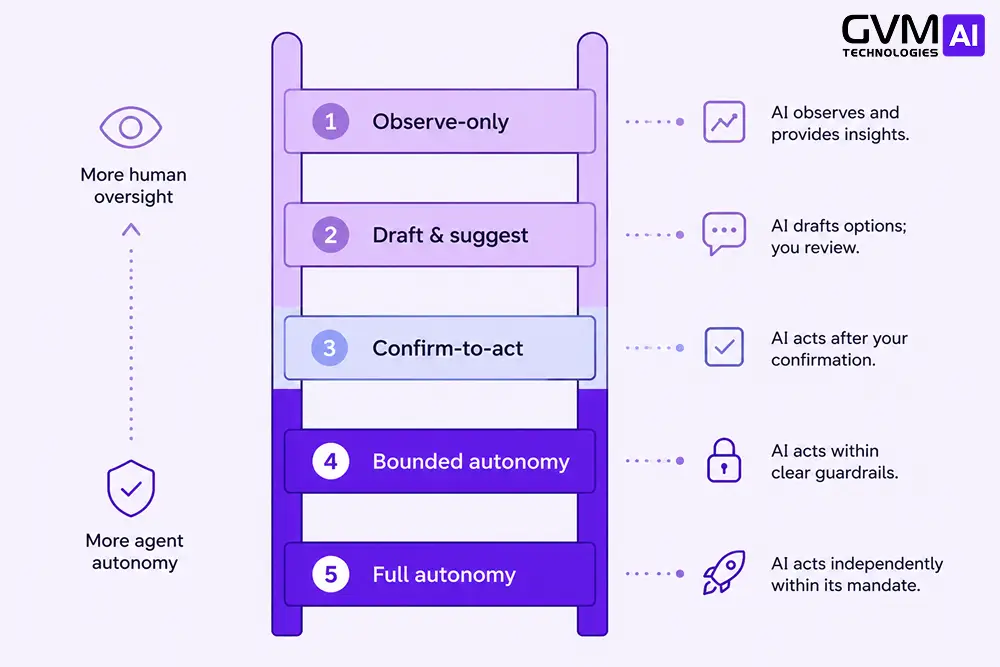
People decide that, deliberately, by watching the agent work and choosing how much rope to give it next. The Agent Oversight Ladder ties what a team learns to how reversible the agent’s actions are.
It’s the same blast-radius logic our AI agent readiness checklist uses to scope a workflow before launch, applied here to what a human needs to know at each stage.
| Rung | What the Agent Can Do | What the Team Trains For |
|---|---|---|
| 1. Observe-only | Reads data, drafts nothing, acts on nothing | Reading agent logs; recognizing normal output |
| 2. Draft and suggest | Prepares a reply or record change; a human sends it | Fast, structured review: what to check first |
| 3. Confirm-to-act | Executes after one explicit approval per action | Deciding quickly without rubber-stamping |
| 4. Bounded autonomy | Acts on its own inside a narrow, reversible scope | Monitoring dashboards, escalation triggers, the kill switch |
| 5. Full autonomy | Acts independently, review happens in aggregate | Auditing patterns over time, not single errors |
No team should train for Rung 5 in week one. Most workflows have no business reaching it.
Each rung teaches a distinct, learnable skill. Skipping one is exactly how a confidently wrong output reaches a customer before anyone reviews it.
New hires need someone to shadow at every rung. A new employee learning Rung 3 should watch someone already fluent there, the same way they’d shadow a colleague on any other system.
Building the Training Program: A 7-Step Process
1. Map the Real Workflow Before Writing a Single Slide
Training built around “how AI works” instead of “how this ticket gets handled” produces people who freeze the first time the agent does something unexpected.
Sit with two or three people who currently do the task by hand. Write down every step, including the ones nobody’s written down before.
That list becomes the curriculum. It’s also the starting draft of what the agent needs to know, which matters again in Step 5.
2. Split the Room Into Three Tiers, Not One
A single all-hands session teaches the median person in the room and almost nobody else well.
Split training by the role each person actually holds:
- Operators direct the agent daily inside their own workflow and flag anything that looks off.
- Reviewers, usually senior staff, approve higher-stakes actions and learn the specific failure patterns for that workflow, not AI risk in general.
- Workflow Owners are the named, accountable person who reads the override and error trends and decides when the team moves up or down the ladder.
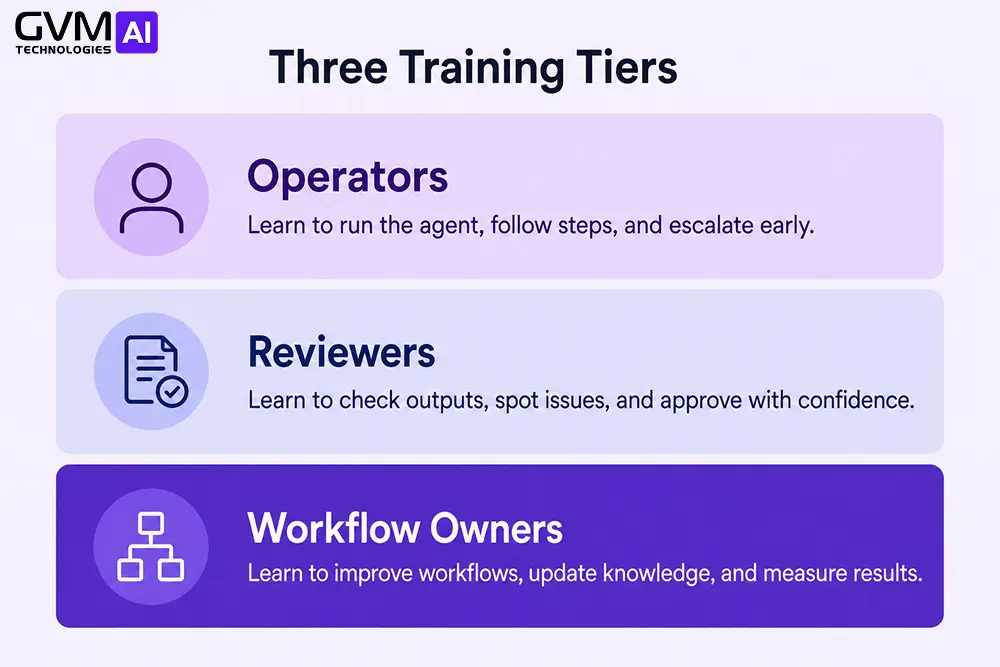
Three short, role-specific sessions consistently beat one long session covering all three. Reviewers are the backstop, and a backstop trained identically to the front line catches nothing extra.
3. Teach Verification, Not Just Prompting
This is the step most training programs skip, and the one that actually prevents damage.
An agent wrong 10% of the time isn’t the real risk. One that sounds equally confident on the wrong 10% as the right 90% is.
Tone gives no signal about which output needs a second look.
That’s the practical line between a system that merely automates steps and one that exercises judgment, the same distinction our guide to AI agents versus no-code automation draws when scoping a workflow.
Train Reviewers on failure patterns specific to their own workflow, not generic warnings:
- A number that’s suspiciously round, or doesn’t match a source document anyone can point to
- A confident answer to a question the agent had no real way to know
- An action that matches the instruction technically but misses what the person clearly meant
- Output that’s internally consistent but doesn’t match what five minutes of human context would conclude
Automation bias gets worse the longer an agent runs error-free. Track a live override rate, and adjust autonomy against that number, not how the agent “feels” to work with.
A team that hasn’t caught a bad output in three weeks isn’t ready for more autonomy. It’s overdue for one.
4. Train People to Verify Data Freshness, Not Just Output Quality
A stale cache sounds exactly as confident as live data, and almost nobody trains reviewers to ask which one they’re looking at.
Teach two checks before trusting a number: where it came from, and when that source was last updated.
A three-week-old CRM export presented with this morning’s confidence is a training gap, not a model failure.
This single habit catches quiet errors that prompting skill never will. It’s the same discipline behind spotting shadow AI in the workplace: an agent pulling from an unmonitored source is a governance problem first.
5. Build the Knowledge Capture Loop
Every workflow runs on rules nobody wrote down. “This client gets a call, not an email.” That knowledge lives in a handful of heads until someone tells the agent, once, in a reusable form.
The loop runs in five steps:
- Notice. The agent hits a gap and either guesses or asks.
- Route. The question goes to the person who actually knows, not whoever’s online.
- Draft. The answer gets captured, tagged with who provided it and when.
- Approve. A second person signs off before it becomes a standing rule. One person’s preference isn’t policy yet.
- Publish. It goes live with a source and gets reused, so the same gap never gets answered from scratch twice.
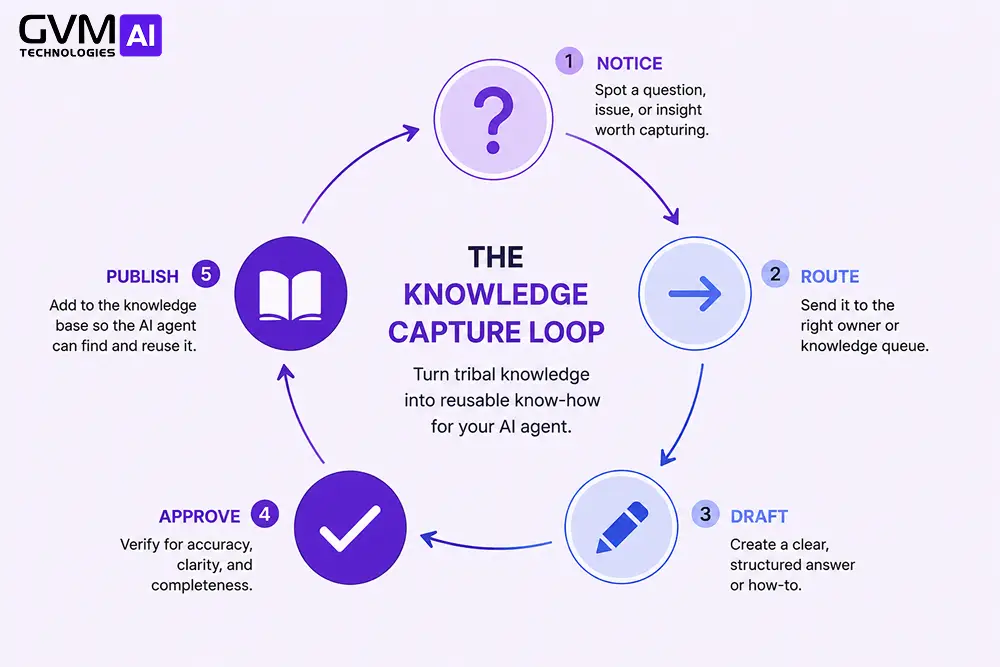
Skip step four and one hasty answer becomes a rule the agent trusts forever, wrong department or just wrong.
This is also where the difference between RAG and fine-tuning decides how captured knowledge gets built in, since how an agent handles memory and context determines whether it sticks between sessions.
6. Sort Captured Knowledge Into Facts, Rules, and Exceptions
Not every entry deserves the same treatment, and lumping them together creates quiet confusion:
- Facts are sourced and stable, like a pricing table or policy document.
- Rules need an owner, a version, and an effective date, because they change.
- Exceptions are the dangerous middle ground: “this client always gets a call first” looks like policy but is really a local override.
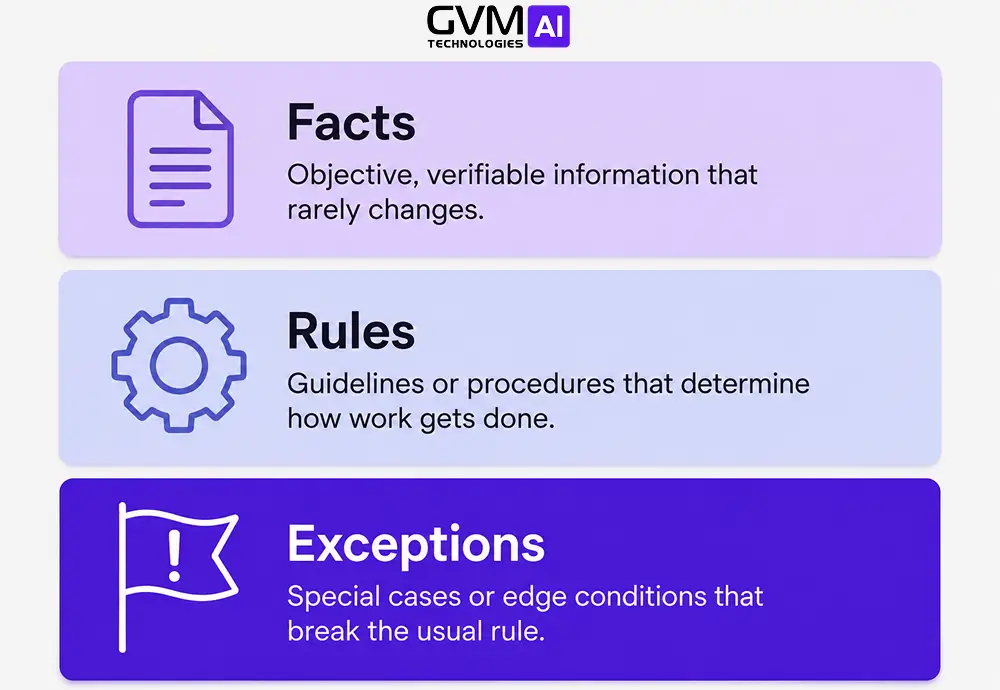
Train Workflow Owners to name which of the three a new entry actually is before it gets approved.
Treating an exception as a blanket rule is how an agent starts applying one person’s preference to everyone.
7. Run the First Cohort Through a Live Workflow, Not a Slide Deck
A live walkthrough of one real ticket teaches more in thirty minutes than an hour of documentation. People remember a mistake they watched get corrected far better than a bullet point describing it.
Aviation figured this out decades before software did. Simulator training built pilots’ judgment of when to override the autopilot, not just how to fly.
Agent oversight training works the same way. The skill is recognizing, in the moment, when this specific output needs a human to step in.
Measuring Training Success With Leading Indicators, Not Attendance
A completion certificate proves someone sat through a session. It proves nothing about whether they can catch a bad output at four on a Friday.
| Metric | What It Actually Tells You |
|---|---|
| Override rate | How often a human corrects the agent; falling steadily means training is working |
| Repeat-correction rate | Whether the same mistake keeps recurring, a sign the knowledge loop isn’t running |
| Escalation time | How fast a Reviewer flags a real problem |
| Time-to-independent-use | How long until someone runs the agent unsupervised on a real task |
| Confidence-vs-accuracy gap | Whether Reviewers catch output scored high-confidence but wrong |
An override rate that never drops isn’t automatically a training failure. It may mean the workflow was scoped too broadly, a problem the readiness checklist catches earlier.
An override rate that’s never measured, though, is always a training failure. Nobody can tell the two problems apart.
Seven Mistakes That Undo Otherwise Good Training
- Stopping at prompting. A team that writes great prompts but was never taught to verify output is trained on the easy 80% of the job.
- One session for every role. Operators, Reviewers, and Workflow Owners need different training, not the same deck for everyone.
- No path from trained to trusted. Without the Oversight Ladder, autonomy either never expands or expands on a launch date, not a track record.
- Treating knowledge capture as someone else’s job. If nobody owns Step 4 of the loop, fixes get shared once and never re-enter the system.
- No named escalation owner. A real problem needs one specific person to reach, not a general channel that turns urgent into eventually.
- Measuring completion instead of competence. A 100% completion rate next to a flat override rate means the training didn’t teach what it needed to.
- Skipping the freshness check. A team never taught to ask “how current is this” trusts stale data as much as live data.
What Training Actually Costs and How Long It Takes
There’s no single number, but a pattern shows up across well-run programs.
| Phase | Typical Length | What’s Happening |
|---|---|---|
| Workflow mapping and curriculum build | 1–2 weeks | Document the real workflow; write role-specific training |
| Tiered training delivery | 3–5 days | Separate sessions for Operators, Reviewers, Workflow Owners |
| Live pilot at Rung 2–3 | 2–4 weeks | Small group, real workflow, override rate tracked from day one |
| Moving up the ladder | Ongoing | Autonomy expands only when the metrics support it |
Vendor research from Iternal puts the financial case in perspective:
- Trained employees run roughly 2.7 times more proficient than self-taught peers.
- Adopters report meaningful weekly time savings per employee once a program is running.
Treat vendor ROI figures like these as directional, not gospel. Validate them against your own override-rate data first.
Budgeting is less about a line item and more about who’s qualified to build it. An internal AI lead can usually run the first three steps alone.
The knowledge capture loop and its measurement discipline are where internal teams run out of bandwidth, often the deciding factor in the AI agency versus in-house AI team decision.
A New Regulatory Reason to Get This Right in 2026
Most training guides frame oversight as good practice. It’s becoming a legal expectation, and the rules just shifted.
Colorado’s original AI Act would have required formal risk-management programs for high-risk AI. Governor Polis signed a full rewrite, SB 26-189, in May 2026.
What changed, in short:
- The paperwork-heavy risk-management program and annual impact assessments are gone.
- In their place: proof of “meaningful human review” before a consequential decision reaches someone.
- The new standard takes effect January 2027.
That’s not a training mandate on paper. In practice, it’s exactly what a documented Oversight Ladder demonstrates: a Reviewer who actually checked a high-stakes action, with a tracked override rate and an escalation trail.
This matters most for workflows touching consequential decisions or sensitive records, the category our guide to giving an AI agent access to customer data covers from the governance side.
Signs Your Team Is Ready to Move Up the Oversight Ladder
Run this checklist before expanding an agent’s autonomy, not after something goes wrong.
- Has the override rate trended down for two consecutive reporting periods?
- Can every Reviewer name the failure patterns for this exact workflow, not AI risk in general?
- Does the knowledge loop have at least one entry that came from a caught mistake?
- Is there a named Workflow Owner reviewing the metrics, not just whoever configured the agent?
- Has the team run one full live pilot cycle at the current rung?
Two or more “no” answers means another cycle at the current rung.
As agent use scales past one workflow, the same discipline has to hold across a single agent versus a coordinated multi-agent system, where oversight gaps compound faster.
FAQs
1. How is training a team for an AI agent different from general AI training?
General AI training teaches literacy and prompting. Agent training adds two skills literacy skips: catching confidently wrong output, and feeding the agent institutional knowledge it lacks.
2. How long does it take to train a team to work alongside an AI agent?
One to two weeks to build the curriculum, a few days for tiered delivery, and two to four weeks of live pilot oversight. Expanding further depends on metrics, not the calendar.
3. Who should be trained first: everyone, or just the daily users?
Start with Operators and the Reviewers approving higher-stakes actions. Company-wide AI literacy is worth doing eventually, but it doesn’t replace workflow-specific oversight training.
4. What’s the single biggest skill gap in most AI agent training?
Verification. Most programs teach people to direct the agent and stop, skipping the harder skill of recognizing output that sounds right and isn’t.
5. How do we know if our training actually worked?
Track override rate and repeat-correction rate over time. A completion certificate says someone attended; a falling override rate says they can do the job.
6. Should every employee learn to use the AI agent, or only specific roles?
Role-based training beats company-wide training here. General AI literacy suits everyone; oversight training is for people who’ll actually supervise output.
7. What is the Agent Oversight Ladder?
A five-rung framework, from observe-only to full autonomy, tying what a team is trained on to how reversible the agent’s actions are at that stage.
8. How do we capture the unwritten rules an AI agent needs to know?
Route gaps to the person who knows, capture the answer as a draft, get a second approval, then publish it with a source.
9. Does this training replace the AI agent rollout plan, or come after it?
It runs alongside it. The rollout guide covers earning trust at launch; this guide covers the curriculum once rollout is underway.
10. What happens if a company skips oversight training and just launches the agent?
The agent likely still works, some of the time. What’s missing is a team that can tell a good result from a confidently wrong one.
11. Does new AI regulation actually require this kind of training?
Not directly, but the direction is clear. Colorado’s rewritten law requires “meaningful human review” from January 2027, and a documented Oversight Ladder is the clearest way to prove it.
The Bottom Line
Most AI training teaches one skill: how to ask the agent for something. That’s necessary and nowhere near sufficient once the agent acts on its own.
The programs that hold up teach three skills, split by role, and tie autonomy to evidence instead of a launch date:
- Direction, so the agent gets enough context to act correctly.
- Verification, so a confidently wrong output gets caught before it reaches a customer.
- Knowledge capture, so the same gap never gets answered from scratch twice.
That takes longer to build than a one-hour demo. It’s also the version still working six months later, when the team has barely noticed the agent move from Rung 2 to Rung 4.
Build a Training Program Your Team Will Actually Use
Writing a curriculum outline is the easy part. Building the oversight ladder, the knowledge capture loop, and the metrics behind them, on your actual workflows, is where most internal efforts stall.
GVM Technologies AI builds AI agent training around the specific workflow being automated, with role-based curricula and a measurement plan in place before autonomy expands.
Our customer outreach agent case study shows a trained, phased handoff running in production, not on a whiteboard.
Talk to our team about the workflow you’re training people around. No pitch, just an honest read on which tier of training your team needs first.