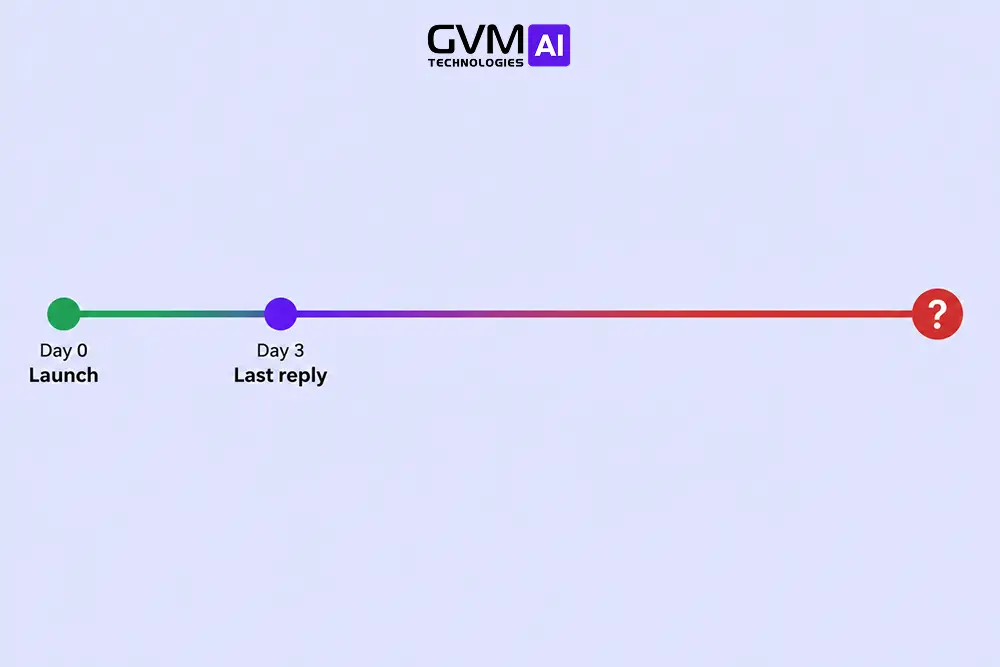
An AI vendor usually goes silent after launch because the invoice cleared and the incentive to answer you moved with it.
The team that built and demoed your system was never assigned to run it. Post-launch AI support was never anyone’s actual job.
You are not imagining the silence. The ticket you filed after a model update broke a workflow that worked yesterday is still sitting untouched.
This is an accountability gap, not a technical one.
Quick answer: These AI vendor red flags separate a busy team from one that has checked out. Check the 7 signs below, then run the 4-step escalation ladder in order.
Key takeaways
- Post-launch silence is usually a staffing and incentive problem, not proof of a scam.
- These AI vendor red flags separate a slow week from a vendor that has checked out for good.
- A ticket number and a named engineer move a stuck request faster than a 4th follow-up email.
- Builder.ai’s 2025 collapse left hundreds of small-business clients with half-built apps and no refund path.
- 74% of enterprise leaders say losing their primary AI vendor would disrupt operations, per Zapier’s 2026 survey of 542 US executives.
Why AI vendors ghost you the moment the invoice clears
Most AI agencies staff for the build, not the years after it.
Once your chatbot, voice agent, or automation ships, the people who understood it best get reassigned to the next signed deal.
Vendor onboarding gets a full project team. The months after launch get whoever happens to be free.
Gartner projects over 40% of agentic AI projects will be canceled by 2027. A missing ownership plan is a common reason.
| Structural cause | Why it happens | What it means for you |
|---|---|---|
| The build team’s bonus ends at go-live | Engineers are measured on shipping, not on running | Your ticket competes with a new sale for the same attention |
| Nobody owns the account after handoff | Sales closed it, engineering built it, support inherited it | 3 people can plausibly blame each other, so nobody fixes it |
| Support was never priced into the contract | Most AI contracts quote build hours, not a response window | “Support included” with no number is not a commitment |
In practice: agencies track utilization rate, the share of billable hours logged against paid work. A free ticket drags that number down; a renewal call does not.
That single metric, more than any bad intent, explains most vendor silence.
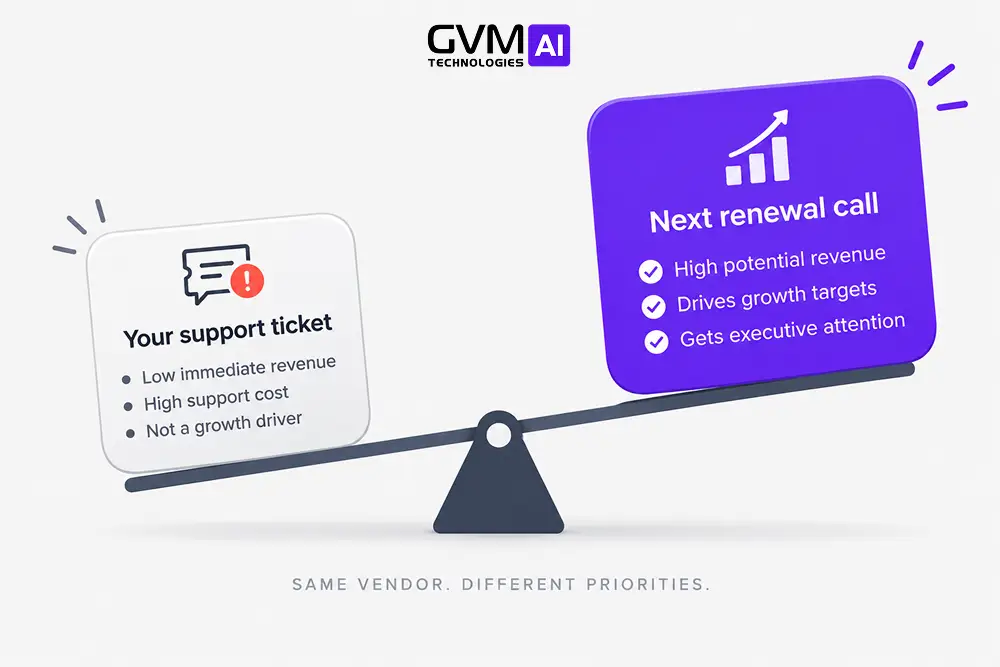
An AI automation agency that never quotes a maintenance line item is telling you the gap already exists, before you even sign.
Real AI vendor accountability starts with pricing the after, not just the build.
The 7 AI vendor red flags no one warns you about
Not every slow reply is abandonment. These 7 behaviors, though, do not resolve on their own.
| Red flag | What’s really happening | What it costs you |
|---|---|---|
| No confirmation a ticket was received | The request landed in a shared inbox nobody triages | You cannot prove you reported it once it escalates |
| The vendor blames your data, every time | No process separates a data issue from a model issue | Weeks lost re-uploading files that were never the problem |
| No answer for “what happens when the AI is wrong” | No monitoring or escalation path exists for bad outputs | Wrong answers reach customers with nobody catching them |
| The model or pipeline changed with zero notice | Nobody owns communicating updates to clients | A workflow that worked Monday breaks Tuesday, silently |
| Dashboards say it’s fine, your team says otherwise | Metrics track volume and containment, not real outcomes | You keep “fixing” a problem the reports say doesn’t exist |
| Your contact changed and nobody told you | Staff turnover with no account handoff process | You start over explaining context to a stranger |
| Every fix is billed as a brand-new project | No maintenance tier exists between “free” and “rebuild” | A 20-minute prompt fix gets quoted like a new feature |
1. No confirmation a ticket was even received
A silent inbox is different from a slow one. If nothing acknowledges your request within a day, the request may not be triaged by anyone at all.
- Ask for an auto-reply with a ticket number as a baseline test.
- No ticket number after asking twice means no real tracking system exists.
2. The model or pipeline changed with zero notice
A vendor that swaps the model or adjusts retrieval without telling active clients is treating your production system like an internal experiment.
In practice: OpenAI’s own deprecation policy commits to at least 6 months’ notice for a generally available model. That is the real-world benchmark.
If your vendor cannot match a fraction of that in writing, ask why.
3. Dashboards say it’s fine, your team says otherwise
A conversation that ends because a customer gave up looks identical, on a dashboard, to one that ended because the problem got solved.
- Ask for the repeat-contact rate on the same issue within 7 days, not just the resolution count.
- One number exposes a quiet failure a deflection chart hides.
4. Your contact changed and nobody told you
A new name replying with zero handoff means the previous owner left no notes. You are re-explaining context that already existed once.
5. Every fix is billed as a brand-new project
Billing every request as new scope is easier for a vendor than defining what ongoing support actually includes. That missing middle tier is itself the warning sign.
Where your vendor actually stands: run these 2 quick tests
A slow first week is common. A pattern that never settles is not.
These 2 tests separate a normal lull from real AI vendor red flags in about 2 minutes.
Test 1: Normal lull or a real red flag?
| Signal | Normal lull | Real red flag |
|---|---|---|
| First response | Same-day acknowledgment, even if the fix is slower | Nothing after 3+ business days |
| Who replies | A named person | A generic address, or nobody |
| 30-day pattern | Response times improve | Response times get worse |
Test 2: Your vendor’s support maturity tier
| Tier | What it looks like | What to do |
|---|---|---|
| 0: No plan | No SLA, no named contact, silence is the default | Escalate immediately, in writing |
| 1: Reactive | Answers only when you chase, no proactive checks | Push for a written response window |
| 2: Defined | An SLA exists and mostly gets honored | Cite the clause the moment it slips |
| 3: Proactive | Vendor flags issues before you notice them | Rare. This is what to hold out for |
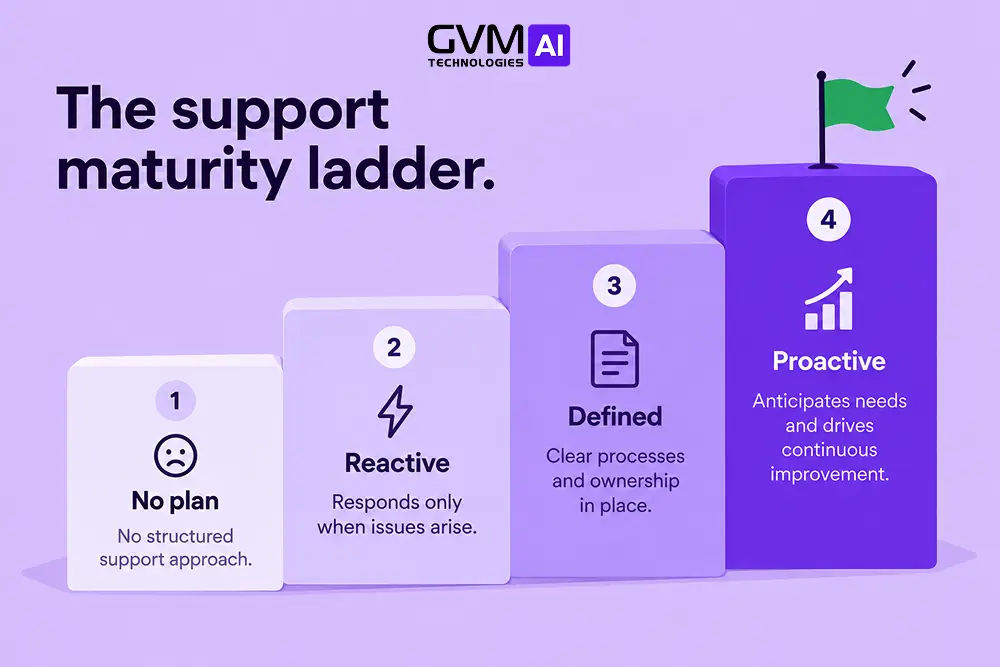
What healthy support actually looks like, not just red flags to avoid
Most vendor-evaluation content only lists warning signs. Here is the positive version, so you know what to hold a good relationship to.
| Timeframe | A healthy vendor | A vendor already checked out |
|---|---|---|
| Day 1-7 | Named contact introduced, first check-in scheduled | Silence, or a generic “let us know if issues arise” |
| Day 30 | A proactive usage or accuracy report, unprompted | You are the one initiating every contact |
| Day 90 | A scheduled review of what to improve next | The relationship has gone fully reactive or dark |
The AI vendor escalation ladder: 4 steps that force a response
A generic “just checking in” email is the weakest tool available. It gives a busy customer support team nothing to act on.
1. Re-send with the exact ticket number and system name
Ask directly which system holds your request: Zendesk, Freshdesk, Intercom, Jira, or Linear. A vague follow-up is easy to skip. A ticket ID inside a named system is not.
2. Ask for the engineer by name, not the support queue
A generic support alias lets a request sit indefinitely. Asking who is assigned, in writing, forces someone to claim it or admit nobody has.
3. Cite the SLA clause and set a written deadline
Quote the clause number if one exists. If not, state your own deadline with a stated consequence, such as escalating to a named contact.
4. Loop in procurement or your original sales contact
The person who closed your deal has an incentive to protect the renewal. Copying them moves your ticket into a relationship the vendor does not want to lose.
- Build your evidence trail first. Save the ticket number, the exact timestamp, a screenshot of the broken output, and the name of everyone who has replied. This turns “they never answered” into something you can actually prove.
What to put in your next AI vendor contract
The best time to fix this is before you sign, not during a 3rd unanswered email.
| Contract clause | Plain-English translation | Why it matters |
|---|---|---|
| Response time by severity | “Critical bugs get a reply within X hours” | Turns “soon” into an enforceable number |
| Model-change notice | “You tell us before you swap or retrain the model” | Stops silent breakage from an update you never saw |
| Named contact after launch | “This person owns our account post-launch” | Removes the 3-people-none-own-it problem |
| Data and model portability | “We can export our data if we leave” | Prevents the Builder.ai scenario: stuck, no exit |
1. A model-change and pipeline-change notice clause
This single clause prevents most “it broke overnight” tickets. It costs the vendor nothing to promise and costs you everything when missing.
A named contact, a response window, and this clause from day 1 are exactly what GVM Technologies AI builds into every engagement.
2. A named point of contact after launch, not just “support@”
A phased rollout should name who owns each phase, including the one after launch. If a vendor cannot name that person during the sales call, they have not planned for it.
3. Response-time definitions by severity, in writing
“Support included” without a number is not a commitment. Ask for a specific window for a broken production system versus a minor cosmetic request.
4. Data and model portability if you ever need to leave
Ask exactly what you can export: conversation logs, your knowledge base, your prompts, your configuration. A vendor that hesitates is not planning for your success.
When to escalate harder and when to find a new partner
Not every silent vendor deserves a breakup. Some are understaffed but competent.
Signs the relationship is still fixable
The vendor responds within a day once escalated, admits the gap, and offers dates. A team that owns a failure is worth keeping.
Signs it’s time to move on
Escalation gets a vague apology with no timeline, or the same failure repeats. At that point, comparing an agency against building the capability in-house beats a 5th email.
Get a straight read on the AI system you already have
Every week of silence keeps costing you customers, staff hours, or both.
GVM Technologies AI reviews an existing build, whoever created it, and tells you exactly where it stands. No vague status update, just a direct read on:
- Whether the silence traces to a staffing gap or a structural one
- What’s actually breaking in the system right now, checkpoint by checkpoint
- Whether a maintenance handoff is realistic, or a rebuild is the honest answer
Book a free AI system review with GVM Technologies AI. No pitch, just a direct answer on where your system and your current vendor relationship stand.
FAQs
1. How long should I wait before assuming my AI vendor has gone silent?
3 business days with zero acknowledgment, not just zero fix, is the point to escalate.
2. Is it normal for an AI vendor to go quiet right after signing?
A short lull in week 1 is common. An AI vendor that went silent and stays worse at day 30 is not a normal lull.
3. What should an AI vendor SLA include for post-launch support?
Response times by severity, a named contact, a model-change notice clause, and defined data portability.
4. My AI vendor stopped responding. Can I still switch vendors?
Usually, though 58% of enterprises that tried switching in the Zapier survey said it failed or took far more effort than expected. Confirm exports first.
5. Is a slow AI vendor a scam, or just understaffed?
Most are understaffed. The FTC’s Operation AI Comply actions target vendors that misrepresented their AI, a rarer problem.
6. What do I do if my AI vendor changed the model without telling me?
Document the exact date output quality changed, ask if a model update occurred that day, and request a standing notice clause going forward.
7. Is this different from a standard AI vendor evaluation checklist?
Yes. A vendor evaluation checklist covers who to hire before you sign. This covers what to do once you already have an AI implementation live and support has gone quiet.
The bottom line
An AI vendor that goes silent after launch is usually a staffing and incentive gap, not proof of abandonment.
Test it against the AI vendor red flags above, then run the 4-step escalation ladder before you assume it is hopeless.
The real fix happens earlier: a contract naming a person, a response window, and a change-notice clause turns “I hope they answer” into something you can enforce.