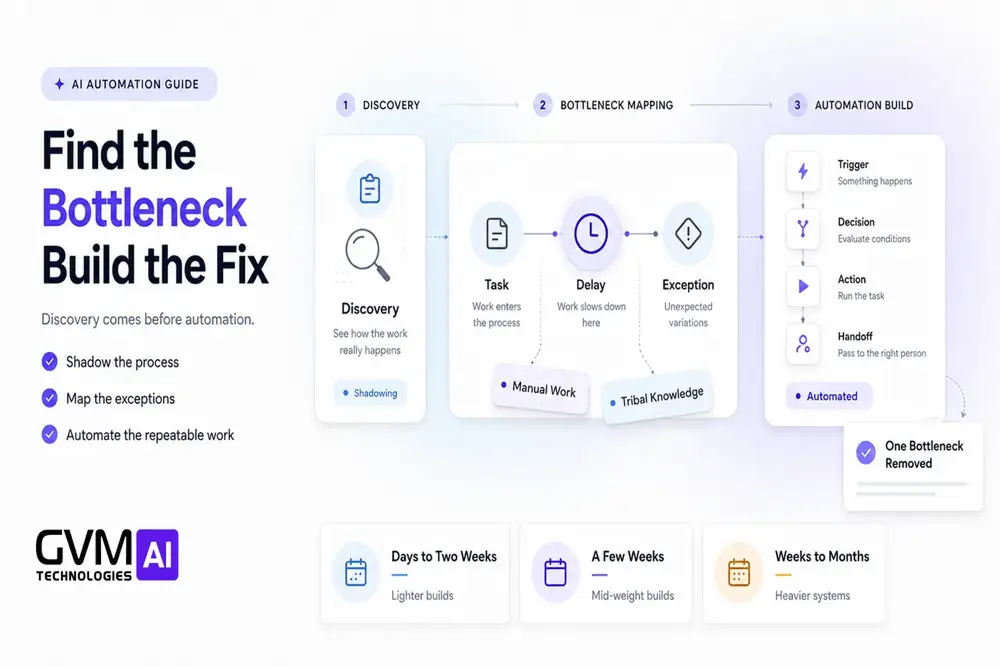
Quick answer: An AI automation agency studies how your business runs, then builds a system, usually workflow automation plus AI models, to remove manual work from one bottleneck. You need one when a repetitive task costs real hours or dollars weekly and nobody has time to build the fix.
Most buyers in this market overpay for a rebranded template. Or they get sold a system so undocumented they can’t leave the vendor.
Both problems trace back to one gap. Nobody told them what separates a real engagement from a reskinned one.
Key takeaways
- An AI automation agency diagnoses the bottleneck first, builds second. Skipping discovery means shipping a system that breaks on the first exception.
- 2026 pricing runs from $500 for one workflow to $100,000+ for a multi-agent system, plus a retainer.
- The task must be repetitive and rule-based. Forcing judgment-heavy work into automation backfires.
- McKinsey’s 2025 survey found 88% of organizations use AI. Only 39% see a measurable financial impact.
- A solo operator handles single-workflow builds well. Multi-department overhauls need a bigger team.
What is an AI automation agency, exactly?
An AI automation agency combines two things most businesses lack in-house. The technical skill to connect software and AI models.
And the patience to find exactly where a process breaks. Before anyone touches a single tool.
The output isn’t a chatbot bolted onto a website. It’s a working system.
A missed call gets a text reply in 90 seconds, not four hours. An invoice gets logged without anyone retyping numbers.
This is distinct from broader AI solutions for business automation, which cover strategy more generally.
It’s also distinct from buying a no-code tool yourself. The agency’s real value sits in the diagnosis, not the tool.
Why the term causes so much confusion
“AI automation agency” got flooded between 2022 and 2024. People watched a few tutorials and started cold-emailing business owners.
Two effects of that wave still show up today.
- Buyer trust is lower than the real work deserves. The market got crowded with people selling the idea of an agency, not running one.
- The label stopped meaning one thing. Some resell a $30-a-month widget for $500. Others run engagements that replace real payroll cost.
Same two words. Two very different services.
AI automation agency vs. RPA, in-house teams, and no-code tools
These terms overlap enough that people use them interchangeably. That overlap causes most of the confusion buyers run into.
| Model | What it actually is | Best fit |
|---|---|---|
| RPA (robotic process automation) | Scripted, rules-based automation, no language understanding | Repetitive digital tasks with zero variation |
| No-code automation tools | Pre-built connectors like Zapier, Make, or n8n you configure yourself | Teams with time to build their own flows |
| In-house AI team | Full-time hires who build automation as a core job | Steady, ongoing needs and salary budget |
| AI automation agency | An outside team that diagnoses, builds, and maintains custom systems | A specific bottleneck, no in-house bandwidth |
The last two rows usually come down to control versus speed. See our guide to choosing between an agency and an in-house AI team.
Most real engagements blend the first three approaches. RPA-style logic handles the predictable 80%.
An AI agent only steps in for the 20% needing judgment.
What AI automation agencies actually build
Marketing pages describe this work in abstractions. Here’s what shows up in real engagements, by effort level.
1. Lighter builds: days to two weeks
- Missed-call and after-hours text-back systems
- No-show reduction: confirmations, reminders, deposit handling
- Lead intake that books a qualified form fill onto a calendar
- Review-request automation after a completed job
2. Mid-weight builds: a few weeks
- Document intake reading invoices into a database
- CRM enrichment and lead scoring from multiple sources
- Support ticket triage: classify, draft, escalate only what needs a human
- Maintenance-request routing to the right contractor
3. Heavier, multi-agent systems: weeks to months
- Operational overhauls connecting inventory, orders, and reporting
- Multi-agent setups sharing one knowledge base
- Custom internal tools with audit trails and compliance handling
Underneath most of this sits an unglamorous stack. A workflow tool for the plumbing.
A real database instead of a spreadsheet. An AI model called only where judgment is genuinely needed.
Businesses that skip the database are usually the ones whose automation breaks. The first time a supplier sends a PDF instead of an email.
Industry context changes what “heavy” even means. Specialized applications for healthcare or finance carry compliance rules.
A retail lead-intake bot never touches those same rules.
4. What this looks like on a real engagement
Take a lead-intake build for a home services business. The brief on paper is one line: text back anyone who fills the form.
In practice, it only works once someone catches what that line never mentions.
A lead at 11pm gets flagged urgent, not queued. The owner said so on day three of discovery, not in the kickoff call.
A referral lead gets tagged differently than a paid-ad lead. The owner tracks ROI by source in a spreadsheet nobody mentioned.
None of that shows up until someone sits with the phone person for a day. That’s the entire case for discovery, in one example.
How the right fit changes by business size
A solo founder, a 20-person business, and an enterprise team aren’t shopping for the same thing.
| Business size | What they usually need first | Why |
|---|---|---|
| Solo founders, under 10 people | A single scoped workflow, not a platform | One person doing five jobs; the win is an hour back a day |
| Growing SMBs, 10–100 employees | A multi-workflow build across one or two departments | Enough volume for a real database; departments need to talk to each other |
| Enterprises, IT-heavy | A choice between agency and in-house team, not agency versus nothing | Depends on whether automation is permanent or a project with an end date |
Our resources hub breaks down real engagement examples across all three tiers.
The real reason most AI projects fail
The adoption-results gap: 88% of organizations use AI in at least one function. Only 39% see a measurable bottom-line effect. (McKinsey, State of AI, November 2025)
That gap is the single most important fact in this topic. Almost nobody explains why it happens.
Here’s the pattern among people who’ve run these engagements for years:
| Who’s describing the process | What they say |
|---|---|
| The manager, in the kickoff call | The process, the way it’s supposed to work |
| The employee, at 9pm on a Friday | What actually happens when three things go wrong at once |
That gap is where projects survive or quietly fail six weeks after launch.
It’s also why businesses that ask for “something simple” get burned. Simple is a story a business tells itself.
The real process is usually held together by tribal knowledge and one person who remembers all the exceptions.
The Discovery-First Method
Agencies that get this right follow a consistent shape, whether or not they name it.
- A kickoff call sets rough scope and identifies who actually performs the task day to day.
- One or two shadowing sessions, 30–45 minutes each, spread across a few days.
- The exceptions surface here: the supplier who sends a PDF instead of an email, the column nobody can explain.
- Scope gets confirmed with the decision-maker only after discovery.
Skipping step two is the single most common reason a first build fails on a case nobody mentioned.
Do you need one? The Automation Fit Score
Score your situation from 0 to 4 using these four questions. Be honest.
Weighing this against hiring in-house instead? Run these same four questions against our agency versus in-house comparison too.
- Can you name a task costing 5+ hours a week, or a real dollar figure in errors? (Yes = 1 point)
- Is the task mostly repeatable, with predictable exceptions? (Yes = 1 point)
- Can you budget a build fee and an ongoing retainer, not just a one-time cost? (Yes = 1 point)
- Can someone spend real time in discovery, not just one 30-minute call? (Yes = 1 point)
What your score means
Score of 4: Strong candidate for a custom engagement.
Score of 2 or 3: Start smaller. A single productized workflow is the safer entry point.
Score of 0 or 1: The ROI case isn’t there yet. Fix process clarity first.
What an AI automation agency costs in 2026
Most competing guides avoid publishing numbers. Here’s a realistic breakdown of current market pricing.
| Engagement type | Typical price | What’s included |
|---|---|---|
| Single scoped workflow | $500 – $3,000 | One automation, days to two weeks |
| Discovery / strategy engagement | $2,000 – $10,000 | Process audit and shadowing sessions |
| Multi-workflow custom build | $3,000 – $15,000 | Several connected workflows, one department |
| Multi-agent operational system | $15,000 – $100,000+ | Cross-department overhaul, custom tooling |
| Managed operations retainer | $150 – $5,000+/month | Ongoing monitoring and fixes |
A retainer isn’t optional in practice, even when marketed as self-managed. APIs change and prompts drift.
If a quote for genuinely custom work comes in far below these ranges, it’s likely a reused template.
Timeline at a glance
| Build tier | Discovery | Build | Total to launch |
|---|---|---|---|
| Single scoped workflow | 1–3 days | 2–10 days | Under 2 weeks |
| Multi-workflow custom build | 3–7 days | 2–4 weeks | 3–5 weeks |
| Multi-agent operational system | 1–2 weeks | 4–10 weeks | 6–12 weeks |
How the engagement actually works, start to finish
A well-run project follows roughly this shape, regardless of who runs it.
- Kickoff call, about 30 minutes: goals and identifying who actually does the work.
- Discovery and shadowing: the step most likely to get skipped, and the one that saves the most money.
- Scope confirmation with the decision-maker.
- Build: days for a single workflow, weeks for a multi-agent system.
- Demo against real data, not a sanitized test case.
- Handoff with a support runbook: what the client owns, what the agency owns.
- Ongoing maintenance through the retainer.
Skipping step six is the single most common cause of scope-creep disputes.
Clients discover the real cost of self-managed only once something breaks.
Providers focused on boosting service delivery with AI treat this handoff document as a core deliverable, not paperwork.
Green flags vs. red flags when evaluating an agency
| Green flag | Red flag |
|---|---|
| Asks to speak with the person doing the task daily | Quotes a price before understanding your process |
| Talks about outcomes over technology | Leads every pitch with “we do AI automation” |
| Provides a written support runbook at handoff | Vague or undefined support terms |
| Prices in line with market ranges | Prices far below market for complex work |
| Explains what happens if the system fails | No plan for failure scenarios |
What AI automation agencies won’t tell you upfront
Four mechanics shape this market that rarely make it into a sales call.
| Mechanic | What it looks like | What to ask before signing |
|---|---|---|
| Templates sold as custom builds | A private library of pre-built flows resold to every client, lightly reconfigured | “Have you built this exact workflow before?” |
| Token usage hiding in the retainer | Every AI model call costs money; usage swings hard with volume | “What happens if my call volume triples?” |
| Vendor lock-in via undocumented systems | A workflow only the agency can access, with logic nobody wrote down | “Who owns the files, and do I get documentation?” |
| First build scoped deliberately thin | A system that solves 70%, creating a natural “phase two” sale | “Was this narrowed for a reason, or for a second invoice?” |
None of these four are automatically dishonest. Each becomes a problem only when it’s priced as something other than what it is.
How to choose the right AI automation agency for your business
Run any shortlisted agency through this checklist before signing.
- Do they ask to shadow the actual operator, not just the manager?
- Do they name a measurable outcome instead of a generic pitch?
- Is their pricing in line with the ranges above, with a defined retainer?
- Do they explain their stack in plain terms?
- Can they point to prior work in your industry?
Businesses researching core AI solutions for their operations often map their biggest time-drain before talking to a vendor.
For infrastructure-heavy environments, decisions also intersect with AI’s role in IT infrastructure management.
Track record matters more than most buyers realize. Read about the team behind any agency, not just their case studies.
Common mistakes businesses make when hiring an AI automation agency
- Asking for “something simple.” Simple rarely stays simple once shadowing starts.
- Skipping discovery to save time. It costs far more time by week three.
- Treating the build fee as the total cost. Budget the retainer from day one.
- Choosing the cheapest bid for complex work. Rock-bottom pricing usually signals a reused template.
- Expecting the system to replace judgment, not just labor. It tends to fail quietly instead of obviously.
Two broader shifts are worth reading before you scope anything: how AI is transforming the IT industry, and how AI-driven analytics support decisions.
Both shape what “good” looks like for your specific industry.
Will AI replace AI automation agencies?
No, not entirely. The honest answer splits cleanly in two.
| What’s getting automated | What’s staying human |
|---|---|
| Assembling a workflow | Diagnosing what’s actually broken |
| Drafting the initial prompt logic | Getting a client to articulate real needs |
| Connecting tools and APIs | Managing change for the team adopting it |
| Routine monitoring | Answering the phone at 2am when it breaks |
Trust and diagnosis are harder to automate than the build step. They depend on a relationship, not a repeatable task.
Providers who only assemble workflows face real margin pressure as assembly commoditizes.
Ready to fix the bottleneck instead of just naming it?
If you scored 3 or 4 on the Automation Fit Score above, the next step isn’t more research.
Book a free consultation with GVM Technologies and walk through your bottleneck with a team that starts by shadowing the person doing the work.
You’ll leave with a clear scope and a real number, not a generic sales pitch.
FAQs
1. How much does an AI automation agency cost?
Single workflows run $500–$3,000. Multi-workflow builds run $3,000–$15,000. Multi-agent systems run $15,000–$100,000+, plus a monthly retainer.
2. How long does a project take?
A single workflow: days to two weeks. A multi-agent system: several weeks to a couple of months.
3. What tools do these agencies typically use?
Workflow platforms like n8n or Zapier. A real database instead of spreadsheets. An AI model API for language-heavy tasks. For IT-heavy setups, this overlaps with broader infrastructure decisions.
4. Is this the same as buying a no-code automation tool?
Not exactly. The value is the diagnosis and custom logic layered on top, not the tool itself.
5. What’s the biggest red flag when evaluating an agency?
Quoting a price before spending real time understanding your process.
6. Can a solo freelancer deliver this well?
Yes, for single-workflow and mid-weight builds. Capacity caps around three to five active projects before quality slips.
7. Does this replace my existing CRM or software?
No. A good engagement connects to what you already run, rather than replacing it.
8. Which industries benefit most from AI automation right now?
Service businesses with high lead volume, property management, and anything document-heavy see the fastest ROI. Regulated fields benefit too, though specialized applications there carry extra compliance work.
Conclusion
An AI automation agency is worth hiring when you can name a specific, repeatable bottleneck. And when you’re budgeting for real diagnosis, not just a build fee.
It’s not worth hiring yet if the work is mostly judgment. Get the diagnosis right, and the automation takes care of itself.
Still mapping which bottleneck to tackle first? Our core AI solutions overview is a reasonable next stop.