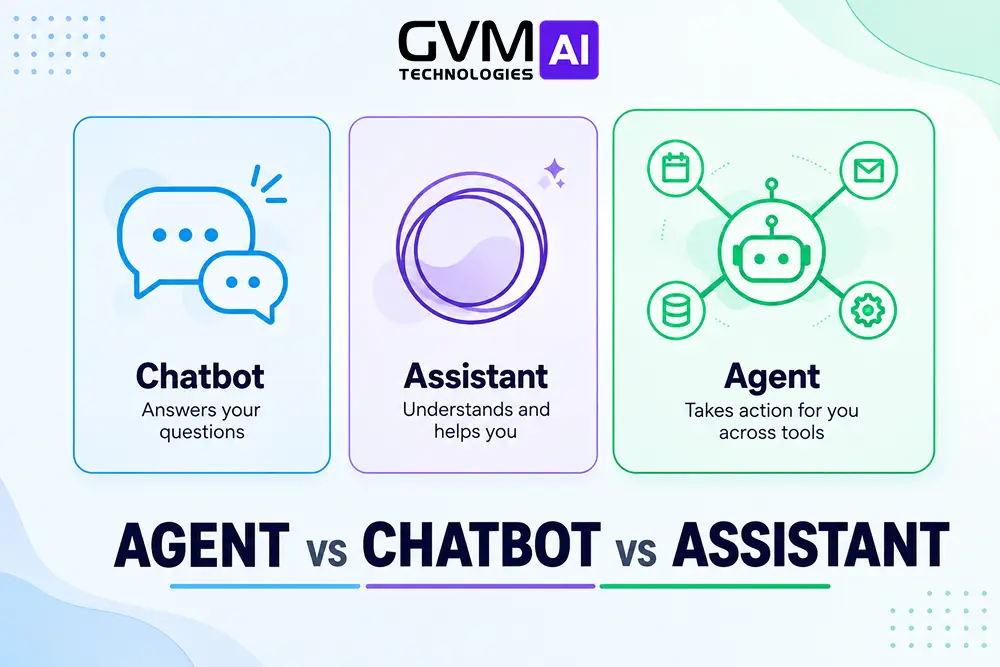
Quick answer: AI agent vs chatbot vs virtual assistant the real difference is who takes action. See the test that decides which one your business needs.the difference is autonomy. A chatbot answers and stops. A virtual assistant finishes one task, then goes quiet.
An AI agent chases a goal across systems until it’s done. Even active AI users mix these up constantly. Half of any large AI forum thread confuses “agent” with “a smarter chatbot.”
Our core AI solutions for business team sees the paid version of that mix-up weekly. A client buys a chatbot expecting CRM updates, or pays agent rates for one LLM call.
This guide draws the line before you sign a contract.
Key takeaways
- One test settles it: what happens after the first response? Waits for you: chatbot. Finishes one task, stops: virtual assistant. Tries something new on its own: AI agent.
- Gartner predicts chatbots stay the primary service channel for a quarter of organizations through 2027.
- The same firm projected conversational AI cuts contact center labor costs by $80 billion in 2026, this year.
- Gartner also forecasts 15% of work decisions run autonomously via agentic AI by 2028, with 33% of enterprise software carrying it.
- The same research warns over 40% of agentic AI projects get canceled by 2027 over cost or missing guardrails.
- “Virtual assistant” means two different things: a human VA to one buyer, an AI product like Siri to another.
- The EU AI Act’s Article 50 rule became enforceable on August 2, 2026, requiring AI disclosure to users.
- None of the three is obsolete. Most stacks run a chatbot for triage, an assistant for the channel, and an agent for the workflows that need one.
The core difference between AI agents, chatbots, and virtual assistants
A chatbot answers and hands control back. A virtual assistant finishes one task inside its own app, then goes idle. An AI agent gets an outcome, not a script.
It picks its own tools, order, and next move. That’s the same conversational AI foundation, just running at three different levels of independence.
1. The one-line definition of each system
- Chatbot: answers a message and stops there. No action outside the conversation.
- Virtual assistant: completes one task inside its own connected app. Holds some session memory.
- AI agent: calls tools across systems and decides its own next step. No human approves each move.
Most enterprise builds run the agent as a sense-think-act loop, grounded in a RAG knowledge base so decisions stay tied to real company data.
2. Why autonomy is the only dimension that matters
Memory, voice support, and natural language are features. Autonomy is the architecture underneath them.
A chatbot with great natural language and zero autonomy is still a chatbot. An “agent” with one tool is closer to a smart chatbot.
Judge by what decides the next step. Our AI agent vs. no-code automation guide runs this same test one layer deeper.
3. Why “virtual assistant” confuses buyers the most
This term carries two unrelated meanings, and most comparisons skip that entirely.
- A human VA: a remote person, hired through a staffing service, handling admin work like inbox triage and scheduling.
- An AI-powered assistant: a software product like Siri or Alexa, built to complete tasks inside its own ecosystem.
A business owner asking “AI agent vs. hiring a VA” wants a staffing answer. A developer asking the same three words wants an architecture answer.
The practical fix: audit the role for two weeks.
- Tasks that repeat identically belong to business process automation.
- Tasks needing judgment or negotiation still belong to a human.
The three-way comparison table for AI agents, chatbots, and virtual assistants
| Dimension | Chatbot | Virtual Assistant | AI Agent |
|---|---|---|---|
| Decides its own next step | No | Rarely | Yes |
| Acts across multiple systems | No, one channel | Within its own apps | Yes, by design |
| Memory across a session | Minimal | Moderate | Persistent |
| Typical trigger | A message | A direct command | A goal |
| Failure behavior | Hands off to a human | Asks for clarification | Retries or reroutes |
| Build complexity | Low | Moderate | High |
| Real-world example | Website FAQ bot | Siri, Alexa | GVM’s outreach agent |
| Best fit | High-volume, low-risk | Personal, single-app | Multi-step, cross-system |
1. Reading the table correctly
This isn’t a ranking from weak to strong. It’s three answers to three different problems.
A chatbot solving a chatbot-shaped problem beats an agent on the same task, every time, on cost and speed.
2. Where vendors blur these lines on purpose
“Agentic” sells better than “chatbot” right now. Plenty of products get relabeled without changing what runs underneath.
Our own guide to what an AI automation agency does exists to close that exact gap.
A single function call bolted onto a chat widget isn’t an agent because the pricing page says so. The test below settles it fast.
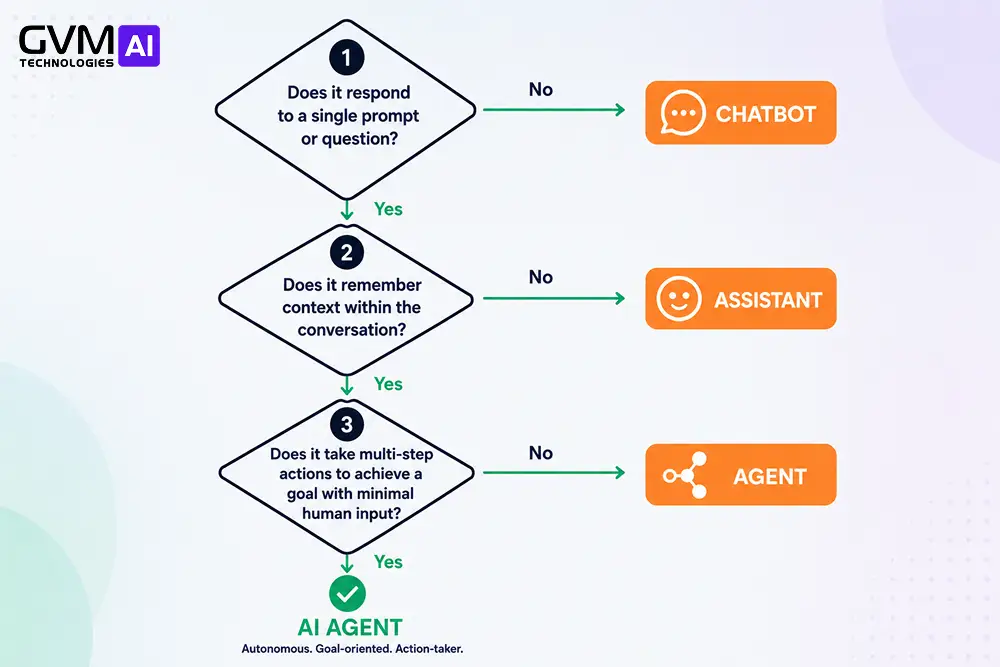
The three-question autonomy test that settles the debate
Engineers who build all three use this instead of arguing over definitions:
- Does it act without being asked? Chatbots never do. Assistants rarely do. Agents keep moving once given a goal.
- Does it cross system boundaries? Chatbots only talk. Assistants stay inside one app. Agents chain actions across several.
- What happens when step one fails? Chatbots hand off. Assistants ask for clarification. Agents try a different tool.
1. Applying the test in under a minute
Answer all three and you’ve placed the system, no matter what the pricing page calls it.
| Signal | Chatbot | Virtual Assistant | AI Agent |
|---|---|---|---|
| Acts unprompted | Never | Rarely | Routinely |
| Crosses systems | No | Own app only | Yes, several |
| Failed-step response | Hands off | Asks for help | Retries |
2. What the test does not tell you
The test places a system on the spectrum. It doesn’t say whether that autonomy level fits your task.
That’s a scoping call our specialized applications team makes before writing code. The five-question framework below gives you your own version.
The autonomy spectrum score from zero to four
Score any system 0 to 4 instead of forcing it into one box.
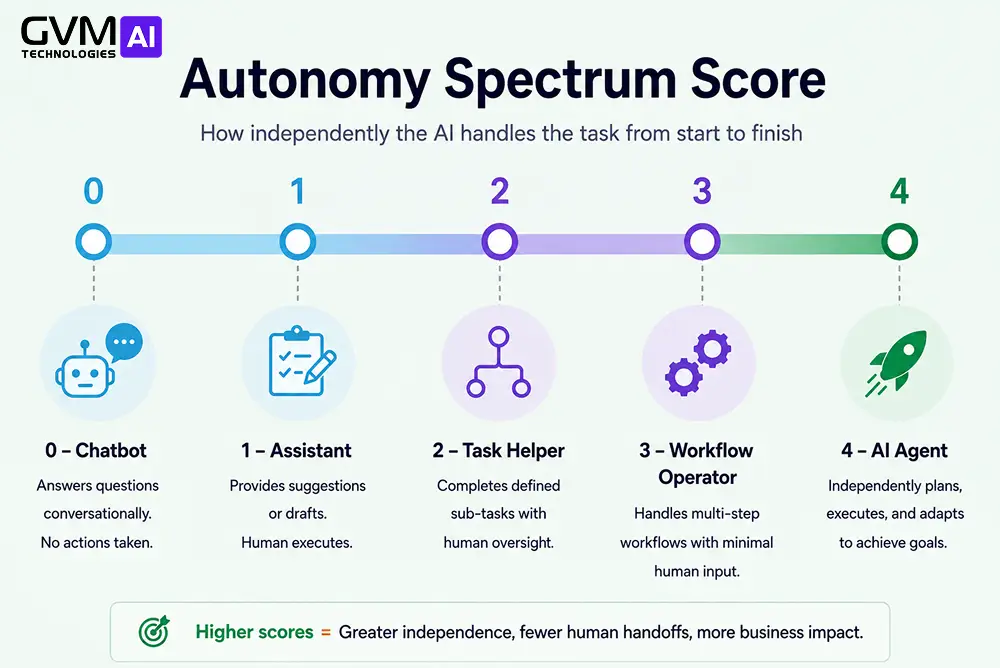
| Score | System type | What it does |
|---|---|---|
| 0 | Rule-based chatbot | Matches keywords to scripted replies |
| 1 | LLM-powered chatbot | Answers from a knowledge base, one reply per turn |
| 2 | AI virtual assistant | Holds context, completes single tasks |
| 3 | Single-action agent | Executes one multi-step task across systems |
| 4 | Multi-step agent | Chains tools, adapts, escalates on low confidence |
1. Scoring real products
- Siri and Alexa typically score a 2.
- A knowledge-base support widget scores a 1.
- A system that checks order data and issues a refund in one pass scores a 3 or 4.
2. Why most demos show you a level-two system
Most vendor demos show a Score 1 or 2 system, marketed with Score 4 language.
Bolting on more “agents,” as our single agent vs. multi-agent guide covers, doesn’t raise the score either.
The three-question test catches that gap before signing, not after.
The chatbot-wearing-a-costume problem
Plenty of systems labeled “AI agents” are one LLM call with one function attached. Check inventory, then answer. Nothing about the next move was decided by the system.
This isn’t only a vendor problem. Regular users hit the same confusion on the consumer side.
Two versions of the same mix-up:
- Vendor side: a chat widget with one API call gets sold as an “agent.”
- Consumer side: a chat model’s “browse” toggle feels autonomous, but it’s still one thread answering one prompt.
A real agent doesn’t wait for your next message. It keeps working across your calendar, inbox, and CRM in the same run.
1. How to spot a chatbot marketed as an agent
Ask who decided the tool order: the system, or whoever built the workflow?
A five-node flow with one AI step is automation using a language model. Our AI agent vs. no-code automation guide covers this distinction in depth.
2. Why this confusion costs real money
Teams that buy “agent-level” promises get a scripted flow instead. They find out when a request breaks every pre-built branch.
The same gap resurfaces in single agent vs. multi-agent systems: adding “agents” to a pipeline adds coordination overhead, not autonomy.
Where each system actually wins in production
None of the three is a worse version of the others. Each fits a different shape of problem.
1. Where a chatbot wins
- High volume, low stakes: FAQs, order status, store hours.
- Speed and cost: live in days, a few hundred dollars a month.
- Predictability: the same question always gets the same answer.
2. Where a virtual assistant wins
- Personal productivity: reminders, quick lookups, device control.
- Natural interaction: one voice command beats five app taps.
- Session memory: it remembers what you just asked.
3. Where an AI agent wins
- Cross-system workflows: qualifying a lead, updating a CRM stage, and booking a call in one pass.
- Shape-shifting tasks: support triage where the next step depends on the last result.
- Auditable judgment: decisions that need to be explainable after the fact.
See this in a live account: our case study on GVM AI’s email and CRM solution shows the agent’s next move shift per contact.
Common misconceptions about AI agents, chatbots, and virtual assistants
None of these five claims survive contact with how the systems actually behave.
1. Misconceptions about chatbots and virtual assistants
- “GPT or Claude inside it means it’s an agent.” Wrong. That’s generative AI in a chat, not autonomy.
- “Memory means it’s an agent.” Wrong. Plenty of chatbots retain history. Unprompted action is the real signal.
- “Voice interface means virtual assistant.” Wrong. Task completion in a connected app is the real feature.
2. Misconceptions about AI agents specifically
- “Agents will replace chatbots.” Gartner’s own numbers disagree: a quarter of organizations still lean on chatbots through 2027.
- “More autonomy always wins.” Gartner’s 40% project-cancellation warning says otherwise.
Cost, build complexity, and maintenance compared
The real gap between these systems shows up in the invoice, not the demo.
A basic chatbot often costs a few thousand dollars upfront, plus a few hundred a month. A single AI agent workflow often starts where that chatbot’s annual cost ends.
| Cost factor | Chatbot | Virtual Assistant | AI Agent |
|---|---|---|---|
| Setup cost | $0 to a few thousand | Usually bundled in | $40K to $180K fixed-scope, or $500 to $100K+ |
| Ongoing cost | Flat SaaS fee | Usually included | Variable, tied to steps taken |
| Who maintains it | Support or ops | Platform vendor | An engineer who reads model behavior |
| What breaks it | A stale FAQ entry | A platform update | A model update or unguarded retry loop |
| Audit burden | Low | Low to moderate | High |
What actually breaks each system
- Chatbots break when a FAQ entry goes stale.
- Agents break when a model update quietly shifts behavior nobody tested.
Budget agent maintenance as a variable line, closer to a utility bill than a subscription. That line should cover human-in-the-loop review too.
Our guide to AI agent access to customer data covers the security side of the same enterprise build.
A five-question framework to decide which one you need
Score each row 0 to 2. Higher totals lean toward more autonomy.
| Question | 0 | 1 | 2 |
|---|---|---|---|
| One answer, or several actions? | One answer | One app | Several systems |
| How often does the next step change? | Never | Sometimes | Often |
| Cost of a wrong output? | Low | Moderate | High |
| Who maintains it? | Non-technical ops | Vendor | An engineer |
| How fast do you need it? | Days | Already available | Weeks |
Reading your total
- 0 to 3: a chatbot covers it.
- 4 to 6: look at an AI assistant, or a narrow single-action agent.
- 7 to 10: the task is agent-shaped. Budget for a guardrailed build.
The hybrid model most production systems actually run
“Pick one” is exactly why teams overbuild or underbuild. Real stacks layer all three.
- A chatbot handles the front door, filtering routine questions before they reach anything costly.
- A virtual assistant owns the always-on channel, where one natural command should complete one task.
- An agent handles the workflows needing judgment, where the next step depends on what just happened.
This mirrors the decide-then-execute split in our AI agent vs. no-code automation guide: the agent decides, an auditable layer executes.
Neither simplicity nor autonomy needs to win outright. Most stacks need all three, at different points in the funnel.
Where this comparison is heading next
Two forces are reshaping this faster than the labels update.
1. Regulation now applies to all three categories
The EU AI Act’s Article 50 disclosure rule covers chatbots, assistants, and agents alike.
- Autonomy doesn’t exempt a system from disclosure.
- “Which category am I building” now matters less than “can I prove what it did.”
2. Two adoption curves, one timeline
Gartner’s own forecasts hold both facts true at once:
- 33% of enterprise software carries agentic AI by 2028.
- A quarter of organizations still run chatbots as their default channel through 2027.
Read together, that’s convergence into layered systems, not one category replacing another.
The bottom line
This isn’t a ranking from basic to advanced. It’s three answers to one question: how much of the next decision does the system make on its own?
A chatbot answers and stops. An assistant finishes a task, then goes quiet. An agent chases a goal until it’s done, or knows to ask for help.
Pick based on what the task needs, not which label sounds best in a sales deck.
Build the right one, not just the trending one
A template chatbot is often the right first move: fast, cheap, and quick to reveal what the task actually needs.
Teams get stuck one layer up, where the task needs to:
- Reason over a specific CRM’s validation rules.
- Act across WhatsApp, calendar, and CRM in one pass.
- Hand off to a human on low confidence.
- Produce an audit trail compliance will accept.
GVM Technologies AI builds exactly that layer, scoped to wherever your task sits on the spectrum: chatbot, assistant, or fully guardrailed agent.
Our specialized applications team scopes the build around your actual workflow, not a generic template.
If the test above put your task at a 3 or 4, talk to our team at GVM Technologies AI about a properly scoped build.
Read more on our about page, or browse the resource library for budgeting guidance.
FAQs
1. Is Siri or Alexa a chatbot or an AI agent?
Neither, strictly. They’re AI-powered virtual assistants. They complete single tasks inside their own ecosystem, but don’t chain actions across unrelated external systems.
2. Can a chatbot become an agent just by adding ChatGPT or Claude?
No. That improves how natural the replies sound. It’s agentic only once the system decides its own next action from a result.
3. What’s the difference between an AI virtual assistant and a human VA?
An AI assistant automates structured, repeatable tasks cheaply. A human VA handles judgment and relationship-sensitive work AI still can’t own. Most teams use both.
4. Do I need an AI agent, or is a chatbot enough?
Run the three-question test above. One repeatable question, one answer: a chatbot works. A next step that keeps changing: you need agent-level autonomy.
5. Are AI agents safe to give access to customer data?
Yes, with the right architecture: narrow read access, no independent external communication, human approval on writes. Our guide to AI agent access to customer data covers the controls.
6. Will AI agents eventually replace chatbots and virtual assistants?
Unlikely soon. Per the key takeaways above, Gartner has chatbot use and agentic adoption both rising on the same 2027-2028 timeline. That’s convergence, not replacement.