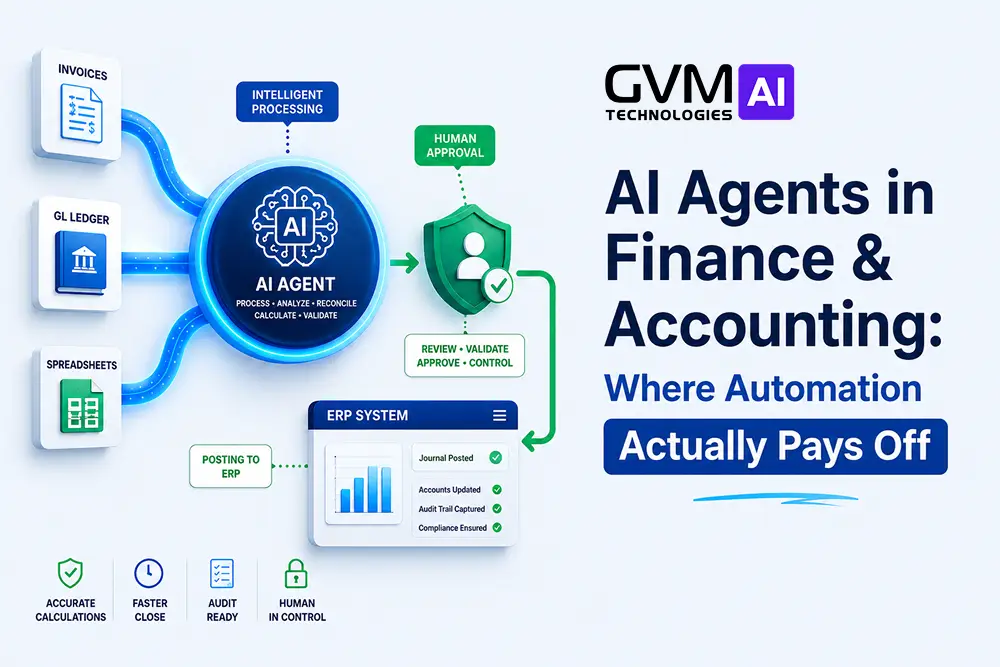
Quick answer: AI agents in finance and accounting deliver real ROI when restricted to data-heavy, investigative, and preparatory tasks (variance review, reconciliation exceptions, document parsing) while keeping humans strictly in the loop for decisions involving money movement, journal entries, and irreversibles. Discover how custom AI integration services enable finance teams to build safe, auditable automation.
Key Takeaways
- The Read-Prep-Decide Framework: Deploy AI agents exclusively for reading data and preparing evidence, but reserve all final financial approvals for humans.
- High-ROI Finance Workflows: Monthly close variance review, reconciliation exception triage, contract terms extraction, and audit fieldwork narratives offer immediate productivity gains.
- Determinism Over Generative AI: Rely on Python scripts or VBA macros for exact mathematical calculations. Use LLMs strictly for context aggregation and narrative drafting.
- Data Plumbing Drives Success: Clean ERP data structures, standardized APIs, and audit trails matter far more than model size or prompt complexity.
- Token Cost Safeguards: Running raw LLM calls over full general ledgers creates massive token bills and hallucination risks, which hybrid architecture solves.
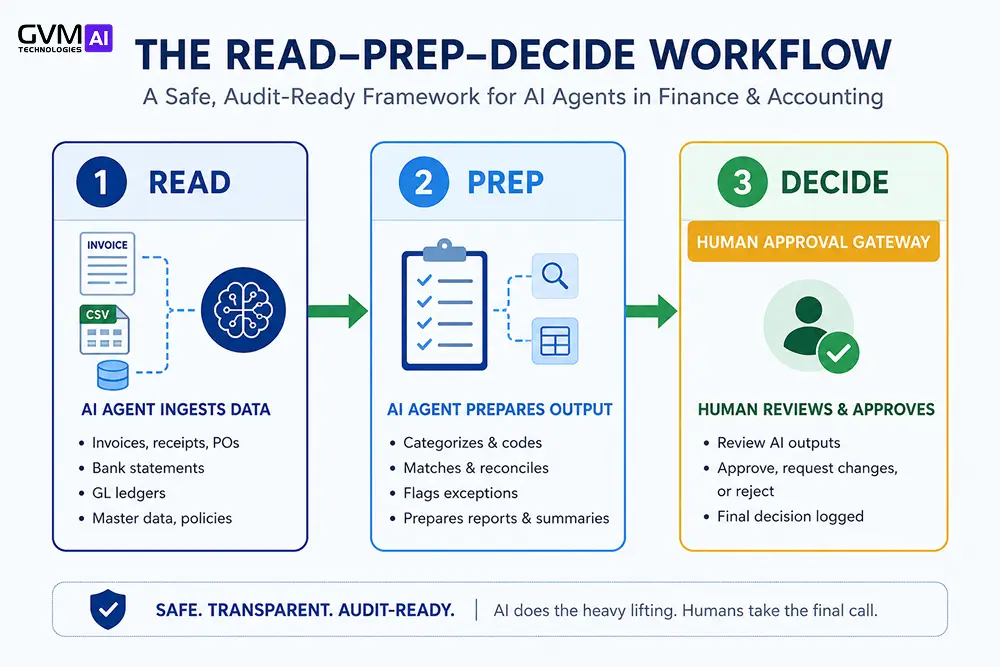
The Core Framework: The Read-Prep-Decide Layer
Finance executives routinely ask whether autonomous AI can replace accounting staff during month-end close.
The short answer is no. Generative AI is inherently probabilistic, whereas financial accounting demands absolute determinism.
When finance teams fail with AI, it is almost always because they handed decision-making authority over money movement to a probabilistic model.
To build automation that yields measurable ROI without compliance failures, every accounting process must be divided into three distinct operational layers.
| Workflow Layer | System Responsible | Primary Function | Financial Risk |
|---|---|---|---|
| 1. Read | AI Agent / ETL Pipeline | Ingest invoices, contracts, and ledger entries | Zero |
| 2. Prep | AI Agent / Python Script | Group variances, assemble audit trails, draft memos | Low |
| 3. Decide | Human Accountant | Post journal entries, execute wire payments, sign close | High |
At GVM Technologies AI, our core architectural standard separates the task from the operational layer.
Every financial workflow must be split into three explicit operational boundaries:
- 1. The Read Layer: AI agents fetch records, parse supplier contracts, read scanned PDFs, and ingest bank statements into clean tables.
- 2. The Prep Layer: AI agents query purchase orders, inventory logs, and emails to build diagnostic variance summaries when numbers shift.
- 3. The Decide Layer: Human accountants review drafted evidence, approve adjustments, post journal entries, and authorize wire payments.
+-----------------------------------------------------------------------+
|              THE READ-PREP-DECIDE FRAMEWORK IN FINANCE                |
+-----------------------------------------------------------------------+
|                                                                       |
|  [ READ LAYER ]  ====>  [ PREP LAYER ]  ====>  [ DECIDE LAYER ]       |
|  - Fetch Ledgers        - Group Mismatches     - Approve Adjustments  |
|  - Parse PDFs           - Draft Variance Notes - Post Journal Entries |
|  - Ingest Invoices      - Match Citations      - Authorize Wire Trans |
|                                                                       |
|  (AI Agent Scope)        (AI Agent Scope)       (HUMAN ONLY SCOPE)    |
+-----------------------------------------------------------------------+
4 High-ROI Finance and Accounting AI Workflows
Where do AI agents deliver tangible financial returns today?
Instead of attempting total close automation, successful firms focus on four data-heavy, labor-intensive tasks.
Finance teams utilizing specialized artificial intelligence solutions achieve massive time savings across these core operational areas.
1. Automated Variance Review and Driver Attribution
Month-end close variance review consumes dozens of hours as analysts search through files and email threads to explain why numbers moved.
- Primary Pain Point: Analysts spend 80% of variance review time hunting down transaction source documents across disparate folders.
- AI Agent Function: An AI agent continuously monitors general ledger balances, pulls supplier invoices, checks cost codes, and drafts a variance memo.
- Human Review Output: The controller receives a fully cited draft explanation in minutes, verifying the attribution before final sign-off.
In our financial software client engagements, we find that the largest productivity gap is not identifying that numbers moved, but discovering why they moved.
2. Reconciliation Exception Triaging
Bank reconciliations and subledger-to-GL matching are fundamentally deterministic tasks best handled by database scripts.
- Primary Pain Point: Unmatched exceptions like fee discrepancies, timing differences, or ambiguous vendor names stall the close queue.
- AI Agent Function: AI agents review unmatched items, fetch underlying documentation from billing tools, classify the mismatch type, and suggest checks.
- Human Review Output: If an invoice is off by $12.50 due to a wire fee, the agent flags the fee pattern and drafts the adjustment entry for supervisor sign-off.
3. Document Intake and Contract Extraction
Extracting key terms from legal agreements, lease documents, and complex supplier contracts requires substantial manual audit labor.
- Primary Pain Point: Auditors manually read 50-page legal contracts to locate renewal clauses, escalation rates, and termination penalties.
- AI Agent Function: Document parsing agents extract payment schedules, renewal options, interest rates, and legal terms into structured tables.
- Human Review Output: Extracted terms populate testing matrices, enabling auditors to cross-check financial statement footnotes against contracts instantly.
Across enterprise audit workflows, the highest-value automation wins consistently occur in document-heavy processes.
4. Audit Fieldwork and Substantive Write-Ups
Drafting substantive analytical write-ups and risk assessment memos consumes a huge portion of audit fieldwork hours.
- Primary Pain Point: Audit seniors spend critical hours typing boilerplate narrative summaries instead of evaluating accounting risk.
- AI Agent Function: Agents take structured population sampling data and draft narrative sections explaining why fluctuations align with economic realities.
- Human Review Output: Audit seniors review the generated control memos, adjust key assumptions, and finalize compliance files.
Why GenAI Fails at Raw Accounting Calculations
A common mistake corporate teams make is attempting to replace existing Excel, Power Query, or VBA reconciliation scripts directly with Large Language Models.
Generative AI models are probabilistic text prediction engines. They do not provide guaranteed mathematical repeatability.
Corporate finance teams encounter three distinct failure modes when relying solely on generative AI for math:
- Non-Deterministic Arithmetic: LLMs predict text probabilities rather than calculating exact mathematical formulas.
- Unbounded API Token Costs: Feeding massive general ledger dumps into LLM context windows incurs unsustainable monthly API fees.
- Lack of Audit Trails: Probabilistic model responses function as black boxes, preventing step-by-step audit reconstruction.
| Feature / Capability | VBA / Python Scripts | Large Language Models (LLM) |
|---|---|---|
| Execution Speed | Sub-second execution | 5 to 30 seconds per run |
| Determinism | 100% exact, repeatable output | Probabilistic; output varies by run |
| Audit Trail | Clear, step-by-step code log | Black-box token reasoning |
| Ongoing Operating Cost | $0 (Runs locally/on server) | Continuous token API subscription fees |
| Best Utility | Exact math & rule-based matching | Summarization & unstructured text analysis |
+-----------------------------------------------------------------------+
|               HYBRID FINANCIAL AUTOMATION ARCHITECTURE                |
+-----------------------------------------------------------------------+
|                                                                       |
|  RAW DATA INGESTION  -->  DETERMINISTIC PYTHON  -->  EXCEPTIONS ONLY  |
|  (Bank/ERP Files)         (Exact Calculations)        (LLM Agent)     |
|                                     |                      |          |
|                                     v                      v          |
|                             100% MATCHED ITEMS      DRAFTED MEMO WITH |
|                             (Auto-Processed)        CITATIONS FOR     |
|                                                     HUMAN REVIEW      |
+-----------------------------------------------------------------------+
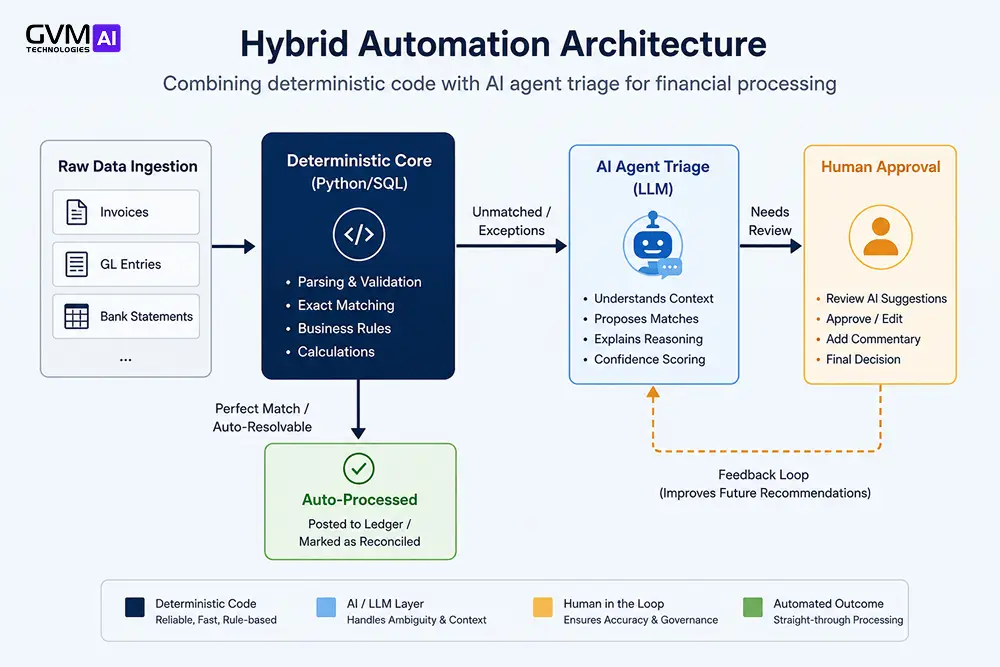
Rather than running LLMs directly on calculations, modern engineering teams build dedicated Python development solutions to handle math deterministically while using LLMs solely for context retrieval.
Data Plumbing: The Real Foundation of Finance AI
Many organizations focus heavily on selecting AI models while neglecting their underlying data infrastructure.
In reality, an AI agent is only as effective as the data pipelines connecting it to enterprise databases.
Through our engineering projects at GVM Technologies AI, we have repeatedly proven that real financial ROI is rarely driven by model size or prompt complexity. Instead, it is driven by data plumbing.
+-----------------------------------------------------------------------+
|                   FINANCE DATA PLUMBING CHECKLIST                     |
+-----------------------------------------------------------------------+
|  [x] Standardized API Endpoints for ERP & Billing Systems            |
|  [x] Unified Chart of Accounts Across Subsidiary Entities             |
|  [x] Automated OCR & Structuring for Inbound PDF Invoices             |
|  [x] Immutable Log Trails for All Agent Queries                       |
|  [x] Scoped Read-Only Database Views for LLM Context Windows          |
+-----------------------------------------------------------------------+
To prepare your financial stack for AI deployment, implement these core data hygiene steps first:
- Standardize Chart of Accounts: Ensure department codes and vendor IDs are uniform across subsidiary ledgers.
- Build Immutable Logging: Store every raw data payload, agent prompt, and output response in a centralized audit log.
- Isolate Database Views: Expose only scoped, read-only SQL views to AI tools to prevent unauthorized data exposure.
- Implement Automated OCR: Convert all physical and PDF receipts into structured JSON data prior to agent processing.
Organizing data plumbing first ensures AI tools operate on clean, auditable financial records from day one.
Building the Hybrid Deterministic Architecture
How do enterprise software developers build production-ready financial AI systems?
The optimal setup pairs deterministic execution scripts with LLM reasoning agents.
Teams seeking to launch scalable web and cloud tools often leverage SaaS solution development frameworks to enforce strict boundaries.
# Production Hybrid Pattern: Deterministic Python + Agentic Investigation

def process_monthly_reconciliation(bank_statement, general_ledger):
    # Step 1: Deterministic Matching in Python (100% Exact)
    matched_records, unmatched_exceptions = exact_python_match(bank_statement, general_ledger)

    # Step 2: Agentic Triage ONLY for Unmatched Exceptions
    exception_reports = []
    for item in unmatched_exceptions:
        # Agent gathers context, emails, and POs without altering balances
        context = agent_fetch_supporting_docs(item.vendor_id, item.amount)
        narrative = llm_draft_variance_explanation(item, context)

        exception_reports.append({
            "exception_id": item.id,
            "amount": item.amount,
            "proposed_reason": narrative,
            "status": "PENDING_HUMAN_APPROVAL"
        })

    return matched_records, exception_reports
1. Deterministic Execution Layer
Python scripts or database routines handle all mathematical operations, sum validations, and exact-string matching.
- Speed & Precision: Runs in sub-second execution speeds with 100% repeatable mathematical accuracy.
- Cost Controls: Executes locally or on enterprise cloud servers at $0 ongoing API token cost.
- Auto-Matching: If a bank payment perfectly matches a GL invoice number and dollar amount, Python reconciles it automatically.
2. Agentic Exception Layer
When Python encounters an unmatched item, it routes the record to the LLM agent.
- Context Retrieval: The agent queries the ERP database, reads recent vendor emails, and checks payment schedules.
- Diagnostic Memos: It drafts a summary explaining why the discrepancy occurred and cites supporting documents.
- Approval Queue: It packages the exception into a dashboard queue where a human accountant can approve or reject the entry.
Governance, Risk, and Audit Trail Requirements
Deploying AI in financial operations introduces regulatory, security, and compliance risks that must be actively managed.
Under frameworks like SOC 2 and the EU AI Act, financial systems must maintain reproducible audit records.
| Risk Category | Severity | Technical Control Measure |
|---|---|---|
| Data Exfiltration | High | Scoped Read-Only Database Roles |
| Hallucinated Calculations | Critical | Deterministic Python Calculation Core |
| Unapproved Wire Transfers | Critical | Air-Gapped Human Approval Gateway |
| Compliance Audit Failures | High | Complete Prompt & Context Logging |
When integrating AI into enterprise financial workflows, implement these mandatory governance controls:
- Complete Audit Trail: Log every prompt, model response, retrieved document snippet, and user approval timestamp.
- Air-Gapped Payment Execution: Ensure AI agents lack write access to banking APIs or payment portals.
- Data Privacy Contracts: Ensure enterprise AI agreements explicitly prohibit vendor training on private financial data.
- Independent QA Testing: Rigorously validate all software logic through dedicated software QA testing services prior to release.
Allocating 20% to 30% of your project budget to governance and testing ensures full compliance during external audits.
FAQs
1. Can AI agents execute journal entries without human review?
No. AI agents should never post journal entries or move funds autonomously because probabilistic LLMs can hallucinate numerical fields; they must only draft entries for human CPA approval.
2. Why are Python and VBA better than generative AI for bank reconciliations?
Python and VBA execute exact mathematical matching deterministically at $0 token cost, whereas generative AI models are probabilistic text engines that produce non-repeatable calculations.
3. How do AI agents improve monthly close variance reviews?
AI agents eliminate manual document hunting by automatically querying purchase orders, invoices, and email threads to build cited diagnostic memos for unexpected ledger movements.
4. What security controls protect customer financial data when using AI?
Protecting financial data requires restricting AI agents to read-only database views, enforcing strict enterprise zero-data-retention DPAs, and air-gapping payment execution APIs.
5. What is the Read-Prep-Decide framework in financial automation?
It is an enterprise security model where AI handles data ingestion (Read) and evidence compilation (Prep), while human accountants retain total control over financial postings and wire approvals (Decide).
Transform Your Financial Workflows with GVM Technologies AI
Automating finance and accounting workflows requires balancing cutting-edge AI capabilities with strict deterministic precision.
At GVM Technologies AI, we specialize in building enterprise-grade software solutions, custom data pipelines, and secure AI agent integrations tailored to your business needs.
Whether you need to streamline variance reviews, build auditable ERP connectors, or deploy hybrid financial automation, our engineering team delivers clean, reliable code.
Explore how our expert Generative Engine Optimization services and custom AI development can modernize your financial operations.
Ready to automate your accounting workflows safely? Book a consultation with GVM Technologies AI today.