
Quick answer: Voice AI Agents vs Chat AI Agents comes down to matching the interface to how customers already reach you, not to whichever demo looked more impressive.
Phone-first businesses (clinics, trades, real estate) get faster payback from voice AI agents, since a missed call is a lost customer. Digital-first businesses (SaaS, e-commerce) get faster payback from chat AI agents, since visitors are already typing.
Most buyers never frame it as a real decision. They watch one polished demo and buy whichever interface the vendor showed first.
Our core AI solutions for business team has scoped both voice and chat builds for the same client in the same week. The failure pattern repeats: the model isn’t the problem, the interface was never matched to how the customer wanted to talk.
Key Takeaways
- The real decision isn’t “which AI is smarter.” It’s which interface matches how your customers already contact you.
- Live chat carries an average 87% CSAT score against roughly 44% for phone support, yet 76% of people still prefer a call for complex, nuanced problems.
- Human conversation hands off a speaking turn in about 200 milliseconds. Voice AI has almost no room for lag before it reads as broken.
- Roughly 68% of callers abandon a call once a voice agent feels sluggish, a failure mode text simply doesn’t have.
- A failed chatbot reply is a shrug. A failed voice call is a hang-up and a lost customer, which is why voice AI carries far less margin for error than chat.
- Neither interface survives a bad handoff. Customers forgive an AI that admits it doesn’t know something, but rarely forgive repeating themselves to a human who got no context.
- Most growing businesses end up running both: chat on the website and app, voice on the phone line, one shared knowledge base underneath.
Voice AI Agents vs. Chat AI Agents: The Core Difference
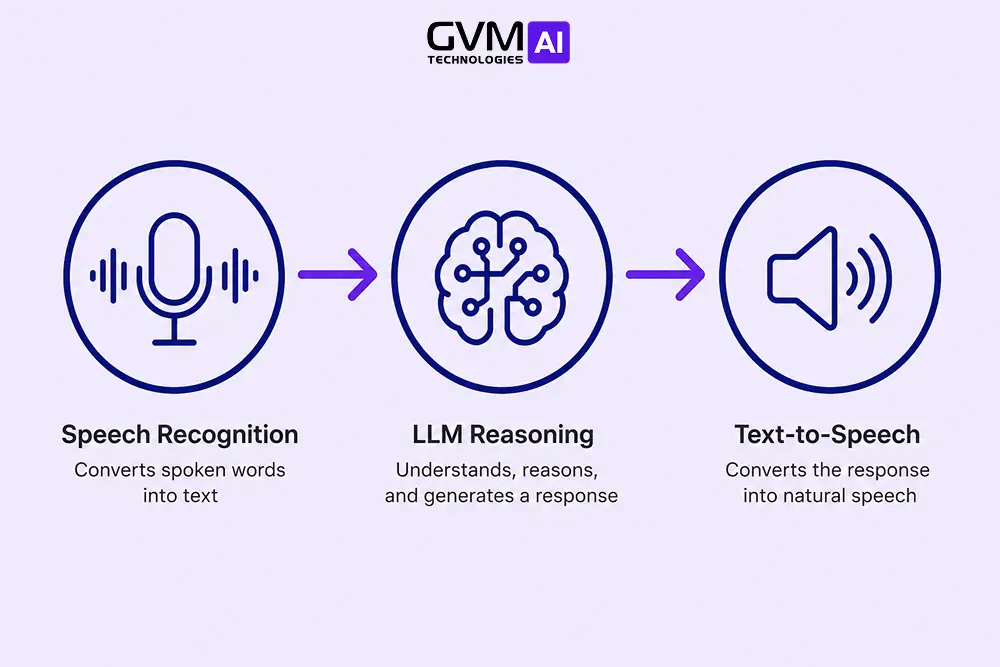
A voice AI agent listens through automatic speech recognition (ASR), reasons over the request with an LLM, and replies out loud through text-to-speech (TTS), all inside the same breath of silence a caller barely notices when it works.
A chat AI agent works differently. It reads a typed message, pulls context through retrieval-augmented generation (RAG) against your knowledge base or CRM, and writes a reply back into the same thread.
Both usually share the same LLM, the same NLU layer, and the same knowledge base underneath.
The real split sits in the interface layer: audio versus text, real-time versus a few forgiving seconds of “thinking” time. That delay tolerance is what makes voice AI agents harder to build well than chat AI agents.
Precision-sensitive or agentic workflows still lean toward chat. A wrong word in a text transcript is easy to spot and correct.
The same error spoken aloud is easy to miss until the customer is upset. Typing also forces a more structured request; a spoken one tends to be looser and harder to parse.
An omnichannel platform typically tracks containment rate (how many conversations the AI resolves without a human) separately per channel, since voice and chat rarely contain requests at the same rate even on one knowledge base.
Our AI agent vs. chatbot vs. virtual assistant guide covers a related but different axis: how much autonomy the system has once it’s already replying, in either voice or text.
Voice AI vs. Chat AI: The Side-by-Side Comparison
| Dimension | Voice AI Agent | Chat AI Agent |
|---|---|---|
| Core tech | ASR, NLU, TTS, telephony | NLU, generative AI, chat SDKs |
| Tolerable response gap | Under roughly 1,200ms | Several seconds, often unnoticed |
| Written record | Only if transcribed separately | Automatic and native |
| Emotional nuance | High: tone, pace, pauses | Low: text alone |
| Error visibility | Low, easy to miss mid-call | High, sits in plain text |
| Best failure mode | Graceful mid-call handoff | “I don’t know” plus a link |
| Surge handling | Absorbs sudden call spikes | Absorbs sudden message spikes |
| Typical setup | Higher, real-time infrastructure | Lower, faster to iterate |
This isn’t a ranking. A voice agent solving a voice-shaped problem, like an after-hours emergency, beats a chatbot every time, and a chatbot wins just as clearly for a visitor comparing specs at 11 p.m.
Why Voice Fails Where Chat Doesn’t
Latency is the real fault line between these two interfaces, showing up in two failure modes vendor demos rarely reveal.
The Latency and Interruption Problem
Voice AI needs barge-in support, the ability to detect and respond when a caller talks over it mid-sentence, backed by voice activity detection (VAD) that separates real speech from noise.
Demos run a clean, single-intent script in a quiet room. Real calls look nothing like that.
Real callers regularly:
- Interrupt mid-sentence and change their mind halfway through.
- Talk to someone else in the room without addressing the agent.
- Give a half-answer, pause, then self-correct.
An agent that can’t tell the difference answers a comment that wasn’t meant for it, and the call comes apart. The deeper failure hits on topic switches: an agent that pivots but silently drops the fields it already collected forces the caller to repeat their account number.
Chat has no equivalent tripwire. A “typing” indicator absorbs several seconds of processing without anyone assuming the system crashed.
That’s also why voice AI pauses past the 300-millisecond natural turn-taking window read as slow, while the same delay in a chat widget goes unnoticed.
Our guide to AI agent hallucinations in production covers the accuracy side of that problem: a confidently wrong answer, spoken quickly, is harder to catch than one sitting in text.
The Handoff Problem Neither Interface Solves Alone
Raw intent accuracy gets most of the attention in vendor pitches. It’s rarely what loses the customer.
What loses the customer is a human agent who receives no context and asks them to start over.
Before trusting any vendor, ask three questions:
- Does the human agent see the full transcript, or just an AI-generated summary?
- Is escalation a deterministic rule in code (a confidence threshold, a keyword trigger), or a soft judgment call left to the model?
- Does the transcript reach the CRM screen, or does it stop at a webhook nobody reads?
That third question matters most. Whether a transcript survives a handoff often comes down to the telephony layer.
Agencies that build native computer-telephony integration (CTI) into your CRM pass the full conversation automatically. Generic webhook connectors often pass only a summary, one that can read as complete while it drops the detail the customer already repeated.
Our guide to AI agent access to customer data covers the audit-trail and PII-handling side of building that handoff correctly.
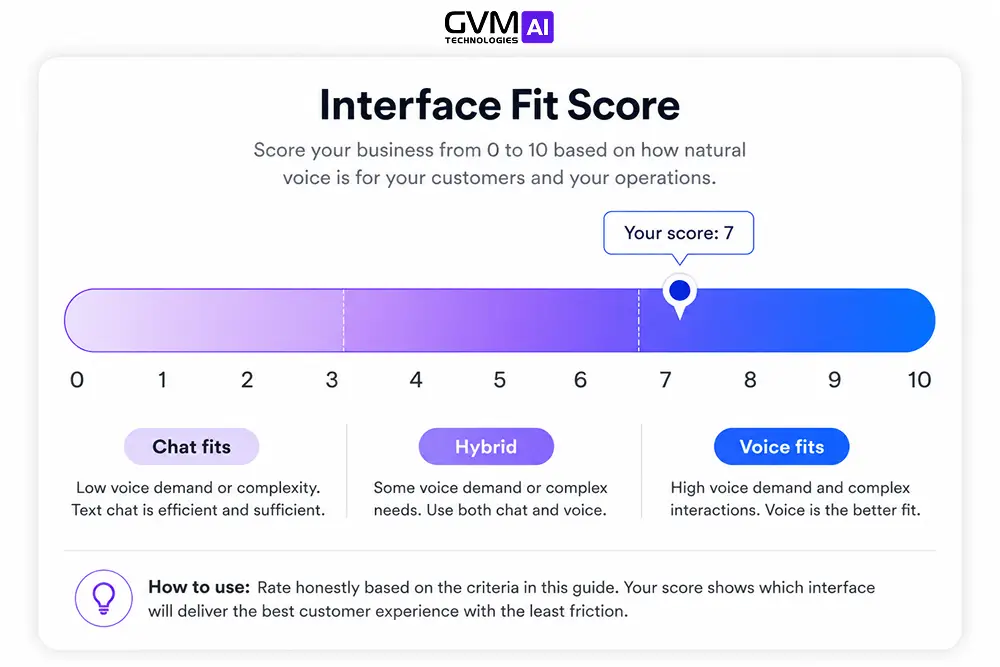
The Interface Fit Score: A 5-Question Framework
Score each row 0 to 2. A higher total leans toward voice, a lower total leans toward chat.
| Question | 0 | 1 | 2 |
|---|---|---|---|
| Where do customers already reach you? | Website / app | Mixed | Phone |
| How urgent is the typical request? | Can wait hours | Same day | Immediate |
| How emotionally loaded is it? | Low, factual | Moderate | High, needs reassurance |
| Does a written record matter? | Essential | Helpful | Not critical |
| How fast do you need to launch? | Days | A few weeks | Flexible |
Read your total against these bands:
- 0 to 3: chat covers the need well on its own.
- 4 to 6: run a hybrid setup, chat for volume and voice for urgent or after-hours lines.
- 7 to 10: the task is voice-shaped. Budget for real-time infrastructure and latency tuning from day one.
Before scoping either build, run our AI agent readiness checklist against your actual call and message volume.
What Voice and Chat AI Agents Cost in 2026
| Cost factor | Chat AI Agent | Voice AI Agent |
|---|---|---|
| Setup | $0 to a few thousand | Several thousand for a scoped build |
| Ongoing | Flat monthly SaaS fee | $0.04 to $0.12 per minute plus LLM cost |
| Agency build | Lower, faster to iterate | Often $5,000+ to start, $6,000 to $9,000+ monthly |
| Maintenance | Support or ops team | An engineer reviewing call recordings, not transcripts |
Voice carries a hidden tax chat doesn’t: every voice-to-text-to-voice round trip adds token cost and latency on top of the model call itself.
That’s part of why per-minute voice pricing runs well above flat-fee chat plans, not just the phone infrastructure behind it.
Treat voice upkeep as a recurring line item, closer to a utility bill than a one-time purchase. Prompts and escalation rules drift as call patterns shift.
If your score points toward voice or a hybrid build, our AI agency vs. in-house AI team guide helps weigh staffing it internally versus bringing in a specialist team.
When to Choose Voice, Chat, or Both
Match the Channel to Where Customers Already Are
If your traffic is digital-first and conversion happens on-screen, a chat AI agent captures value fastest, at lower risk and lower cost to test. Our AI solutions for business automation team sees this pattern with SaaS and e-commerce clients.
If customers pick up the phone by habit, a voice AI agent solves a problem chat can’t. It answers calls you’d otherwise miss and absorbs the spike when a promotion or storm closure floods the line at once.
Starting with chat data, even in phone-heavy businesses, still pays off. A few weeks of chat volume reveals the questions customers actually ask before you commit a larger voice budget.
The Hybrid Model Most Businesses Land On
- A chat agent handles the front door, filtering routine questions before they become a ticket.
- A voice agent owns the phone line, especially after hours and during call spikes.
- Both draw from the same knowledge base, so a customer who chats Monday and calls Wednesday isn’t starting over.
See this pattern in our case study on GVM AI’s outreach agent, where one logic layer drives both channels.
Mistakes That Sink Pilots, and How to Pressure-Test First
Most regret after a rushed purchase traces back to one of these:
- Buying voice because the demo was slick, not because customers call.
- Judging a voice agent from a text transcript, where interruptions and dead air don’t show up.
- Assuming more autonomy always wins, when a narrow, well-tested chat agent often beats an overreaching voice agent past its guardrails. See our single agent vs. multi-agent systems guide for why more agents rarely means better results.
- Skipping the handoff test entirely, checking replies for weeks and never once checking what the human agent actually sees.
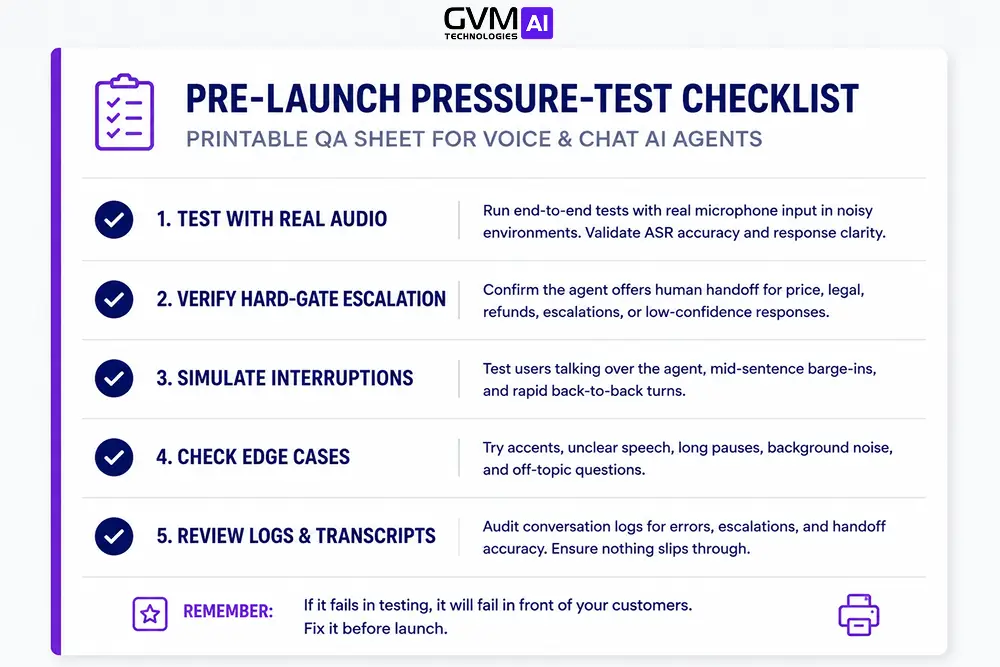
Before launch, run this checklist:
- Test with real audio from your own call logs, not a vendor’s clean sample script.
- Make escalation a hard gate, not an average. One missed distressed-customer case should fail the whole test, not just lower a score.
- Count crashed test cases as failures. Errors quietly dropped from the scored set make the average look better than the system is.
- Test the voice tool-calling path, not just text. Tool calls behave differently under real audio than in a clean transcript, so a green text-only evaluation can still ship a broken voice agent.
- Interrupt it on purpose and confirm it drops the old thread instead of steamrolling through the script.
Our guide to what an AI automation agency does breaks down how a properly scoped vendor avoids these traps from the discovery call onward.
The Bottom Line
This was never a contest between a smarter AI and a weaker one. Voice and chat solve two different situations your customer is in.
Voice wins when hands are busy, the moment is urgent, or the tone needs to feel human. Chat wins when the customer is on a screen, multitasking, or needs a written record.
Score your use case with the framework above, and budget for the tuning that keeps either interface from drifting back into “sounds like a robot.”
Build the Interface Your Customers Actually Use
GVM Technologies AI builds voice and chat agents on the same underlying logic, so your customer gets one consistent experience no matter which one they pick up first. Full context passes at every handoff, and guardrails keep a misheard word from turning into a wrong action in your CRM.
Our specialized AI applications team scopes each build around how customers contact you, not a generic template.
If the framework above scored your business a 4 or higher, talk to our team at GVM Technologies AI about a properly scoped voice, chat, or hybrid build.
FAQs
1. Is a voice AI agent more expensive than a chat AI agent?
Usually. Voice runs on real-time infrastructure and per-minute costs on top of the LLM, while chat runs on a flat fee that’s cheaper to test.
2. Can one AI agent handle both voice calls and chat messages?
Yes, when both sit on the same knowledge base and reasoning layer, so the experience stays consistent even though the interface changes.
3. Do voice AI agents still sound robotic in 2026?
Less than before, but quality varies by vendor. A slightly synthetic voice that says “sorry, did you mean Tuesday?” and recovers gracefully beats a polished voice that confidently answers wrong.
4. What’s the biggest reason voice AI pilots fail?
A broken handoff, not a wrong answer. Repeating a problem to a human with zero context does more damage than the original mistake.
5. Should a small business start with chat or voice first?
Score it with the Interface Fit Score above. Digital-first businesses usually start with chat; phone-first ones like clinics and trades usually see faster ROI with voice.
6. How long does deployment actually take?
A scoped chat agent can launch in one to two weeks. A production-ready voice agent with proper latency tuning and CRM integration takes several weeks longer.
7. Can AI voice agents handle interruptions and mid-call topic changes?
The better ones can, using barge-in detection and voice activity detection, though it remains one of the hardest problems in voice AI. Test it directly by interrupting the agent mid-sentence and confirming it drops the old thread instead of talking over you.