
RAG gives your AI agent access to information it doesn’t already have. Fine-tuning changes how the agent behaves once it already has that information.
Confusing the two is the single most expensive mistake in AI agent budgets right now.
A support agent quoting stale pricing doesn’t need retraining, it needs better retrieval. A drafting agent that ignores your house style doesn’t need a bigger knowledge base, it needs fine-tuning.
Quick answer: RAG retrieves external information at query time and feeds it into the model’s context window, without touching the model’s weights. Fine-tuning retrains those weights on your own examples so behavior changes permanently.
Use RAG when data changes often or you need citations. Use fine-tuning when you need consistent tone, format, or reasoning the base model lacks.
Most production agents in 2026 run both, layered, and some train them together using a technique called RAFT.
This guide covers RAG vs fine-tuning and what each approach does inside an agent, a decision framework, 2 real production case studies with opposite answers, the security question most guides skip, and what a hybrid build actually costs.
Key Takeaways
- RAG retrieves external data at query time. Fine-tuning retrains the model’s weights. Different problems, not competing versions of the same fix.
- Gartner projects 40% of enterprise apps will include task-specific AI agents by 2026, up from under 5% in 2025.
- Harvey, a legal AI platform, hit the ceiling of plain RAG and built a fine-tuned model with OpenAI on 10 billion tokens of US case law.
- Klarna’s OpenAI-built support agent handles the volume of roughly 700 human agents through retrieval, not fine-tuning.
- Fine-tuning doesn’t reliably teach new facts, and it can’t defend an agent against prompt injection on its own.
- LoRA made single-GPU fine-tuning realistic for small teams. RAFT trains retrieval and generation together instead of layering them.
- The real 2026 pattern is 3 layers: RAG for facts, fine-tuning for behavior, an orchestration layer deciding which to call.
What RAG and Fine-Tuning Actually Do Inside an AI Agent
Both terms get treated as 2 flavors of the same fix. They aren’t.
1. What RAG Actually Does
RAG works in 4 steps: chunk and embed your documents into a vector database, embed the user’s query the same way, retrieve the closest matching chunks, and insert them into the prompt before the model answers.
The model’s weights never change. Your agent’s answer quality is capped by retrieval quality, not by which model you picked.
Retrieval doesn’t have to mean a vector database either. Structured lookups against your own SQL tables or a CRM automation layer count as grounding too, and often beat semantic search on structured data.
- Good for: knowledge that changes weekly, answers needing a citable source, lower upfront cost.
- Weak point: chunking and embedding choice do most of the real work.
- The gap most guides skip: plain RAG struggles to summarize an entire document, since it only retrieves matching chunks.
2. What Fine-Tuning Actually Does
Fine-tuning trains the model on input-output examples until its weights shift toward that pattern.
LoRA and QLoRA freeze most of the model and train a small adapter instead. That’s why single-GPU fine-tuning is now realistic for smaller teams.
- Good for: strict output formats, a specific voice, classification or extraction, faster inference once trained.
- Weak point: doesn’t reliably add facts, slower to update than swapping a document.
- The real risk: a careless run causes catastrophic forgetting, degrading skills the model already had.
3. Where Agentic RAG Fits Between the Two
Agentic RAG is worth knowing before you pick a side. Instead of retrieving once, the agent judges whether the result is good enough and searches again if it isn’t.
That’s still RAG, weights stay frozen, but it closes part of the gap fine-tuning advocates point to. If your setup already runs multiple coordinated agents, you’re likely closer to agentic RAG than plain RAG already.
RAG vs. Fine-Tuning: The Side-by-Side Comparison
1. Comparison Table by Dimension
| Dimension | RAG | Fine-Tuning |
|---|---|---|
| What it changes | What the model can see | The model’s weights |
| Data freshness | Instant, update a document | Requires a new training run |
| Citations | Yes, points to the source | No |
| Setup time | Days to a few weeks | Weeks, plus evaluation |
| Latency | Slower, adds a retrieval step | Faster once deployed |
| Portability across models | High | Low, tied to the trained model |
| Best for | Knowledge bases, policy Q&A | Formatting, tone, extraction |
2. What the Comparison Table Misses
Portability is the row every other guide skips. Fine-tune on one provider’s model, and a deprecated base version forces a retrain, not just a redeploy.
RAG has no such lock-in, swap the underlying LLM and your knowledge base keeps working.
- Data residency is the second gap. Fine-tuning feeds proprietary examples into a training pipeline you don’t fully control.
- RAG can keep sensitive data external, gated behind your own access rules.
The Knowledge-Behavior Test: A Framework for Deciding
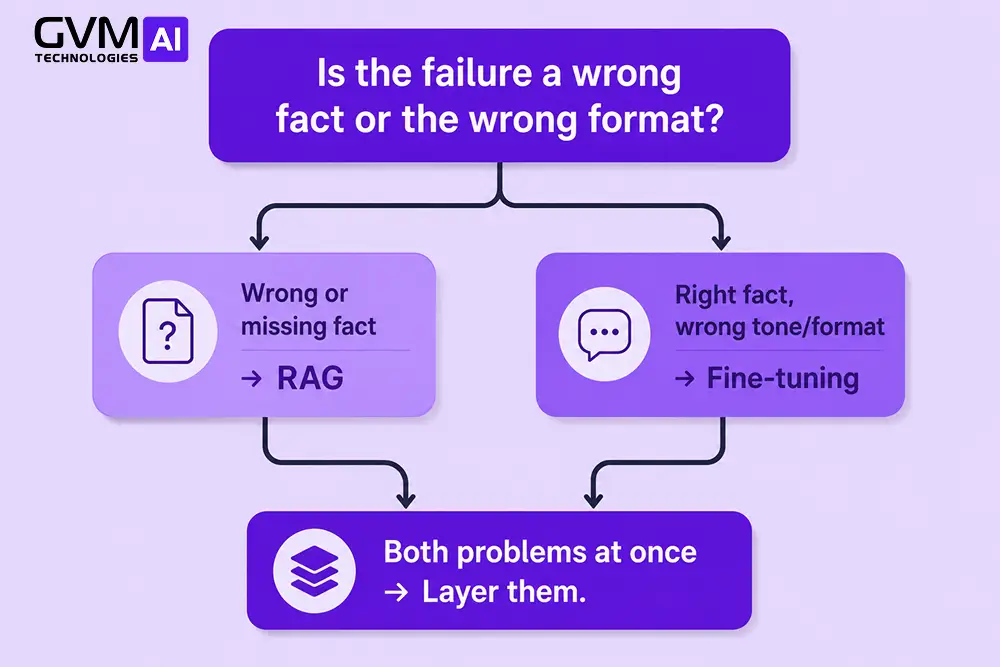
Ask one question before picking either: is the problem missing knowledge, or inconsistent behavior?
Pull 10 to 20 bad agent responses and sort each into a bucket, a knowledge failure or a behavior failure. Whichever bucket has more entries names your actual fix.
1. Signs Your Agent Needs RAG
- Answers reference pricing, inventory, or policy that changes weekly or faster.
- You need every answer traceable to a specific source document.
- Compliance teams handling customer data need to audit what an answer was based on.
2. Signs Your Agent Needs Fine-Tuning
- Right facts, wrong tone or format, repeatedly.
- You need strict, valid JSON or another structured output every time.
- The knowledge itself is stable and won’t change for months.
3. Signs Your Agent Needs Both
- A consistent voice, with facts behind it that change often.
- Domain-specific reasoning where the pattern is learned but the data still updates.
- You’ve tried RAG plus a strong prompt, the behavior gap persists, and retrieval has been ruled out.
The Escalation Ladder Most Teams Skip
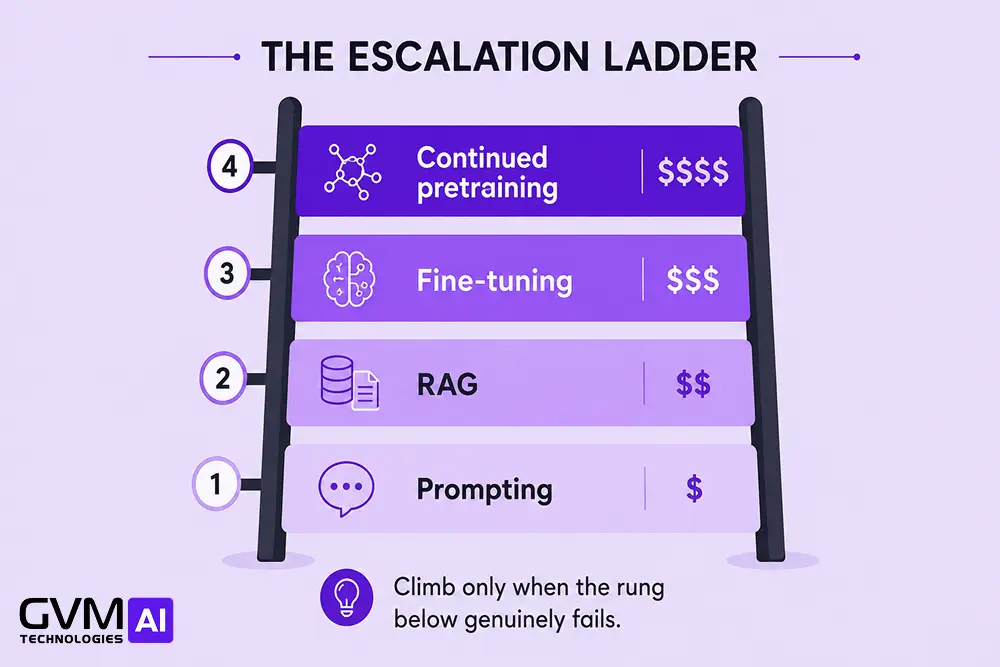
This isn’t a binary choice, it’s a ladder: prompting, then RAG, then fine-tuning, then continued pretraining. Each rung costs more, so climb only when the cheaper one fails.
1. Why Skipping Rungs Wastes Budget
Teams that jump straight to fine-tuning routinely find a stronger prompt or better retrieval would have solved it for less.
The reverse happens too. A team fine-tunes for months chasing a formatting problem a JSON schema would have fixed in an afternoon.
2. The Overlooked Middle Option: Fine-Tuning Just the Embedding Model
Almost no comparison article mentions this: you can fine-tune the embedding model powering retrieval, without touching generation at all.
Harvey did exactly this. Their custom embedding model, trained on legal text, cut irrelevant retrieval results by roughly 25% compared to a standard embedding model.
That’s a targeted fix. The generation model stays swappable.
Real AI Agents That Landed on Different Answers
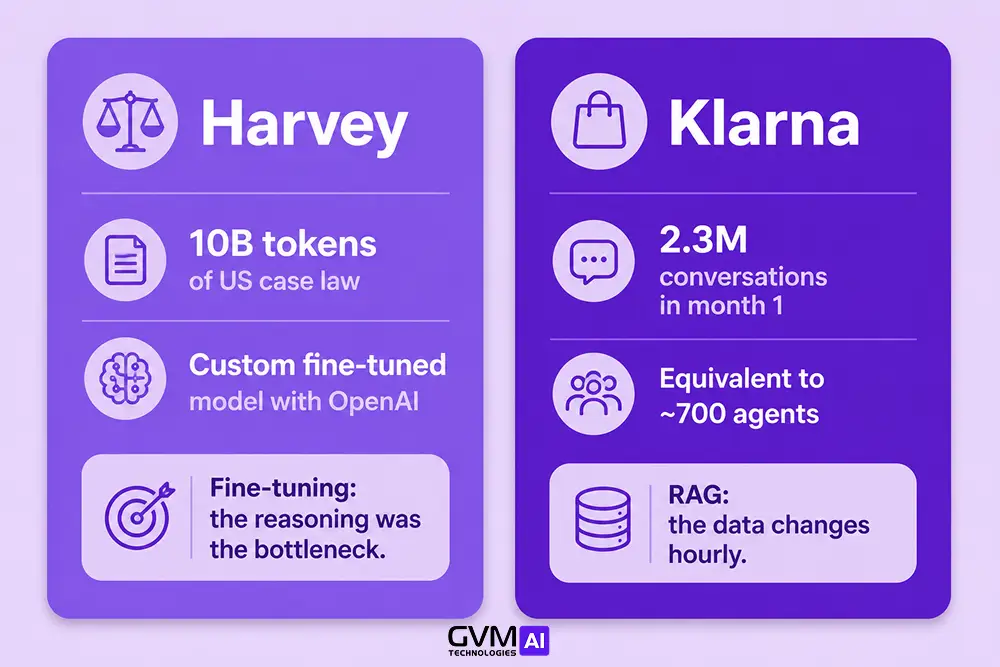
Harvey and Klarna picked opposite tools for the same broad problem, customer-facing AI, because their bottlenecks were different.
1. Harvey: Fine-Tuning for Legal Reasoning
Harvey initially built retrieval-augmented systems on foundation models.
According to OpenAI, that hit a wall on Harvey’s hardest cases. Retrieval could surface case law, but not the domain-specific reasoning a lawyer applies to it.
Harvey trained a custom model on 10 billion tokens of US case law with OpenAI. The knowledge wasn’t the bottleneck, the reasoning pattern was.
2. Klarna: RAG for a Knowledge Base That Changes Hourly
Klarna’s OpenAI-built support assistant handled 2.3 million conversations in its first month, the workload of roughly 700 agents. Response times dropped from 15 minutes to under 2.
Order status and refunds change hourly across millions of accounts. A fine-tuned model would go stale before training finished.
Klarna has also said it kept human agents on its hardest tickets, a reminder neither technique replaces judgment on edge cases.
Why Most Production AI Agents Run Both in 2026
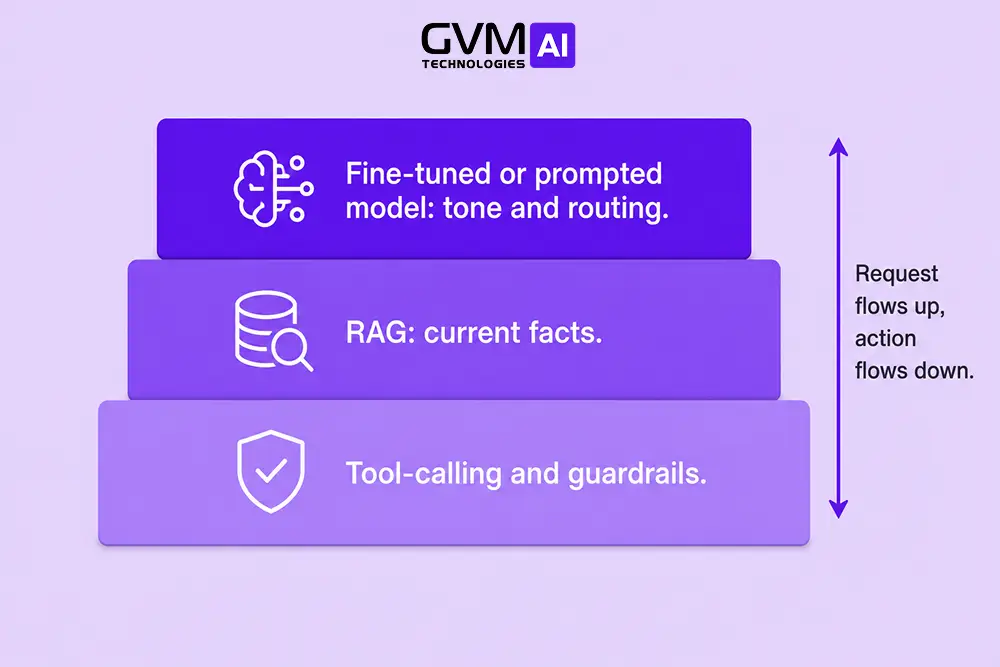
Treating RAG and fine-tuning as either-or is where most confusion comes from. A mature stack usually runs 3 layers at once.
1. What a Hybrid Stack Actually Looks Like
- A fine-tuned or heavily prompted model handles classification and output formatting.
- A RAG pipeline retrieves facts from a knowledge base that updates independently of the model.
- Tool-calling and guardrails let the agent act within limits your team defined.
This mirrors the layered thinking behind why AI agents hallucinate in production: input, grounding, action, and output are 4 different failure points.
RAG hardens grounding. Fine-tuning hardens output. Neither touches action alone.
2. RAFT: Training the Model and the Retrieval Together
RAFT, short for Retrieval-Augmented Fine-Tuning, trains a model on both relevant and deliberately irrelevant retrieved documents, teaching it to cite the right source instead of guessing.
The architecture doesn’t split into 2 systems. Most teams don’t need this yet, but it’s worth knowing it exists.
The Security Question Most Guides Skip
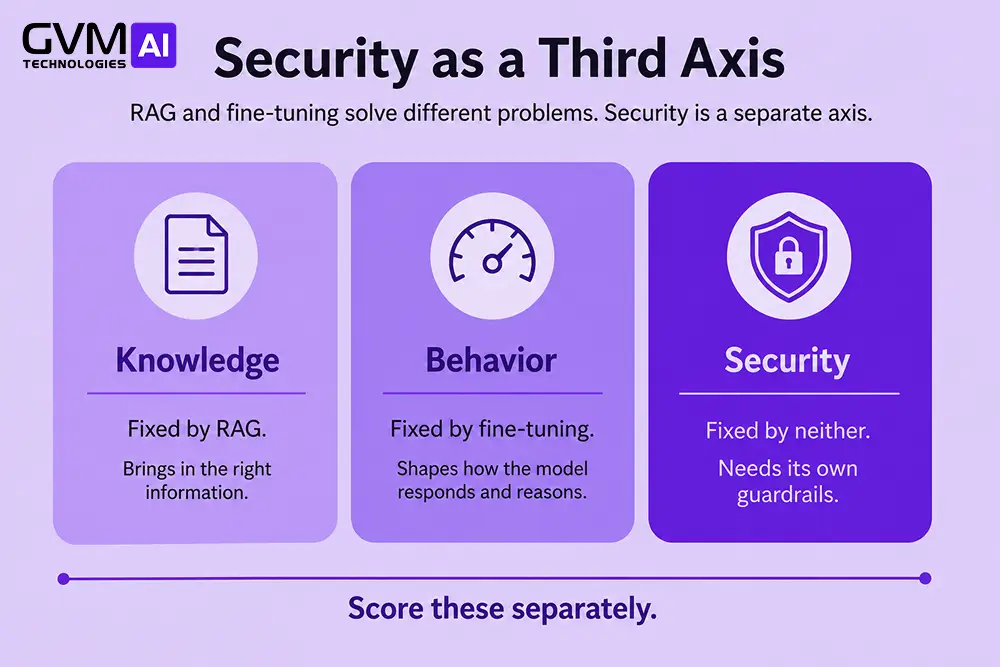
If part of your reason for fine-tuning is making an agent harder to manipulate, that’s a different problem than knowledge or behavior.
1. Why RAG Doesn’t Harden Your Agent Against Prompt Injection
RAG adds information to a prompt. It doesn’t change what the model is willing to do with that information.
A malicious instruction hidden inside a retrieved document can still get followed. The model can’t reliably separate your instructions from text it pulled in.
That needs input sanitization and tool allowlists, not a bigger knowledge base.
2. Why Fine-Tuning Isn’t a Security Fix Either
Fine-tuning resists attack styles it saw in training. It won’t generalize to attacks it never saw.
Guardrail work is its own discipline, closer to shadow AI governance than to either technique. Score security separately, not as a side effect of your architecture choice.
Cost, Timeline, and Team Requirements
1. What RAG Costs to Build and Run
| Factor | RAG-only build |
|---|---|
| Timeline | 2 to 6 weeks |
| Effort goes to | Chunking, embedding choice, reranking |
| Ongoing cost | Vector database hosting, embedding calls |
| Smallest team | 1 engineer |
2. What Fine-Tuning Costs to Build and Run
| Factor | Fine-tuning-only build |
|---|---|
| Timeline | 4 to 10 weeks |
| Effort goes to | Labeling examples, running training jobs |
| Ongoing cost | Compute for retraining |
| Smallest team | Someone comfortable with LoRA runs |
Data prep is the part most guides skip. Cleaning a few hundred quality examples routinely takes longer than the training run, which LoRA now finishes in hours on a single GPU.
Common Mistakes That Waste Budget
1. Mistakes Teams Make With RAG
- Blaming the model before diagnosing retrieval. A wrong answer is usually a chunking problem.
- Skipping reranking. The right document often lands at position 6, not 1.
- Testing only clean inputs. Production queries are messier than a demo.
2. Mistakes Teams Make With Fine-Tuning
- Fine-tuning to add knowledge instead of fixing retrieval, the single most repeated mistake.
- Skipping an evaluation set. Neither technique is safe to iterate on without 20 to 50 scored test cases.
- Treating hybrid as a later upgrade. Retrofitting costs more than designing for both from the start.
Whether you run this in-house or bring in outside help, this audit should happen before a build gets scoped.
Why GVM Technologies AI Runs This Decision Differently
Most vendor content pitches whichever technique that vendor sells.
1. The Diagnosis-First Process
As an AI automation agency, GVM Technologies AI starts from the Knowledge-Behavior Test, run against a real sample of your agent’s failures, before recommending a build.
Recommending fine-tuning for a knowledge gap wastes budget on a problem retrieval solves for less. Recommending RAG for a formatting problem leaves the real complaint unresolved.
2. What You Get Before Any Build Starts
- A scored breakdown of your agent’s failures, knowledge, behavior, or both.
- An honest timeline and cost estimate for the fix that applies.
- A security read, kept separate from the architecture call.
Ready to Find Out What Your AI Agent Actually Needs?
Bring us 10 to 20 of your agent’s worst real responses.
We’ll run them through the Knowledge-Behavior Test and tell you honestly whether the fix is retrieval, training, both, or neither, before you spend a dollar building it.
Talk to our team at GVM Technologies AI for a straight read on where your agent’s actual gap sits.
If you’re still validating the investment itself, our AI agent readiness checklist is the step before this one.
FAQs
1. What is the main difference between RAG and fine-tuning?
RAG retrieves outside information when a question is asked, without changing the model. Fine-tuning retrains the model’s weights on your own examples, changing its behavior permanently.
2. Can fine-tuning teach an AI model new facts?
Not reliably. It shifts style, tone, and reasoning patterns more than it stores retrievable facts.
3. Is RAG or fine-tuning cheaper to build?
RAG, usually, often 2 to 6 weeks. Fine-tuning costs more in data prep time than compute.
4. Can you use RAG and fine-tuning together on a single AI agent?
Yes, and most mature production agents do this by 2026: a fine-tuned model for behavior, paired with RAG for current facts.
5. Does fine-tuning make an AI agent respond faster than RAG?
Usually, yes, once deployed. Fine-tuning skips the retrieval step entirely.
6. Does RAG make an AI agent safe from prompt injection?
No. RAG changes what an agent can see, not what it’s willing to do with untrusted text.
7. What is agentic RAG?
A pattern where the agent judges whether a retrieved result is good enough and searches again if it isn’t, instead of retrieving once and answering.
8. Do small businesses need fine-tuning, or is RAG enough?
Most only need RAG plus solid prompting. Fine-tuning earns its cost once you have a narrow, repeatable task at real volume.
The Bottom Line
RAG vs. fine-tuning isn’t a competition with one winner. RAG solves missing or changing knowledge. Fine-tuning solves inconsistent behavior.
Harvey needed the second problem solved. Klarna needed the first. Most agents built in 2026 need both, plus a security layer neither technique provides alone.
Run the Knowledge-Behavior Test on your own agent’s failures before spending on either one.