
On-premise AI agents run on infrastructure your company owns. Every prompt and document stays inside your own network. Cloud-hosted AI agents call a vendor’s shared infrastructure instead, reachable only through an API.
For regulated industries, that difference of on-premise vs cloud AI agents decides whether your compliance team approves a project or kills it in week 2. Most teams treat it as a binary choice. In practice, it isn’t.
Quick answer: On-premise fits when a regulation legally bars data from leaving your network, latency has to stay under 100ms, or GPU use already clears roughly 10,000 hours a month. Cloud fits everything else, provided the contract includes a signed Business Associate Agreement (BAA) and zero data retention (ZDR). Most 2026 healthcare, finance, and insurance deployments run a hybrid of both, and pair that choice with a credential broker so the agent itself never holds a raw secret.
Key Takeaways
- EU AI Act Article 50 high-risk rules became enforceable on August 2, 2026. Fines reach EUR 15 million or 3% of global turnover.
- The 2025 HIPAA amendment made encryption mandatory. A BAA now has to cover PHI access even when it lasts one inference call.
- An H100 GPU costs $25,000 to $40,000. A full 8-GPU server runs $300,000 to $450,000.
- Self-hosting only clears breakeven above roughly 500 active developers or 11 billion tokens a month.
- In March 2026, an attack on LiteLLM, a widely used AI gateway proxy, exposed credentials tied to an estimated 500,000 corporate identities. Location didn’t matter. The credential layer did.
- Most audit failures aren’t missing logs. They’re missing provenance: which policy was active and who approved the action.
On-Premise vs. Cloud AI Agents: Key Differences Explained
An on-premise agent keeps its model, data, and logs inside your network. A cloud agent processes your data on a vendor’s servers you never touch.
The real question isn’t where the servers sit. It’s who can be legally forced to explain what happened to one specific record.
1. What each deployment model actually means
Most teams asking for “on-premise AI” mean one of 3 different setups, and mixing them up causes most planning mistakes.
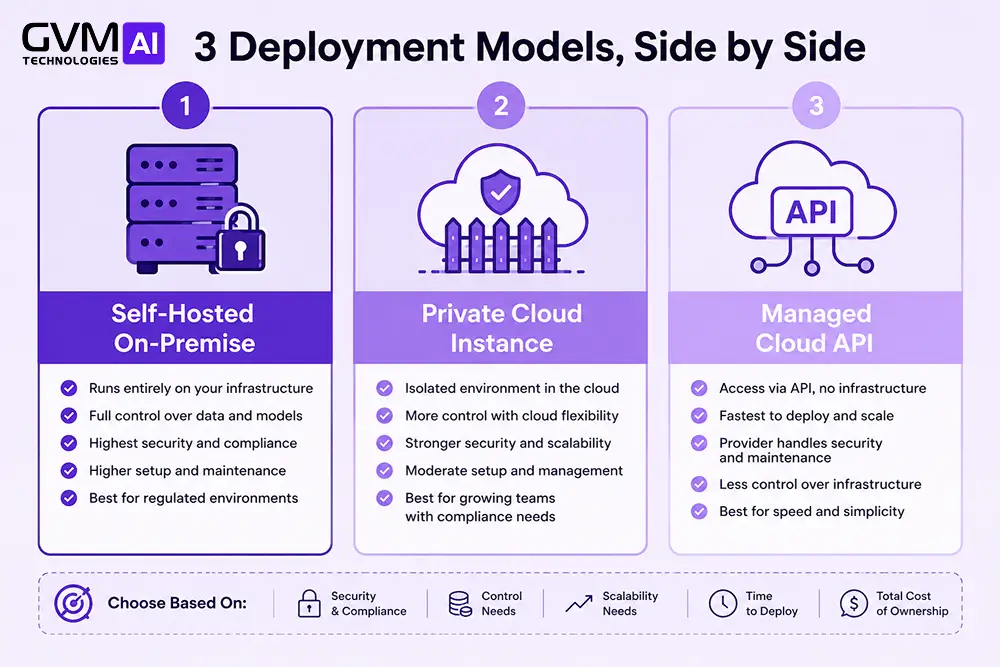
| Model | Where data sits | Best fit |
|---|---|---|
| Self-hosted on-premise | Never leaves your network | Air-gapped defense, classified data |
| Private cloud instance | Your own isolated cloud account | Most regulated healthcare, finance, insurance |
| Managed cloud API (BAA + ZDR) | Processed transiently, not retained | Lower-sensitivity, faster time to production |
Private cloud wins by default for most regulated teams. It gives on-premise isolation without the multi-month procurement cycle.
2. Where each option genuinely wins
On-premise wins only when a regulation legally bars the data from leaving, not just prefers it. Cloud wins on setup speed, elasticity, and the staffing math below enterprise scale.
Hybrid quietly wins by default. Sensitive data and the final write action stay on-premise or private cloud. Lower-risk reasoning runs through a contracted cloud API.
| Factor | On-premise | Cloud (BAA + ZDR) | Hybrid |
|---|---|---|---|
| Data residency | Full control | Contract-dependent | Sensitive data stays local |
| Setup time | Months | Days to weeks | Weeks |
| Talent needed | ML infra + security staff | Minimal, plus a governance owner | Both, but less of each |
| Best fit | Air-gapped, heavy sustained GPU use | Most regulated workloads | Most real 2026 deployments |
Why Regulated Industries Face Stricter AI Agent Rules in 2026
The law now treats AI systems as their own compliance category. 3 rule changes made this a hard requirement.
1. HIPAA’s 2025 amendment closed the loophole
Encryption for PHI used to be “addressable,” meaning a covered entity could document a workaround and skip it. That option is gone.
Encryption is now mandatory, and FIPS 140-3 validation is required. A BAA has to cover PHI access even when it’s transient, lasting only one inference call.
A vendor that “doesn’t store” your data can still fail an audit if no BAA covered that moment.
2. The EU AI Act and 3 more frameworks most teams forget
EU AI Act Article 50’s high-risk tier became enforceable August 2, 2026. It covers agents that score credit, price insurance, or triage health benefits, based on where the output is used, not where your company sits. Article 10 adds a separate requirement: documented data lineage.
GDPR Article 28 needs a signed data processing agreement. PCI DSS 4.0 requires network segmentation around cardholder data. FedRAMP High blocks controlled unclassified information from leaving its boundary entirely.
This is exactly why an AI automation agency that has scoped these frameworks before earns its fee: getting one of them wrong is expensive.
| Framework | What it requires | Who it hits |
|---|---|---|
| HIPAA (2025) | Mandatory encryption, unique identity per accessor, operation-level logs | Any agent touching PHI |
| EU AI Act | Data lineage, risk management, human oversight | High-risk agents, EU users |
| GDPR Article 28 | Signed data processing agreement | Any EU personal data |
| SOC 2 Type II | A current audit report, not a badge | Any client-data vendor |
| FedRAMP High | Authorized boundary only | Defense, public sector |
A self-attested “SOC 2 compliant” badge on a pricing page proves nothing. Ask for the current audit report before you sign anything.
On-Premise vs. Cloud AI Agent Costs: What You’ll Actually Pay
The real cost isn’t the GPU sticker price. It’s the depreciation on hardware sized for a peak load your workload never hits.
1. The developer-based breakeven math
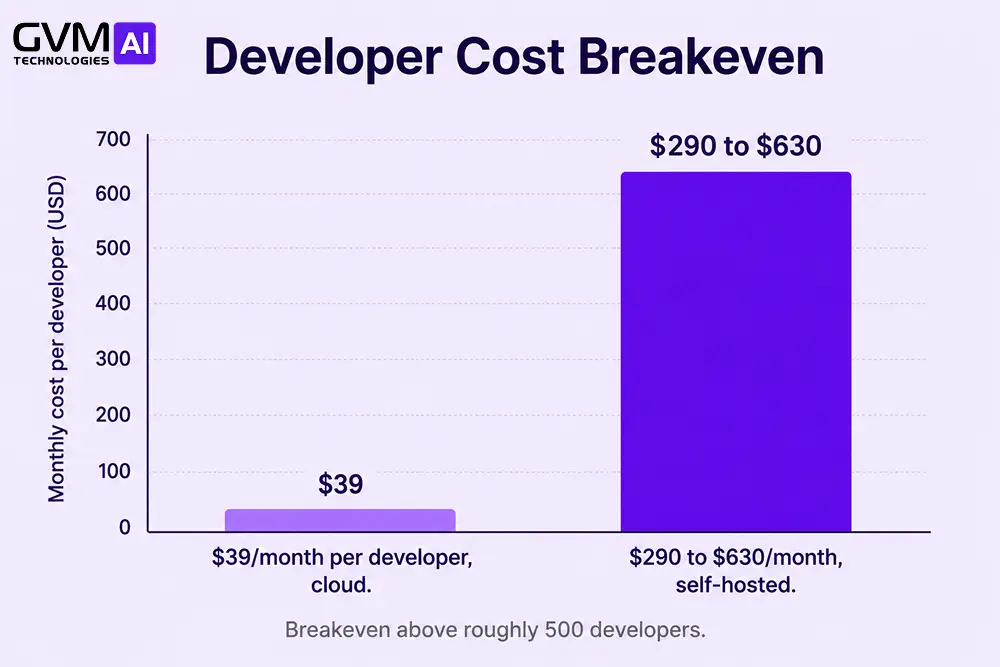
For a 100-person engineering team, cloud AI tools run roughly $39 per developer a month. Self-hosting, GPU cluster plus dedicated MLOps staff, runs $290 to $630 per developer a month.
Self-hosting only clears breakeven above roughly 500 active developers or 11 billion tokens a month. Below that, cloud wins on pure economics, before compliance even enters the math.
2. Hidden costs the pitch deck skips
An 8-GPU server runs $300,000 to $450,000 before staffing. At 10% utilization, that GPU inflates your cost per token by roughly 10 times.
Staffing is the real surprise: 1 to 2 dedicated MLOps engineers cost $12,000 to $24,000 a month, and enterprise GPU procurement takes 6 to 12 months.
- 1 to 50 developers, low regulatory burden: cloud tools, full stop.
- 51 to 250 developers, high burden (HIPAA, FedRAMP): self-host, the mandate leaves no choice.
- 250+ developers, high burden: self-host, economies of scale finally justify it.
The AI Agent Security Risk Deployment Location Doesn’t Fix
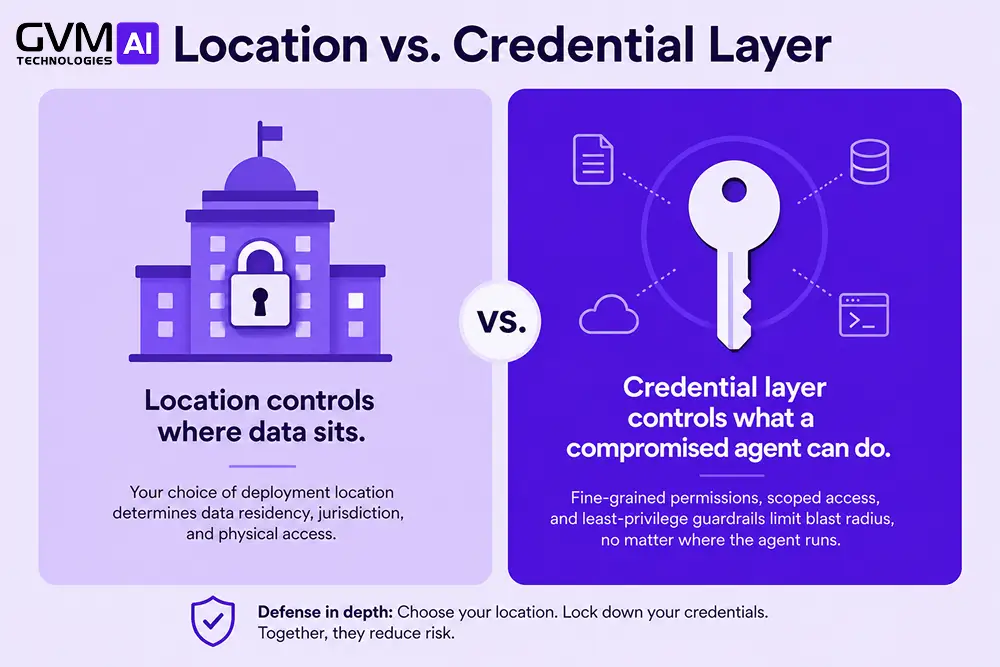
Deployment location controls where data sits. It says nothing about whether the agent’s credentials could be stolen.
1. Why on-premise alone isn’t enough
An agent that reads an API key from a config file holds that secret in memory for the life of the process. It makes no difference whether that process runs on-premise or in a compliant private cloud.
In March 2026, a supply chain attack on LiteLLM, an AI gateway proxy used by thousands of enterprises, harvested SSH keys, API keys, and database passwords tied to roughly 500,000 corporate identities. Location wasn’t the failure point. The credential layer was.
2. The credential broker fix
The fix gaining ground in 2026: the agent never holds a credential at all. It authenticates with its own identity, calls through a broker, and the broker injects the real token just in time.
This mirrors the guarded retry pattern we build into every agent. A compromised agent under this model leaks a request pipe, not a reusable secret.
What Changes When an AI Agent Accesses PHI or Financial Records
An agent touching PHI or financial data is treated like a human employee with one added risk. It can generate an action nobody explicitly authorized.
1. Access control and minimum necessary access
A shared service account is the fastest way to fail a HIPAA audit. HIPAA requires a unique identifier per accessor, so you can prove which agent touched a given record.
A system prompt telling the model “only access what you need” is a suggestion, not a control. Prompt injection can talk a model out of a suggestion.
Our own customer data access framework redacts PII before the model ever sees it. Local models catch it in roughly 35ms; regex handles known formats in under 2ms.
2. Provenance beats logs
Logs prove an action happened. They rarely prove it was authorized. A regulator’s real question is which policy was active and who approved it, not just that an API call fired.
What an auditor actually asks for:
- Which specific agent identity touched the record
- What authorized that access
- Whether access matched the minimum necessary
- Whether the action can be reconstructed after the fact
On-Premise, Cloud, or Hybrid: How to Choose the Right Deployment
Most regulated teams don’t pick one model for everything. They score each workload against the same short list.
1. The Regulated Blast Radius Test
- Reach. Can the agent act without a human checking first?
- Reversibility. Undo in minutes, or a multi-week cleanup?
- Detection speed. Who catches a bad action, and how fast?
- Jurisdiction. Can you prove, in writing, where the data actually went?
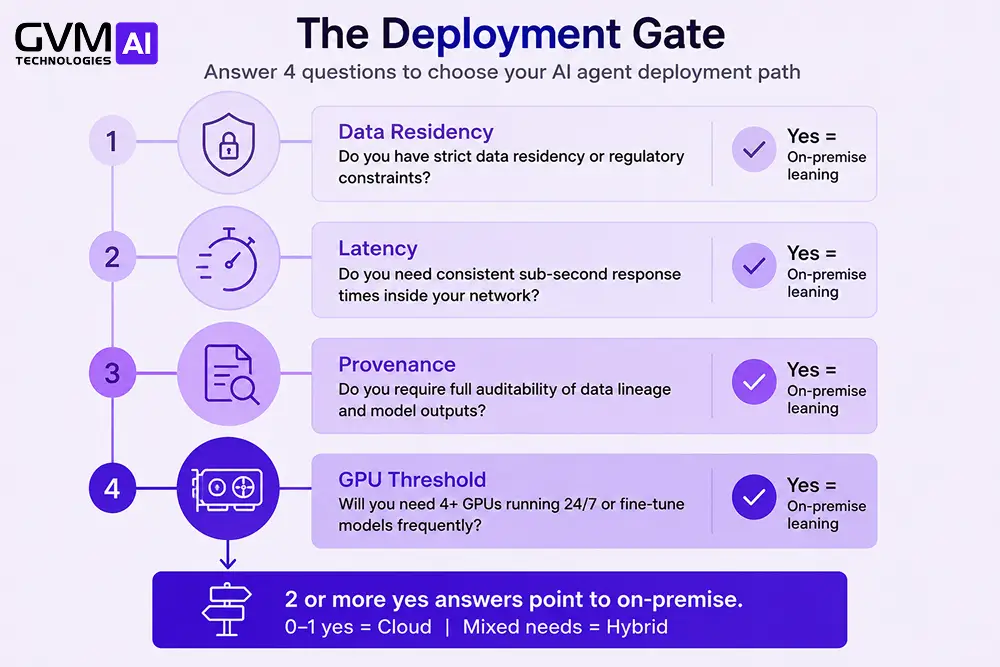
2. A quick deployment gate
- Does a named regulation legally bar this data from leaving your network?
- Is the workload latency-critical enough that an API call breaks it?
- Will your regulator ask for provenance, not just logs?
- Has GPU use cleared the on-premise breakeven for 3+ months straight?
Two or more “yes” answers point to on-premise or private cloud. Zero or one points to a well-contracted, credential-brokered cloud deployment, the same scoring we walk through in AI agent vs. no-code automation.
Common AI Agent Deployment Mistakes in Regulated Industries
These teams rarely pick the wrong technology outright. They skip one step, and it surfaces months later in an audit.
- Banning AI instead of approving one path. Staff move to a personal ChatGPT account with zero audit trail, the exact failure our shadow AI research covers.
- No named owner for the deployment decision. A verbal agreement isn’t a record any auditor recognizes.
- Treating “enterprise tier” as automatic compliance. A BAA and ZDR terms have to be signed, not implied.
- Connecting an agent through a shared service account. Fast to set up, impossible to audit later.
- Sizing a cluster for usage that never shows up. Hardware depreciates at 10% utilization while the cloud bill it replaced keeps running.
- Letting the agent hold its own credentials. The LiteLLM incident shows exactly what that costs once one link gets compromised.
Frequently Asked Questions About On-Premise vs. Cloud AI Agents
1. Can AI agents be used in a HIPAA-covered business?
Yes. A BAA has to cover the vendor, access has to match the minimum necessary, and every action needs operation-level logs with mandatory encryption.
2. Is a cloud AI agent with a signed BAA compliant enough, or do we need on-premise?
A signed BAA plus ZDR satisfies HIPAA for most workloads. Full on-premise becomes necessary only when a specific regulation, not a preference, bars the data from leaving your network.
3. How much does it cost to self-host an AI agent?
$25,000 to $40,000 per H100 GPU, $300,000 to $450,000 for a full server, and breakeven rarely clears below roughly 500 active developers.
4. Does the EU AI Act apply if my company isn’t based in the EU?
Yes. It applies based on where the output is used, not where the company is headquartered.
5. What is a credential broker, and does my AI agent need one?
It injects a real token into an agent’s action only when needed, so the agent’s memory never holds a reusable secret. Any agent with write access to a regulated system needs one.
6. Is a hybrid AI agent deployment less secure than full on-premise?
Not inherently. A hybrid model with regulated data kept on-premise and a credential-brokered cloud API for low-risk tasks often audits better than an under-resourced, self-managed on-premise stack.
Conclusion: Which AI Agent Deployment Is Right for You
The on-premise vs. cloud decision comes down to 4 questions: what the law bars, what latency you need, what your regulator will ask for, and whether your GPU use has actually cleared a real cost threshold.
Location was never the whole answer. The teams that pass their first audit also solve the credential layer, so the agent itself never becomes the weak link a deployment decision can’t fix.
Scoping that split correctly is where most internal teams run out of time before they run out of budget. GVM Technologies AI builds this for healthcare, finance, and insurance teams, with all 4 pieces in place from sprint one:
- Private cloud instances, scoped to the workload
- PII redaction ahead of the model, not inside the prompt
- Credential-brokered agent identity, never a raw secret
- Operation-level audit logging your regulator can actually read
Our customer outreach agent case study shows what that looks like in production.
Talk to our team about where your data, and your credentials, actually need to sit. No pitch, just a direct read on what genuinely needs on-premise and what doesn’t.