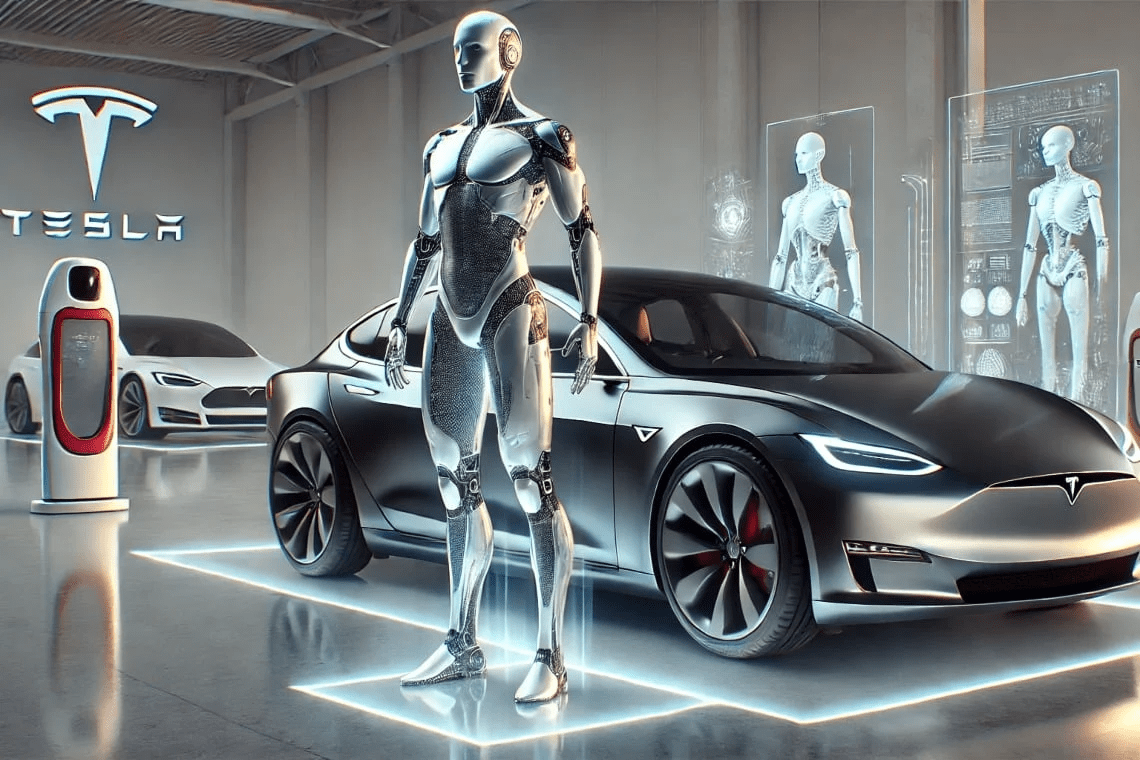
Revolutionizing Autonomous Driving with AI – Tesla’s AI-Powered Success

Tesla, a leader in electric vehicles (EVs), has transformed the automotive industry by leveraging Artificial Intelligence (AI) to power its Autopilot and Full Self-Driving (FSD) systems. By integrating AI across perception, decision-making, and control systems, Tesla has set new standards in autonomous driving technology. This case study explores how Tesla developed and implemented AI for its vehicles, the challenges it overcame, and the measurable impact on innovation, safety, and user adoption.
tesla-ai-img

Introduction

Founded in 2003, Tesla is recognized for pushing boundaries in EVs, clean energy, and advanced transportation technologies. A significant contributor to Tesla’s success has been its bold investment in AI, particularly in developing self-driving capabilities. With the goal of achieving fully autonomous driving, Tesla has created an end-to-end AI ecosystem, spanning from data collection and neural network training to real-time deployment in its fleet.

image-1

Challenge:

Tesla aimed to create a self-driving system that could operate reliably in diverse environments, without the need for high-definition maps or external sensors like LiDAR. The company faced several challenges:

  • Achieving accurate perception of roads, objects, and obstacles in real-time
  • Processing vast volumes of driving data efficiently
  • Ensuring safety and compliance in complex traffic scenarios
  • Scaling a self-improving system across a global fleet

Solution:

Tesla’s AI and Neural Network Platform To meet these challenges, Tesla built a vertically integrated AI system centered on computer vision, deep learning, and real-world data. Key elements include:
one
Tesla Vision
A camera-based perception system that mimics human visual processing. Using 8 surround cameras, Tesla Vision captures video data to detect lane markings, vehicles, pedestrians, traffic lights, and more.
two
Dojo Supercomputer
Tesla’s in-house supercomputer designed to train deep neural networks on petabytes of video data. Dojo accelerates training of models for perception, prediction, and planning.
three
Neural Networks
Deep learning models that interpret raw camera input to make decisions on steering, braking, acceleration, and navigation.
forth
Fleet Learning
Data from millions of Tesla vehicles is used to continuously refine AI models. Edge cases and real-world driving scenarios are fed back into training pipelines.
fifth
OTA Updates
AI model improvements are deployed over-the-air (OTA) to the global fleet, ensuring that all Tesla vehicles benefit from the latest advancements.

Implementation Process

Data Collection
  • Every Tesla vehicle collects video and telemetry data to fuel model training.
Model Development
  • Engineers use supervised learning, reinforcement learning, and simulation environments to train neural networks.
Validation
  • Rigorous simulation and real-world testing ensure model reliability before deployment.
Deployment
  • OTA updates deliver the latest AI models to vehicles, ensuring systems stay current with evolving road conditions and driving behaviors.
Feedback Loop
  • Performance metrics and new data from vehicles are continuously used to enhance AI systems.

Key Results

  • Advanced Autopilot Capabilities: Tesla Autopilot and FSD can handle highway driving, navigate city streets, perform lane changes, and park autonomously.
  • Improved Safety: Tesla reports significantly lower accident rates per mile driven with Autopilot engaged compared to manual driving.
  • User Engagement: Tens of thousands of beta users contribute to improving FSD through feedback and edge-case reporting.
  • Cost Efficiency: Tesla avoided costly LiDAR sensors, opting for scalable, camera-based AI.
  • Global Deployment: AI systems are active in over 2 million vehicles worldwide, continually evolving through data-driven improvement.

Challenges & Learnings

  • Regulatory Hurdles: Autonomous driving features face differing legal and safety standards across countries.
  • Edge Case Complexity: AI systems must learn to handle unpredictable scenarios such as road construction or unusual pedestrian behavior.
  • Ethical Considerations: AI decision-making must align with safety, fairness, and accountability.

Conclusion

Tesla’s AI-first approach has redefined what’s possible in autonomous driving. Through end-to-end data integration, deep learning, and constant iteration, Tesla has built one of the most advanced AI platforms in the automotive world. As regulatory frameworks evolve and technology matures, Tesla is positioned to lead the transition to fully self-driving cars.

About Tesla

Tesla, Inc. is a U.S.-based company that designs and manufactures electric vehicles, battery energy storage, and AI-driven mobility solutions. With a focus on sustainability and innovation, Tesla is advancing the future of transport through intelligent technologies.

Contact Information

Visit: www.tesla.com
FSD Beta Program: Explore Features
Learn More: Tesla AI Day

white-line-image
white-line-image

Call to Action Accelerate Your AI Journey

Get in touch with us to collaborate on innovative AI solutions that enhance user experiences and drive sustainable business success.
