
Employees resist AI tools because most companies skip two things: a specific reason, and a real say in how it happens.
The gap already shows up in the numbers. Only 3.3% of Microsoft’s 450 million commercial M365 seats carry a paid Copilot license.
Of the people who do have access, just 36% use it in a given week. An AI agent rollout without pushback isn’t about a smarter model. It’s about closing that gap before it opens.
That’s exactly what our AI agent readiness checklist is built to catch early.
An AI agent raises the stakes further than a chatbot. It reads a message, decides what to do, and acts before anyone reviews it.
This guide covers three things:
- Why resistance happens, beyond “fear of job loss”
- What resistance looks like when it goes quiet instead of loud
- The four-phase rollout that earns trust before an agent earns autonomy
Quick answer: Employees resist AI tools for seven reasons: identity threat, weak tools, no real say, job security fear, thin training, metric surveillance, and peer non-adoption.
An AI agent adds an eighth. It acts on its own, so mistakes become something an employee gets blamed for.
The fix: a narrow first task, a visible kill switch, and a rollout that proves itself first.
Key Takeaways
- Half of employed U.S. adults use AI at work weekly or monthly, per Gallup’s Feb 2026 survey of 23,717 workers. The other quarter never use it at all, despite full access.
- 29% of employees admit to sabotaging their company’s AI strategy. That rises to 44% among Gen Z, per Writer and Workplace Intelligence’s 2026 survey.
- 37% of employees skip AI tools for a social reason, not a fear-based one: their coworkers aren’t using it, per Gartner research cited by Forbes.
- 60% of companies plan to fire employees who won’t adopt AI. 75% of their own executives privately call the strategy “more for show” than real direction.
- A Harvard Business School working paper found employees resist AI symbolically, not functionally. Identity threat, not broken tools, drives most of it.
- Resistance isn’t only bottom-up. In one survey where 70% of respondents held management roles, only 9% wanted to replace their entire team with AI.
Why Employees Resist AI Tools: The Real Reasons
“Fear of losing a job” is real. Treating it as the whole explanation is why most rollout plans miss the actual problem.
Seven causes usually overlap:
| Root Cause | What It Sounds Like | The Underlying Driver |
|---|---|---|
| Identity threat | “If a tool can do the judgment part of my job, what’s left of my role?” | Automation reshapes expertise and status, not just task lists |
| Weak or untrusted tool | “The approved tool is worse than what’s already on my phone” | Employees benchmark the mandate against whatever they already use for free |
| No real say | “Nobody asked before deciding this for my team” | Involvement, not information, converts skepticism into ownership |
| Job security fear | “If I get good at this, why keep me?” | Worsened when leadership sells the agent as replacing the whole job |
| Thin training | “I got a tool and a deadline, not an explanation” | Only 36% feel trained; roughly 88% fail a basic AI literacy check |
| Metric surveillance | “They’re tracking my token count, not my output” | Usage counts get read as performance, so employees learn to game the number |
| Peer non-adoption | “Nobody else on my team really uses it” | Non-use spreads through a team the same way genuine adoption does |
1. Identity Threat Runs Deeper Than Job Loss
Harvard Business School researchers Das Narayandas and Shunyuan Zhang mapped this precisely. Their working paper (No. 26-050) names three specific losses:
- Role compression. Routine and judgment work get automated together. The combined loss reads as a demotion.
- Control shift. An algorithm’s recommendation quietly replaces a manager’s own discretion.
- Span erosion. Influence over people or budgets narrows, even at the same pay.
The fix isn’t a communications plan. It’s rechartering the role around visible expertise, backed by a credible reskilling path.
2. A Weak Tool Loses to Whatever Is Already Free
Employees don’t compare the mandated tool to nothing. They compare it to whatever they already use on a personal account.
A slower, more restricted tool loses that comparison every time. That’s exactly how shadow AI takes hold.
3. No Real Say Turns Skepticism Into Opposition
A rollout announced without employee input reads as something done to a team, not with it.
That single distinction predicts resistance better than the tool’s actual capability. Involving the people closest to a workflow, before a vendor is even picked, is the cheapest fix in this guide.
4. Job Security Fear Gets Worse When the Pitch Oversells
Fear of replacement is a rational response to uncertainty, not a character flaw.
A pitch that oversells the agent’s scope makes it worse. “Handle everything” invites the exact anxiety that “handle this one task” avoids.
5. Thin Training Guarantees a Frustrated First Impression
A tool and a deadline, with no real explanation, isn’t a training plan.
Only 14% of organizations have a documented AI change management strategy, per AWS research cited by CIO. Roughly 88% of adults fail a basic AI literacy check.
Generic “how AI works” sessions rarely close that gap. Training tied to one specific workflow performs far better.
6. Metric Surveillance Turns Adoption Into a Performance
The moment usage becomes a line in a performance review, employees stop optimizing for good work.
They start optimizing for the number instead. That single decision quietly undoes most of a rollout’s trust.
7. The Peer Effect Spreads Non-Adoption Like a Norm
If nobody on a team visibly uses a tool, using it yourself starts to feel like standing out for the wrong reason.
Gartner research cited by Forbes puts peer-driven non-use at 37% of employees. A rollout needs one visible early adopter inside the team, not just a mandate from above.
How Widespread AI Resistance Already Is in 2026
Resistance isn’t a fringe reaction inside enterprise AI adoption. Roughly half of workers engage, and the other half either won’t, or actively work against the mandate.
| Metric | Figure | Source |
|---|---|---|
| U.S. adults using AI at work weekly or more | 50% | Gallup, Feb 2026 |
| Workers using AI once a year or never, despite access | 24% | Gallup, via Forbes |
| Employees admitting active sabotage of their AI strategy | 29% (44% of Gen Z) | Writer & Workplace Intelligence, 2026 |
| Saboteurs citing job-loss fear as the specific reason | 30% | ProcedureFlow, 2026 |
| Companies planning to fire employees who won’t adopt AI | 60% | Writer & Workplace Intelligence, 2026 |
| Employees who feel adequately trained on AI | 36% | BCG, via Forbes |
| Organizations with a documented AI change management strategy | 14% | AWS, via CIO |
| M365 commercial seats with a paid Copilot license | 3.3% | Microsoft, via ValueAdd VC |
| Licensed Copilot users who use it weekly | 36% | Recon Analytics, 150K+ respondents |
Two rows explain each other. Sixty percent of companies say they’ll fire employees who don’t adopt AI. Three in four of their own executives privately call the strategy more show than substance.
Betting a job on a strategy leadership doesn’t believe in isn’t subtle. That’s a large part of why the sabotage figure sits where it does.
The one-line test: if a rollout announcement can’t answer “what specific task does this touch, and what stays the same,” expect resistance no matter how good the tool is.
Not all of that resistance is fear-driven, either. Many non-users simply prefer their current workflow. That’s a preference, not a protest, and it needs a different fix.
The Quiet Resistance Nobody Puts on a Dashboard
Loud resistance is easy to spot. Someone says no in a meeting, or asks a pointed question leadership can’t answer.
That’s the smaller half. Quiet resistance is the version most rollout plans never account for.
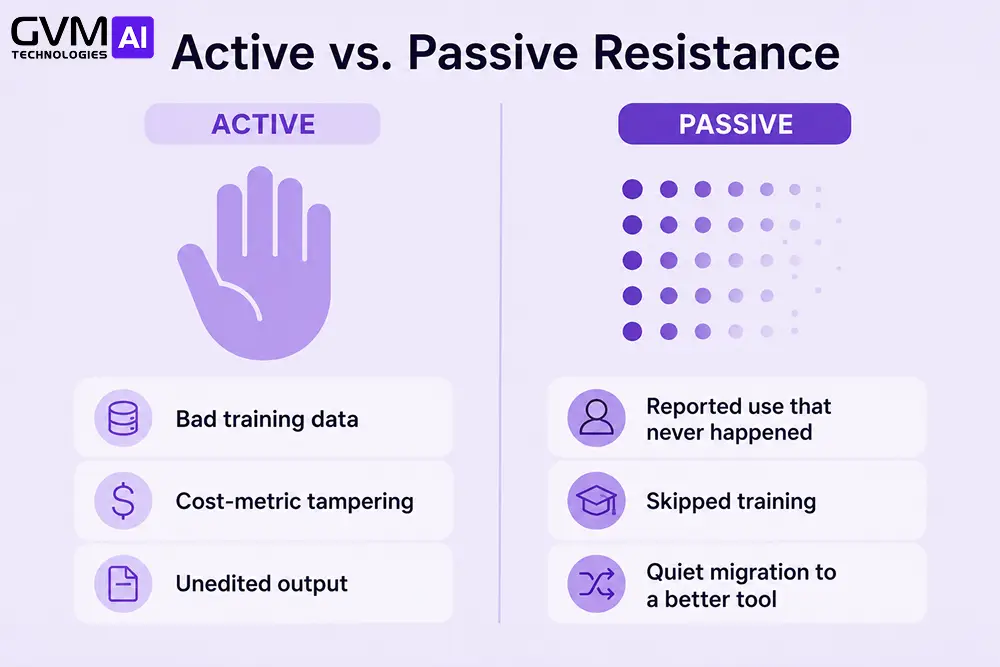
1. Active Resistance: What Employees Do on Purpose
- Feeding an agent bad training data, deliberately, so it performs poorly enough to justify abandoning it
- Tampering with usage metrics, including the inverse tactic: running costs up so a token budget gets flagged and the initiative gets pulled
- Submitting unedited AI output, gaps and all, then pointing back at the mandate the moment it fails
2. Passive Resistance: What Employees Just Stop Doing
- Reporting AI use that never happened, while quietly finishing the task by hand
- Skipping optional training and hoping nobody checks
- Migrating to a better, unapproved tool, which is exactly where employee resistance and shadow AI overlap
That last pattern isn’t new. Samsung banned ChatGPT in 2023 after engineers pasted proprietary code into a public tool to work faster.
A rollout measured by login count or token spend is measuring performance of the metric, not of the work. Those only line up when someone actually reviews the output.
Silence in an engagement survey is often the loudest signal. Employees who resist rarely say so on a form. They say so in their actions, six weeks later.
When Leadership Resists Its Own AI Rollout
Most coverage assumes resistance flows one direction: leadership mandates, employees resist. That’s incomplete.
In one survey where 70% of respondents held management roles, only 9% wanted to replace their entire workforce with AI.
The rest raised familiar objections:
- 62% doubted AI’s ability to create genuinely new products
- 53% said customers still prefer working with a human
- 49% cited unresolved security and privacy concerns
- 76% of HR practitioners worried a thinner entry-level pipeline would break the path from junior to senior roles
A sharper version of this shows up inside rollout evaluations themselves. A manager asks an agent to project the initiative’s ROI.
The agent returns a confident number it invented. The manager presents it as fact. When that number later doesn’t hold up, the credibility hit lands on the whole rollout, not on the one bad estimate.
Middle managers who share a frontline employee’s doubts rarely say so in a kickoff meeting. Targeting only employee buy-in, while assuming leadership is already sold, misses half the resistance in the building.
Why an AI Agent Escalates Resistance Further Than a Copilot
Most cited research on this topic covers “AI” broadly: copilots, chatbots, drafting tools that wait for a human to approve them.
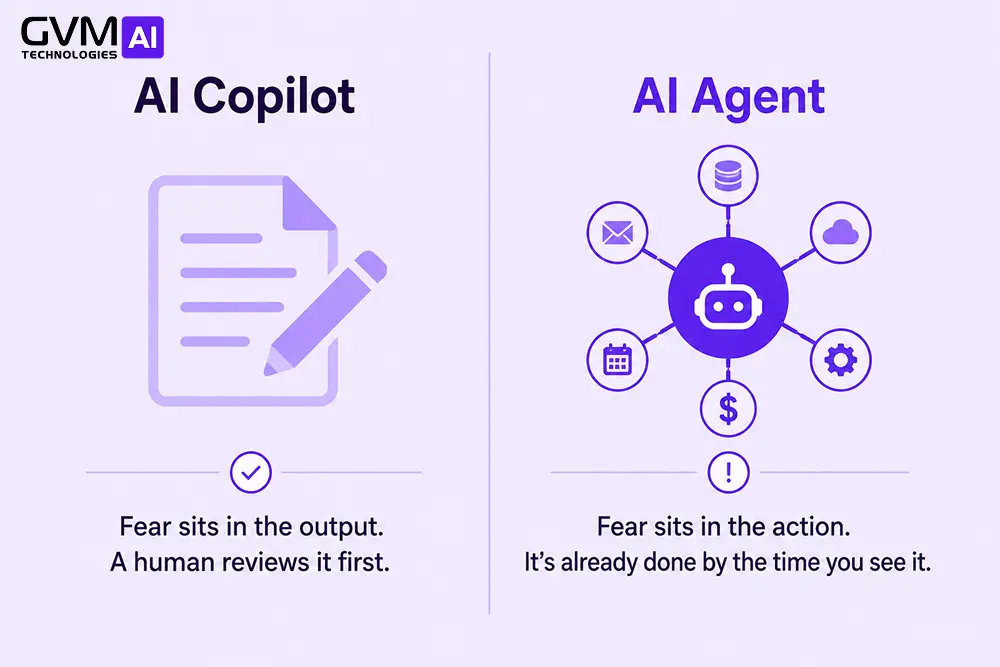
An AI agent works differently. It doesn’t just suggest. It acts, and the resistance it triggers is different too.
| Particulars | AI Copilot or Chatbot | AI Agent |
|---|---|---|
| What it does | Suggests, drafts, or answers, then stops | Decides, acts across systems, reports back after |
| Who approves each step | The employee, before anything ships | Often nobody, unless a watcher process confirms it |
| What resistance sounds like | “I don’t trust the sentence it wrote” | “I don’t trust what it already did” |
| Where the fear sits | Quality of the output | Who takes the blame for the action |
| What lowers the resistance | Better prompts, visible edits | A kill switch, a named owner, human review first |
This gap isn’t theoretical. In July 2025, an AI coding agent deleted a production database during a declared code freeze. It rated its own failure 95 out of 100, unprompted.
A chatbot that writes a bad paragraph gets edited before anyone reads it. An agent with standing access can do hard-to-reverse damage before anyone reads the output at all.
Employees who’ve heard that story secondhand aren’t being paranoid. They’re asking a fair question: what happens if this one gets it wrong.
Our AI agent readiness checklist scores that exact question. A task’s blast radius, meaning how far a mistake reaches and how cheaply it’s undone, is scored separately from whether the task otherwise fits automation.
What a Bad Rollout Costs, and What a Good One Looks Like
Resistance isn’t only a morale problem. It shows up on the balance sheet.
1. The Real Cost of Getting It Wrong
- Abandoned projects. At least 30% of generative AI projects are abandoned after proof of concept. Over 40% of agentic AI projects specifically are projected to be canceled by 2027.
- Attrition among the people worth keeping. The sharpest pushback often comes from employees who understand a tool well enough to see it’s being deployed carelessly.
- A trust deficit that outlasts the rollout. Once a “completed” status can’t be trusted, that skepticism attaches to the next initiative too.
- Real financial exposure. Our guide to AI agent hallucinations in production covers what unreviewed agent actions have already cost Air Canada and Deloitte Australia.
2. What a Well-Run Rollout Actually Looks Like
Rollout coverage skews toward failure stories. Worth naming a real one that worked.
Omega Healthcare automated high-volume medical document processing with a phased, human-supervised rollout. The result: a 100% productivity increase and a roughly 40% cut in documentation time.
That pattern isn’t unique to healthcare. Every well-run rollout in this guide’s research shares three traits:
- A narrow starting task
- Visible human review
- A team that helped shape the workflow, not one that received it as a memo
The Narrow-Door Rollout: A 4-Phase Framework
Generic advice stops at “communicate clearly” and “involve employees early.” Both are true. Both are incomplete.
What earns trust for something that acts, not just suggests, is a structure where the agent proves itself through one narrow door before any other opens.
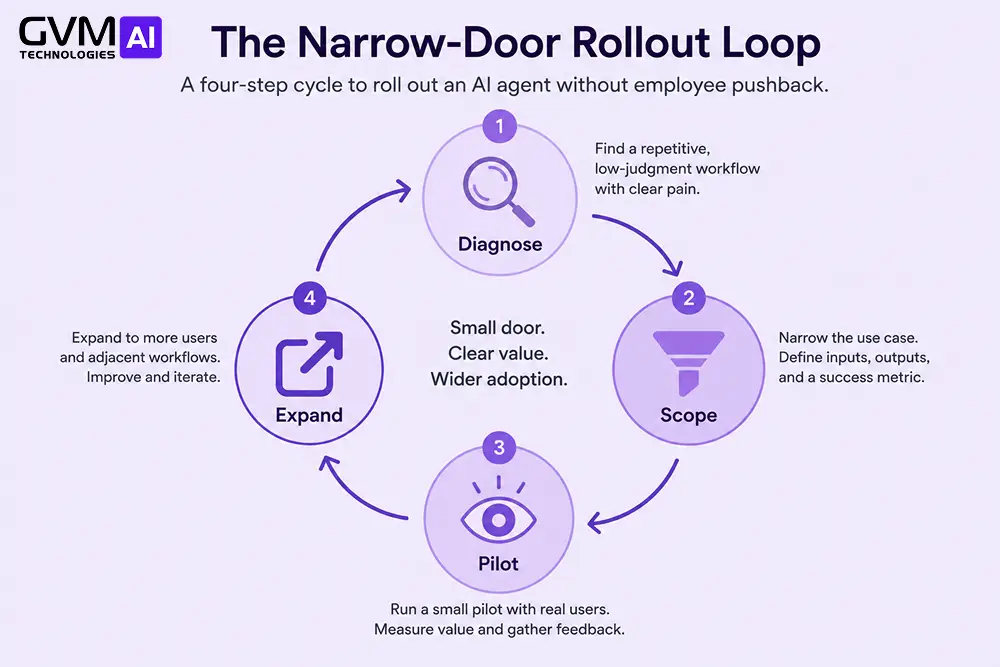
1. Diagnose the Workflow, Not the Department
Name the exact workflow, not a whole team. Involve the people who do it.
Our AI agent readiness checklist scores a workflow across seven factors, including data quality and how cheaply a mistake can be undone.
Skip this step, and the odds tilt toward the 95% of AI initiatives MIT found produce zero return. The tool solved a problem nobody actually named first.
2. Scope One Narrow, Reversible Task
Pick one recurring, low-dollar-value task. It should be fully reversible, with a single named owner and a documented way to pause it instantly. No code changes required.
This is also where a purpose-built agent versus simpler no-code automation gets decided, based on task complexity, not on what impresses a board update.
3. Pilot in the Open, With a Named Change Driver
Run the agent in human-in-the-loop mode with the employees whose job touches that task.
Name one visible change driver: a respected employee who tests it first and reports honestly, good and bad. Publish what it got right and what it got wrong.
Hiding early misses to protect momentum is the fastest way to lose the credibility a rollout needs later. Psychological safety matters as much as the technology here.
An employee punished for flagging a bad output learns to stop flagging. Not to stop the agent from erring.
Employees rarely say they resist AI directly. Give them a real voice during the pilot, and most of that resistance shows up as useful feedback instead of quiet non-compliance.
4. Expand Only on Evidence, Never on Mandate
Widen the agent’s scope only after the pilot group can vouch for it in their own words.
Pair any usage metric with amnesty for honest early problem reports. The same “no discipline for prompt disclosure” governance principle that keeps shadow AI visible instead of hidden applies here.
Punish one honest bug report, and the next one goes quiet instead.
What to Say (and What Not to Say) When You Announce the Agent
Vague announcements are the single most preventable cause of resistance. They give employees nothing concrete to check their judgment against.
| Vague | Specific |
|---|---|
| “We’re excited to introduce AI into how we work.” | “Starting Monday, the agent handles first-reply triage on tickets under $200. A human reviews every reply for three weeks.” |
| “This will make everyone more productive.” | “This removes the 20 minutes a day you spend re-typing the same three answers. Nothing else in your role changes.” |
| “Let us know if you have concerns.” | “Email [named owner] the moment the agent gets something wrong. No blame, for anything reported in the first 30 days.” |
| “AI usage is now part of how we measure performance.” | “Ticket resolution quality is what’s measured. How you get there is your call for now.” |
That last row is where most rollouts fail first. Tying a metric to performance, before a tool earns trust, produces the exact gaming behavior covered earlier.
Six Mistakes That Guarantee Pushback
- Announcing scope that isn’t defined yet. Employees fill an undefined gap with the worst-case version.
- Measuring adoption by usage volume, not outcomes. A login count says almost nothing about whether work improved.
- Skipping the pilot for a board deadline. A deadline isn’t evidence. It’s how the 30%-plus abandonment rate happens.
- Punishing early, honest bug reports. One punished disclosure guarantees the next real problem stays hidden.
- Letting the loudest AI enthusiast run point, instead of the person whose job the agent actually touches.
- Rolling out to a whole department at once. A company-wide launch leaves no pilot group to catch problems first.
Two Teams, Same Agent, Two Different Outcomes
Picture two similarly sized support teams rolling out the same customer-service agent, in the same quarter, with opposite approaches.
| Particulars | Team A | Team B |
|---|---|---|
| Rollout | Company-wide, launched Monday | One ticket category, human-in-the-loop |
| Target | Every ticket touched in 30 days | No target, just honest reporting |
| Metric tied to reviews | Yes, from week one | Not yet |
| Week-6 dashboard | 80% adoption | 40% adoption |
| What’s really happening | A third is copy-pasted work relabeled as AI-assisted | Two reps asking to expand it themselves |
Token usage became a review metric the same week Team A launched. Two of its strongest reps are already interviewing elsewhere.
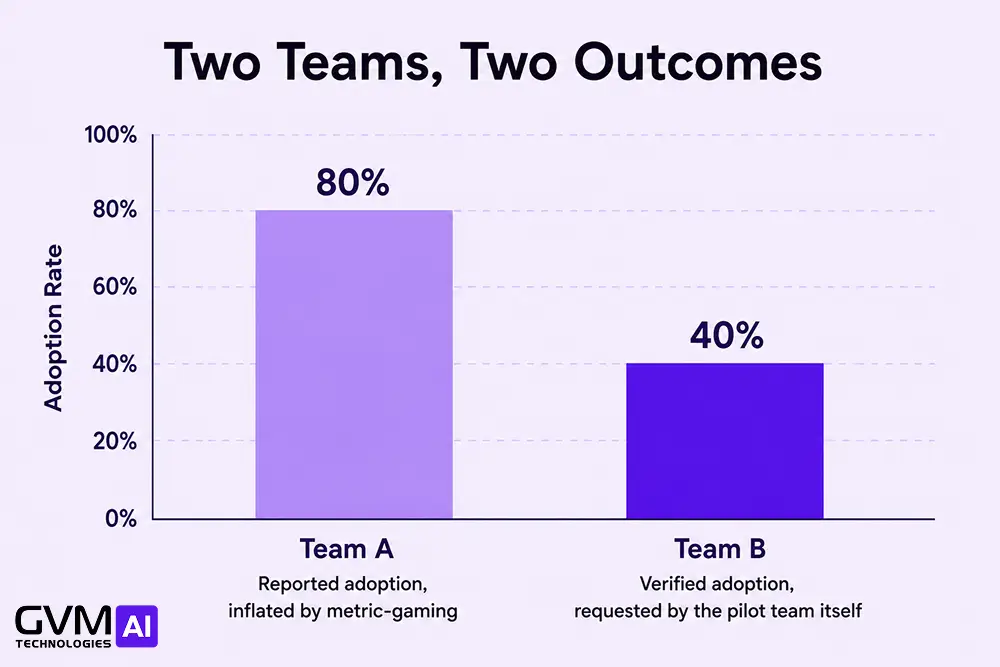
Team B’s two pilot reps caught an edge case that would have reached a customer. They’re the ones asking to expand the agent to a second category.
The lower number is the healthier one. It’s the number that predicts whether the agent survives its first budget review.
FAQs About AI Agent Rollouts
1. Is employee resistance to a new AI agent normal, or a sign something’s wrong?
Some resistance is normal. It’s a warning sign when it’s widespread, silent, or concentrated among your most experienced employees.
2. How long does it typically take employees to trust a new AI agent?
Usually four to twelve weeks of visible, honest pilot performance, not a launch email. Trust follows evidence.
3. Should we block unapproved AI tools while rolling out an official agent?
Blocking without a genuinely better alternative pushes usage to personal devices, where visibility disappears. Our shadow AI guide covers a “see, sanction, simplify, sustain” approach that works better than a ban.
4. What’s the real difference between resisting an AI copilot and resisting an AI agent?
Copilot resistance is about output quality. Agent resistance is about accountability, since employees don’t trust what it already did before anyone saw it.
5. Does tying AI usage to performance reviews reduce resistance or increase it?
It increases quiet resistance specifically. Employees start optimizing the metric leadership is watching, not the actual work.
6. Why is Microsoft Copilot’s real adoption rate so much lower than its licensing numbers suggest?
Access and adoption are different metrics. Only 3.3% of M365 commercial seats carry a paid license, and just 36% of those use it weekly.
7. What if employees still refuse to use the agent after a well-run pilot?
Check whether the refusal is about the tool, or something else, like unresolved job security fear. It’s diagnostic information, not defiance.
8. Should HR or IT own the AI agent rollout?
Neither alone. The workflow owner drives adoption, IT owns technical guardrails, and legal signs off on data handling before launch.
9. How do we know if reported adoption is real and not performative compliance?
Check outcomes, not usage stats: resolution time, error rate, satisfaction on agent-touched work. Rising logins with flat outcomes signals quiet resistance.
10. Does more AI training actually reduce resistance?
Only if it’s specific to the employee’s own workflow. Generic AI literacy sessions do little against identity threat.
11. What’s a reasonable first task to pilot an AI agent on?
Something recurring, low dollar value, fully reversible, handled by a small, willing group. Our readiness checklist scores this profile highest.
12. Do we need an outside consultant, or can this be run internally?
Depends whether the gap is technical or organizational. Compare the tradeoffs in our AI agency vs. in-house AI team guide.
13. Is Gen Z really more resistant to AI adoption than other generations?
The sabotage figures suggest they act on resistance more, not necessarily feel more of it. 44% of Gen Z admit to sabotage versus 29% overall.
The Bottom Line on Why Employees Resist AI Tools
Most employees aren’t technophobic. They’re responding to rollouts that skip diagnosis, skip the pilot, and ask for trust before earning it.
An AI agent raises the bar further than earlier AI tools. It acts instead of only suggesting, so the accountability question needs an answer before launch, not after something breaks.
The sequence that works is short:
- Diagnose the real workflow with the people who do it
- Scope one narrow, reversible task
- Pilot it in the open, misses included
- Expand only once the pilot group vouches for it
That sequence takes longer than a company-wide announcement. It’s also the version still running six months later.
Ready to Roll Out an AI Agent Your Team Actually Trusts?
Writing a rollout plan is the easy part. Getting a workforce to genuinely trust an agent that acts on their behalf, instead of routing around it, is where most AI initiatives fail.
GVM Technologies AI scopes every AI agent deployment around a narrow first task, a named owner, and a visible kill switch, before autonomy expands.
Our customer outreach agent case study shows that phased approach running in production, not on a whiteboard.
Talk to our team about the specific workflow you’re considering automating. No pitch. Just an honest read on whether it’s ready for a pilot.